
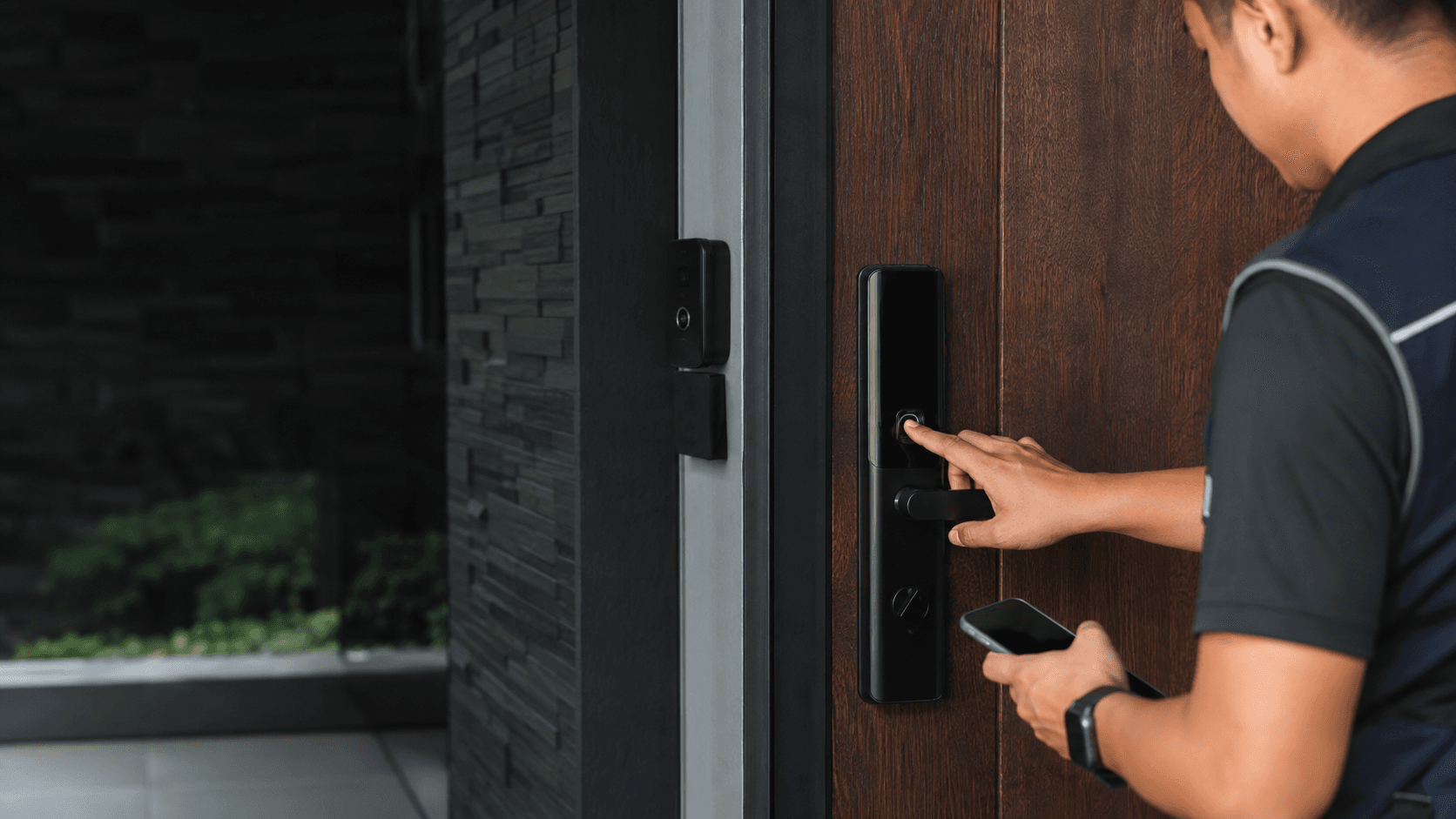
Malaysia's short-stay market — boutique hotels, B&Bs, guesthouses and serviced rooms — runs on turnover. A room changes hands in the time it takes to strip a bed, and every handover of a physical key is a small administrative event: who holds it, who returns it, what happens when it is lost or copied. Keyless hotel door locks remove that event from the front desk and move it into software.
That shift is not purely technical. It changes who can open a door, when that right expires, and what happens at 2am when a guest cannot get in. The sections below work through the decisions in the order they usually arise: how access is issued and revoked, what the door itself will accept, how the main lock types differ, and what installation and handover should cover.
Keyless Hotel Door Locks in Malaysian Hospitality Settings
Malaysian properties considering keyless hotel door locks are usually not choosing between a key and a card. They are choosing between a lock that stands alone on the door and a lock that reports to a central access control panel. The distinction matters more than the credential type.
A standalone smart lock holds its own user list and decides locally whether a code or credential is valid. An access control panel model centralises that decision, which is what makes scheduled access, group permissions and audit records practical across many doors. Eyonic's own product review notes that for business use, the company usually checks whether a standalone smart lock or an access-control panel is more appropriate — a useful framing because the two are not interchangeable at scale.
Property size drives the answer. A four-room guesthouse with one entrance and a resident owner can operate a standalone lock per door and manage codes manually. A twenty-room property with staff shifts, late check-ins and a housekeeping roster needs permissions that can be issued and withdrawn without walking to each door.
How Guest Access Is Issued, Changed and Revoked
Access lifecycle is the part of a keyless hotel door locks project that most often gets under-planned. Hardware is visible; permissions are not, until something goes wrong.
Three questions determine whether the system will hold up:
- Check the door condition, including alignment, warping and frame clearance, because a misaligned door defeats an otherwise sound lock.
- Confirm the lock body type and door thickness match the hardware being considered, since mortise and cylindrical preparations are not interchangeable.
- Decide the power source and what happens when it fails, including whether the lock runs on batteries, on wired power, or on both.
- Map user roles and permissions before installation, separating guest, housekeeping, maintenance and master-level access.
- Agree the backup entry method, so a dead battery, flat phone or network outage does not lock out a paying guest.
- Plan handover and testing, including who is trained, how a test credential is issued and revoked, and who is called when a door fails.
Revocation is the sharper edge. A physical key can be collected at checkout, but it can also be copied before it is returned. An electronic credential can be expired at a set time, which removes the copy problem entirely — provided the lock is online or the credential carries an expiry the lock can read offline. That is a design decision, not a default, and it should be settled before purchase rather than after.
Who controls the master credential
Every system has an override. The practical question is who holds it and how it is stored. A master code written on a card in a desk drawer is a weaker control than a master credential held by a named manager and changed when that person leaves. This is an operational policy decision that the lock can support but cannot make.
Door Condition, Lock Body and Power Before Purchase
Retrofit is where expectations and reality diverge most often. A lock that fits one door may not fit the next one down the corridor, even in the same building.
Door thickness, backset, mortise pocket dimensions and frame condition all constrain what can be installed. Fire-rated doors add a further constraint, because hardware fitted to a rated door assembly can affect its rating — and the requirements that apply to guest room door hardware in Malaysia are a matter for the relevant authority and the project's own consultants, not something a supplier can determine on a property's behalf.
Power is the second constraint. Battery-powered locks avoid cabling but introduce a maintenance cycle and a failure mode. Wired locks remove the battery change but require a route to each door, which in an existing building can be the largest single cost in the project. A hybrid approach — wired where cable routes exist, battery elsewhere — is common but adds a second set of procedures for staff to learn.
Eyonic's published guidance on smart lock door access states that smart locks work best when the door condition, user roles and backup method are reviewed before installation. That ordering is deliberate. reviewing these after the hardware arrives usually means either a return or a workaround.
Keyless Hotel Door Locks Compared With Card and Key Systems
The three common approaches differ less in security than in operational overhead.
A mechanical key is the cheapest to install and the most expensive to administer. Keys are lost, copied and re-cut, and a lost key creates an open question about whether the room is still secure. Rekeying a cylinder is a physical task repeated across every affected door.
An RFID card lock moves the credential to a card that can be programmed with an expiry. Cards are reissued rather than re-cut, and a lost card can be invalidated without touching the cylinder. The trade-off is that cards are physical objects: they get demagnetised, left in rooms, and consumed over time, and the property still needs a card encoder and a stock of blanks.
Keyless hotel door locks remove the physical token entirely, using a PIN, a mobile credential or another electronic identifier. The administrative advantage is real — nothing to hand over, nothing to collect, nothing to lose — but it shifts the dependency onto the guest's device, the lock's power and the network or offline logic that validates the credential. A guest with a flat phone battery is the keyless equivalent of a guest who left the key in the room.
None of the three is universally better. A property with high turnover and low staffing benefits most from removing the handover step. A property with unreliable connectivity may find a card system more predictable. The honest comparison is against the property's own operating pattern, not against a feature list.
Installation, Handover and Daily Operation
Eyonic's documented installation process for its security work runs through site survey, system proposal, installation and handover. That sequence applies to lock work in the same way: the survey establishes what the doors will accept, the proposal sets out scope, installation fits and configures, and handover transfers working knowledge to the people who will run it day to day.
Handover is where a lock project succeeds or quietly fails. It should cover how a guest credential is issued, how it is revoked at checkout, what staff do when a credential does not work, how the backup entry method is used, and who is contacted when a door fails. If those five things are not demonstrated on site with the property's own staff, the system will be operated by guesswork within a month.
Daily operation then settles into a rhythm: monitoring battery or power status, replacing or recharging what needs it, reviewing who holds elevated permissions, and testing the backup path periodically rather than discovering it does not work during an incident. The specific intervals depend on the hardware chosen and the manufacturer's guidance, which should be documented at handover.
What Eyonic Checks Before Recommending a Lock
Eyonic Sdn Bhd is a security system supplier based in Sarawak, Malaysia, working across CCTV and ELV systems with planning, supply and installation for homes, offices, shops and industrial sites. Its founder, Eric Yong, has more than ten years in the industry, with a background in technical installation of digital security solutions for commercial businesses in Sarawak.
The company's documented project work includes the Kuching Immigration Office, where the requirement centred on arrival flow, staff areas, visitor movement and dependable daily operation, and KTA Sarawak Sdn Bhd, an office setup in Kuching supporting staff movement, visitor handling, tidy cabling and clearer daily site control. Both are access and movement problems rather than lock problems, but the underlying questions — who moves through a space, on what authority, and how that is verified — are the same ones a guest room door raises.
Eyonic's published product review of smart lock door access sets out the checks it applies: door condition, user roles and backup method first, then a decision between a standalone smart lock and an access control panel. The company describes its smart lock door access offering as multi-brand, which means the recommendation can follow the door and the operating pattern rather than a single manufacturer's catalogue.
Two limits are worth stating plainly. Eyonic's documented project portfolio covers a government office and an engineering consultancy, not a hotel, B&B or guesthouse, so there is no completed hospitality installation on record to point to. And the company's published package pricing covers CCTV, alarm and autogate systems at RM 1,599 each, with two documented project budgets of RM 12,000 – RM 28,000 and RM 8,000 – RM 18,000; none of that establishes what lock supply and installation would cost, because no lock pricing has been published.
What that means in practice is that a lock enquiry starts with a site survey rather than a price list. The survey establishes door condition, lock body type, power availability and the access roles the property needs, and the proposal follows from those findings. Properties that want to move forward can share their location, property type and required system with Eyonic on WhatsApp at +60 11-5111 7959.