
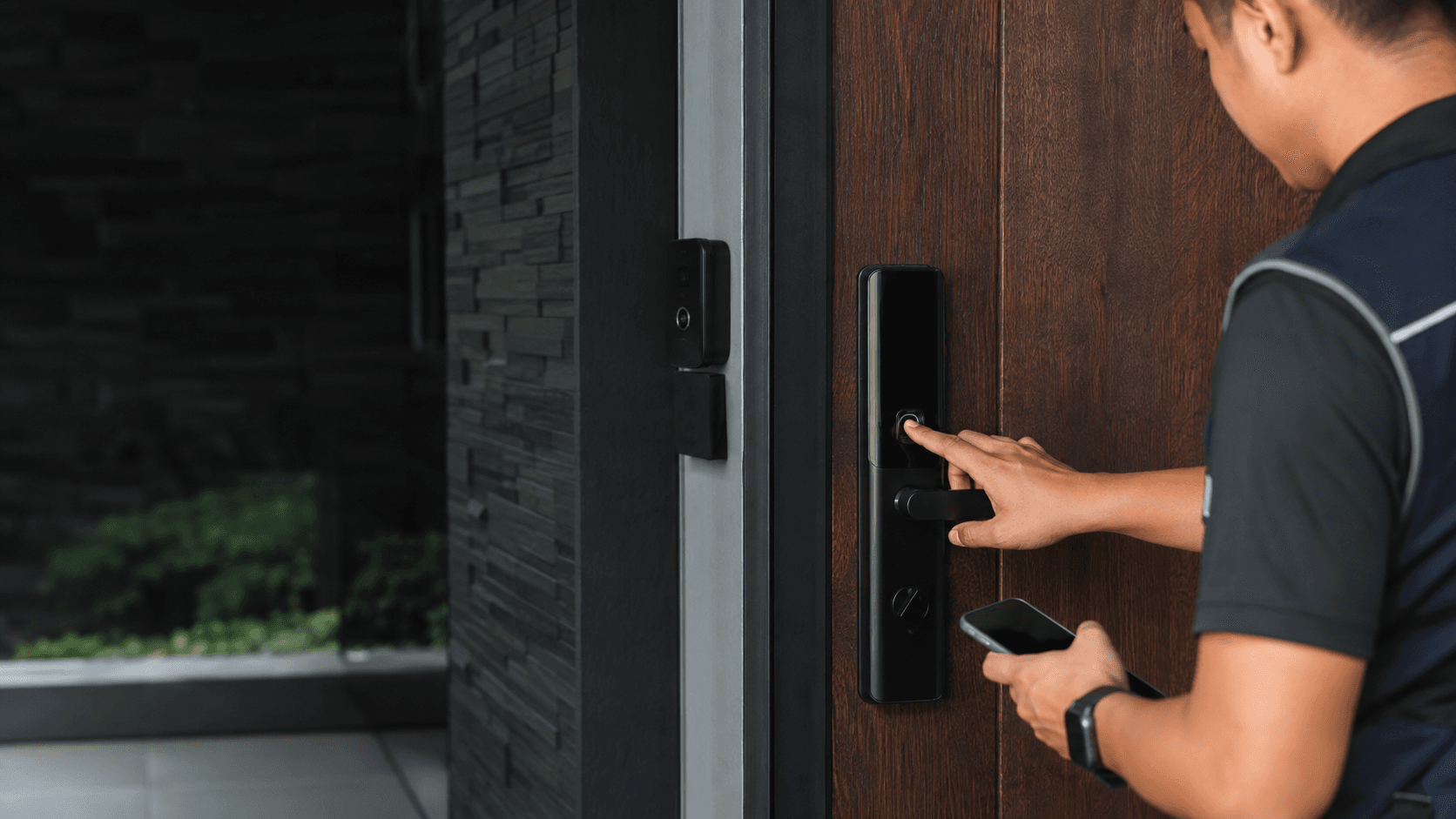
The exact-match query electric door locks for home describes a category that spans several different mechanisms, and the differences matter more in Malaysian houses than the marketing pages suggest. A lock that works well on a steel-framed office door can fail on a hollow-core bedroom door. A lock that suits a family of four behaves differently when a landlord needs to revoke a tenant's code. Eyonic, a security system supplier in Sarawak, treats door access as one part of a wider ELV system rather than a single product purchase.
Electric Door Locks For Home. What Malaysian Buyers Should Know
Malaysian homes present a specific set of conditions. Many terrace houses and apartments have timber door frames that have shifted with humidity, metal gates that sit outside the main door, and a mix of family members, domestic helpers, and occasional contractors who all need some form of entry. Electric door locks for home use have to handle that mix without creating a lockout risk when a battery runs flat or a phone is lost.
The practical question is not which lock is best in isolation. It is which lock suits the door, the people, and the backup plan. Eyonic's own product guidance states that smart locks work best when the door condition, user roles, and backup method are reviewed before installation, and that for business use the choice between a standalone smart lock and an access-control panel is usually the first decision. The same logic applies to a home with more than one regular user.
Keyless Entry Options
Keyless entry covers several distinct mechanisms, and each has a different failure mode.
A keypad deadbolt stores codes in the lock itself. Entry works without a phone, a network, or an app, which makes it the most resilient option during a power cut or an internet outage. The trade-off is that codes must be changed manually, and a shared code cannot be traced to one person.
A fingerprint or biometric lock removes the code-sharing problem entirely. Each user enrols a finger, and the lock records which credential opened the door. The constraint is enrolment. a visitor or a contractor cannot be given temporary access without being physically present at the door first.
An app-connected smart lock adds remote control, temporary codes, and an access history. That convenience depends on the lock's connection method and on the home network staying up. When the connection drops, the lock usually falls back to keypad or key entry, so the fallback still has to be planned.
A card or fob reader sits closer to commercial access control. It suits a home with regular domestic staff or a small home office where several people need consistent, revocable access. It costs more to set up and needs a reader at each controlled door.
Door Condition And User Roles Before Installation
Door condition decides whether a lock can be fitted at all. A deadbolt needs enough solid material in the door and frame to hold the bolt. A hollow-core door, a frame that has swollen and no longer closes squarely, or a metal gate with no existing cutout all change what is possible. Eyonic's installation process begins with a site survey, and for door access that survey is where the door, frame, and existing hardware get assessed.
User roles decide how the lock should be configured. A household with two adults and children needs different permissions from a household that also employs a helper, rents a room, or runs a home business. The useful questions are how many people need permanent access, how many need temporary access, and who has the authority to add or remove a user. A lock that cannot separate those roles will end up with one shared code, which defeats most of the reason for installing it.
Eyonic's project work shows the same pattern at a larger scale. The Kuching Immigration Office project focused on arrival flow, staff areas, visitor movement, and dependable daily operation, and the KTA Sarawak Sdn Bhd project supported staff movement, visitor handling, tidy cabling, and clearer daily site control. Both are commercial settings, but the underlying questions about who moves through which door, and how that movement is managed, apply to a home with staff or regular visitors.
Backup Entry And Battery Planning
Every electric lock has a failure mode, and the backup plan should be decided before installation rather than after the first lockout.
Battery-powered locks depend on the battery. A low-battery warning gives some notice, but the warning is only useful if someone acts on it. Many locks provide a temporary power terminal that accepts a 9-volt battery or a USB power bank for emergency entry, and that option is worth confirming before purchase rather than assuming it exists.
Mains-powered locks depend on the electrical supply. A power cut disables the lock unless it has a battery backup or a mechanical override. For a home, that usually means keeping a mechanical key cylinder as the fallback, stored somewhere other than inside the house.
The backup method also has to be tested. A mechanical key that has never been tried, or an emergency power terminal that no one in the household knows about, is not a backup. Eyonic's handover stage exists for this reason: the system is demonstrated and tested with the people who will use it, so the fallback is understood before it is needed.
Installation And Handover Process
Eyonic's installation process follows four stages: site survey, system proposal, installation, and handover. For door access, the survey covers the door and frame, the existing hardware, and the user roles. The proposal sets out what will be fitted and how access will be managed. Installation fits the hardware and configures the users. Handover demonstrates the lock, tests the backup entry, and confirms that the people who need access can actually use it.
Before committing to a specific lock, four checks are worth completing in order:
- Confirm the door and frame can physically accept the lock, including the bolt depth and the closing alignment.
- List every person who needs access and decide which of them need permanent credentials and which need temporary ones.
- Choose the backup entry method and confirm it works independently of the primary power and network.
- Plan the power source, whether that is a battery replacement routine or a mains supply with a tested fallback.
These checks are the same ones Eyonic applies when reviewing smart lock door access, and they are the reason a site survey comes before a product recommendation rather than after.
Practical Next Step With Eyonic
Eyonic Sdn Bhd plans, supplies, and installs security and ELV systems for homes, offices, shops, and industrial sites in Sarawak. The company's founder, Eric Yong, has worked in technical installation of digital security solutions for commercial businesses in Sarawak for more than 10 years. Door access sits alongside CCTV, alarm, autogate, and keyphone intercom work, which means a door lock decision can be made as part of a wider system rather than in isolation.
Eyonic's published package pricing covers a Hikvision CCTV package at RM 1,599, a Hikvision alarm system at RM 1,599, and an autogate package at RM 1,599. Door access is quoted separately because the hardware and configuration depend on the door and the user roles, and no verified price for electric door locks for home is published.
Share your location, property type and required system with Eyonic on WhatsApp at +60 11-5111 7959 for the next practical step.
Common Questions About
Do work without Wi Fi
Keypad and fingerprint locks work without any network connection because the credential is checked inside the lock. App-based features such as remote unlocking, temporary codes, and access history need a connection, and those features stop working when the network or the lock's connection drops. The lock itself usually continues to accept keypad or key entry.
What happens when the battery runs flat
Most battery-powered locks give a low-battery warning before the battery fails. Once it fails, entry depends on whatever backup the lock supports, which may be a mechanical key, an external power terminal, or both. The specific backup method varies by lock, and it should be confirmed before purchase rather than assumed.
Can a lock be fitted to an existing door
Sometimes. A deadbolt replacement needs a door and frame that can hold the bolt, and a retrofit design can reuse existing hardware in some cases. A door that has warped, a hollow-core door, or a metal gate without a suitable cutout may need additional work or a different approach. This is what the site survey determines.
How many users can be set up
The number of users depends on the lock and on how access is managed. A standalone lock stores credentials locally, while an access-control panel manages users centrally and suits a home with staff, tenants, or a home office. Eyonic reviews user roles before recommending which approach fits.