
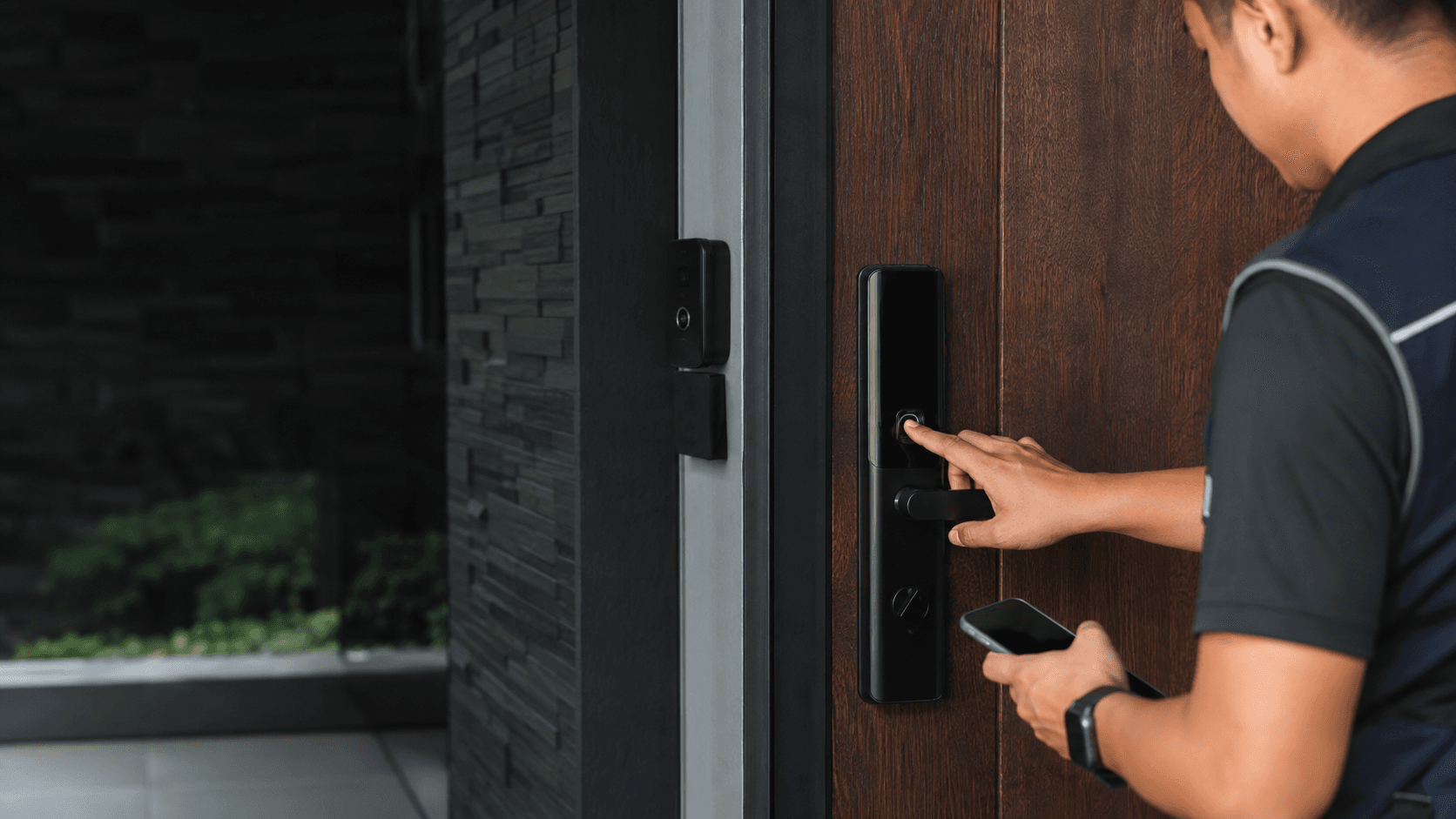
The term covers a small but growing category of door hardware in Malaysia. Most products sold under this label are not traditional round knobs at all. They are lever-handle or deadbolt-replacement locks that connect to a Wi-Fi network, so a phone can unlock a door, issue codes to visitors, and record who entered. Buyers searching for a wifi door knob in Malaysia are usually weighing three things at once: whether the hardware fits the existing door, who needs access, and what happens when the network or the battery fails.
Eyonic Sdn Bhd supplies and installs security and ELV systems in Sarawak, and its smart lock door access work follows the same review sequence used on its CCTV projects: site survey, system proposal, installation and handover. That sequence matters more for door hardware than for cameras, because a lock that does not fit the door cannot be rescued by configuration.
Wifi Door Knob. what the term covers in Malaysia
A wifi door knob describes a door-mounted lock with built-in Wi-Fi connectivity, keyless entry and app-based control. In practice, Malaysian buyers meet the term in three forms.
The first is a lever-handle smart lock, which replaces an existing handle set and keeps the door's look close to standard. The second is a deadbolt replacement, which swaps the main locking bolt and usually keeps the original handle. The third is a retrofit adapter that fits over an existing deadbolt and motorises it from the inside, leaving the outside of the door untouched.
Each form carries a different constraint. A lever replacement changes the door's appearance and may need new screw holes. A deadbolt replacement depends on the bore hole and backset already cut into the door. A retrofit adapter avoids new holes but adds bulk to the interior face and depends on the existing bolt moving freely.
Malaysia adds a further consideration that does not appear in most overseas buying guides: many residential and shoplot doors here are metal, aluminium or solid timber rather than the hollow-core construction common in North American homes. Door material affects how a lock body seats, how heat builds up around the hardware, and whether a magnetic or mechanical latch is used. None of that can be judged from a product listing alone.
Door condition and user roles before a Wifi Door Knob is chosen
Eyonic's own product guidance states that smart locks work best when the door condition, user roles and backup method are reviewed before installation, and that for business use the choice between a standalone smart lock and an access-control panel should be checked first. That is the correct order of decisions, and it applies directly to a wifi door knob purchase.
Door condition is the first filter. A door that has swollen, dropped on its hinges, or has a latch that already needs a push to close will fight any electronic lock. Motorised bolts need the door to sit square in the frame, because the bolt has to travel without resistance. If the door needs adjustment, that work comes before the lock, not after.
User roles are the second filter. A home with two or three regular users needs far less than a shop with rotating staff, a delivery entrance, or a rental unit with short-stay guests. The moment a door needs per-person codes, time-limited access, or a record of who entered and when, the decision shifts from a single smart lock toward a wider access control arrangement.
Backup entry is the third filter, and it is the one most often skipped. Every electronic lock needs a way in when the battery is flat, the Wi-Fi is down, or the app is unavailable. That may be a mechanical key, an external power point, or a second entrance that stays independent of the electronic lock. A door that is the only way into a premises should never depend on a single electronic method.
Pre-purchase checks for a wifi door knob
- Confirm the door closes and latches cleanly without lifting, dragging or force.
- Measure the existing bore hole, backset and door thickness against the hardware's stated fit range.
- List every person and role that needs entry, and note which of them need time-limited or one-off access.
- Decide the backup entry method before purchase, not after installation.
- Check the Wi-Fi signal strength at the door itself, not elsewhere in the building.
- Confirm how the lock is powered and how a flat battery is handled from outside.
- Decide whether the door needs a standalone lock or a managed access control panel.
Wifi Door Knob power, connectivity, and backup entry
Power and connectivity are the two failure points that decide whether a wifi door knob is convenient or frustrating. Both need to be understood before purchase, because neither can be fixed by an app setting.
Wi-Fi connectivity at the door is not the same as Wi-Fi connectivity in the next room. Doors are often set in frames, recessed in corridors, or positioned at the far end of a building from the router. A signal that works well in a living room may be weak at a rear shoplot door. The practical check is to test signal strength at the door position itself, which is why a site survey comes before a proposal rather than after.
Power arrangements vary by product and are not interchangeable. Some hardware runs on internal batteries, some can be wired, and some support an external emergency supply. The relevant question for any buyer is what happens on the day the power source is depleted: whether a mechanical key still works, whether an external supply can be connected at the door, and how quickly that can be done.
Backup entry deserves its own decision because it is a security trade-off, not just a convenience feature. A mechanical key cylinder is the simplest fallback, but it is also the part of the door most exposed to picking or copying. A keyless backup, such as an external power contact, removes the key risk but depends on someone having the right equipment on hand. Neither option is universally better; the right choice depends on who needs access and how quickly a lockout would become a problem.
Network dependency is the third consideration. A lock that relies on Wi-Fi for remote control still needs to open the door when the network is down. Local entry methods such as a keypad, fingerprint reader or mechanical key keep the door usable during an outage, while remote features simply become unavailable until the connection returns.
Wifi Door Knob for homes, offices, and shops in Sarawak
The right hardware depends heavily on the building type, and Sarawak properties present a wider spread of door conditions than a single product category can cover.
For a home, the priorities are usually convenience and family access. A single wifi door knob on a main entrance, with a mechanical key as backup, covers most households. The main risk is choosing hardware that does not match the existing door, which is why fit is checked before brand.
For an office, the priorities shift toward staff movement and visitor handling. Eyonic's work for KTA Sarawak Sdn Bhd in Kuching centred on a practical office setup supporting staff movement, visitor handling, tidy cabling and clearer daily site control. Door access sits inside that same picture: a door that staff cross many times a day needs to be fast and reliable, while a visitor entrance needs controlled, recorded entry.
For a public-facing or high-traffic site, the requirements are stricter again. Eyonic's project for the Kuching Immigration Office focused on arrival flow, staff areas, visitor movement and dependable daily operation. That kind of environment shows why a single standalone lock is often not the right answer: when many people pass through a door and access needs to be managed by role, an access control panel with managed permissions is usually more appropriate than a lock configured one user at a time.
Shops and shoplots sit between these cases. A back door used by staff and deliveries may need time-limited codes, while a front entrance may need nothing more than a reliable keyless lock. The deciding factor is not the size of the premises but the number of distinct access roles at each door.
Wifi Door Knob installation checks and handover
Installation is where a good hardware choice either holds up or falls apart. Eyonic's installation process runs through site survey, system proposal, installation and handover, and the handover stage is where most problems are caught early rather than later.
The survey confirms what the door actually is: its material, its thickness, its bore and backset, how it sits in the frame, and how the latch engages. It also confirms the Wi-Fi position and the power arrangement. Skipping this step is the most common cause of a lock that fits on paper but not on the door.
Installation then covers mounting, alignment and testing. A motorised bolt that binds, a latch that needs a shoulder to close, or a handle that sits loose will all show up in the first week of use if they are not corrected at fitting. Testing should include every entry method the lock supports, not just the app.
Handover is the part that determines whether the system stays usable. It should cover how each user is added and removed, how codes are issued and revoked, what to do when the battery runs low, and how to enter the premises if the electronic method fails. For a business, it should also cover who holds administrative access and how that changes when staff leave.
One practical point carries across from Eyonic's camera work: conditions on site decide placement and configuration, and those conditions should be checked rather than assumed. The same applies to door hardware, where the door itself is the condition that matters most.
questions buyers ask before ordering
Does a wifi door knob need a hub? Some hardware connects directly to Wi-Fi, while other products rely on a separate bridge or hub to reach the network. The product documentation for the specific model is the only reliable answer, because the two designs behave differently during an outage.
Can it be fitted to an existing door? Often, but only if the bore hole, backset and door thickness fall within the hardware's stated range. A retrofit adapter avoids new holes entirely, while a lever or deadbolt replacement may need the door prepared differently.
What happens when the battery runs flat? That depends on the backup method chosen at the planning stage. A mechanical key, an external power contact, or an independent second entrance each solve the problem differently, and the choice should be made before installation.
Is a wifi door knob suitable for a shop or office? It can be, for a single door with a small number of users. Once a site needs per-person permissions, time-limited access or an entry record across several doors, a managed access control panel is usually the better fit.
Does it work without internet? Local entry methods such as a keypad, fingerprint reader or mechanical key generally continue to work. Remote unlocking, notifications and code changes made from outside the premises depend on the network being available.
How is it powered? Power arrangements differ between products and are not interchangeable, so the specific model's documentation should be checked. The practical question is whether the door can still be opened from outside once that power source is depleted.
Eyonic Sdn Bhd plans, supplies and installs security and ELV systems in Sarawak, including smart lock door access alongside CCTV, alarm, autogate, keyphone intercom and Starlink work. Published package pricing covers a Hikvision CCTV package, a Hikvision alarm system and an autogate package at RM 1,599 each; door hardware is quoted by scope rather than by package. Larger site work is budgeted by project, with Eyonic's Kuching Immigration Office project falling in the RM 12,000 to RM 28,000 range and the KTA Sarawak Sdn Bhd office project in the RM 8,000 to RM 18,000 range.
Share the location, property type and required system with Eyonic on WhatsApp at +60 11-5111 7959 for the next practical step.