
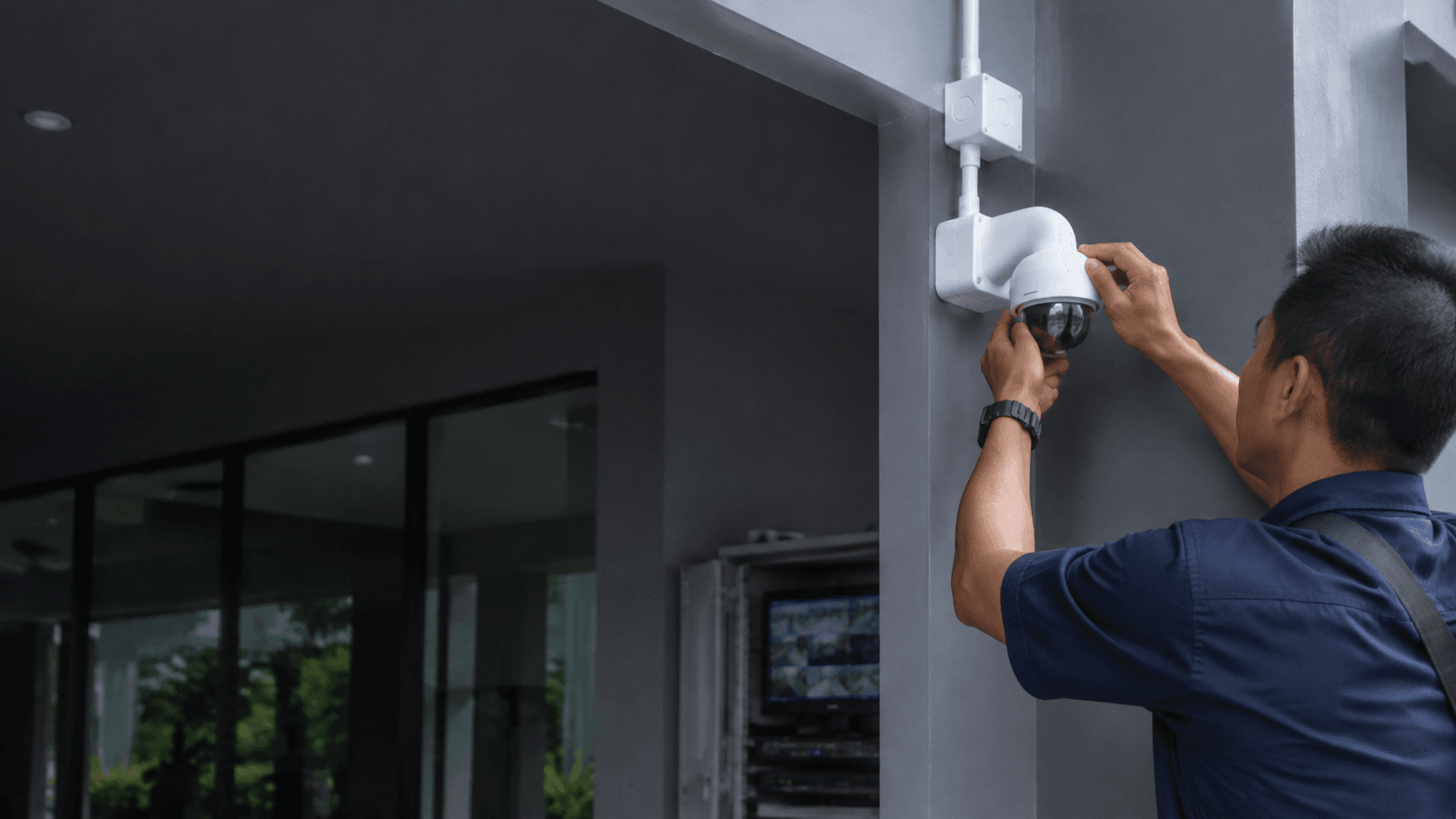
The term covers more than a camera model. A complete AHD system is a chain: cameras, coax cabling, a compatible recorder, power, storage and a viewing method that works on a phone. Each link has to match the others, which is why the phrase "full" matters more than the letters AHD.
Eyonic Sdn Bhd plans, supplies and installs monitoring systems with camera placement, recording and remote viewing for homes, offices, shops and industrial sites. That scope is the practical definition of a full setup in this market.
Full Cctv Ahd. What a Complete Setup Covers
A complete AHD CCTV system has four working parts. Cameras capture the image. Coax cabling carries both video and, in many installations, power. A recorder stores footage and manages playback. A viewing layer lets someone check live or recorded video from a phone or monitor.
Missing any one of those parts leaves a partial system. Cameras without a recorder produce nothing to review. A recorder without remote viewing means footage is only accessible on site. Cabling that was sized for an older analog setup may not carry the signal cleanly.
Eyonic's CCTV installation process includes site survey, system proposal, installation and handover. The sequence matters because camera positions, cable routes and recorder location are decided before any drilling starts.
- Site survey to review the property, entry points and existing cabling.
- System proposal covering camera positions, recorder and viewing setup.
- Installation of cameras, cabling and recording equipment.
- Handover with recording configuration and mobile viewing set up.
That four-stage flow is the same whether the property is a terrace house in Kuching or a shop lot with a back entrance that needs coverage.
How AHD Cameras Carry HD Video Over Coax
AHD stands for analog high definition. The camera sends a high-definition signal down coaxial cable rather than over a network cable. That is the core difference from an IP camera, which sends video as data packets across Ethernet.
The practical consequence is reuse. A property that already has coax run through its walls can often support AHD cameras without pulling new cable. For older buildings in Sarawak, where walls are solid and cable routes are awkward, that can reduce disruption during installation.
Coax cabling also keeps the camera end simple. There is no network switch, no IP address to assign at the camera, and no dependency on the same network that carries office or household internet traffic.
The trade-off is that AHD is a mature analog format rather than a networked one. Where a property needs tight integration with network infrastructure, an IP-based approach may fit better. That comparison depends on the site, and Eyonic reviews it during the survey rather than assuming one answer.
What the recorder does
The recorder is the part most buyers underestimate. It determines how many cameras can be connected, how long footage is retained, and how playback is searched. A recorder that is undersized for the camera count forces a choice between fewer cameras and shorter retention.
Storage is the other half of that decision. More cameras, higher resolution and longer retention all consume more disk space. Retention length is a business decision as much as a technical one, and it should be set before the recorder is specified.
What Eyonic Checks Before Confirming Camera Placement
Placement is where most installations succeed or fail. A camera pointed at the right area with the wrong lighting produces unusable footage at exactly the hour it is needed.
Eyonic recommends checking actual lighting conditions before confirming placement for ColorVu-style cameras. That check happens on site, at the times of day that matter, rather than from a floor plan.
Entry and exit points come first. Doors, gates, driveways and loading areas are where movement is predictable and where identification matters most. Coverage of a corridor or a car park is useful, but it rarely answers the question of who entered.
Cable routes are reviewed at the same time. A camera position that looks ideal on a plan may require a route that is impractical, exposed or expensive to run. Confirming both together avoids a redesign later.
Eyonic's work for the Kuching Immigration Office focused on arrival flow, staff areas, visitor movement and dependable daily operation. That is a useful illustration of how placement follows function: a public office has different priorities from a retail unit or a family home.
Full Cctv Ahd Planning for Homes, Shops and Offices
The same technology serves very different properties, and the planning priorities shift with each one.
For a home, the usual concerns are the front gate, the car porch and any side or back access. Coverage tends to be modest, and the main question is whether footage is clear enough to identify a person or a vehicle at the boundary.
For a shop, the counter, the entrance and the stock area carry most of the risk. Staff movement and customer flow both matter, and retention length often needs to be longer than a household would choose.
For an office, the pattern resembles Eyonic's public-sector work: arrival flow, staff areas and visitor movement, with dependable daily operation as the baseline. An office system that needs constant attention is worse than a simpler one that runs quietly.
Industrial sites add distance and environment to the list. Long cable runs, dust, heat and vibration all affect where cameras can go and how they are housed.
Where AHD fits and where it does not
AHD suits properties with existing coax, modest camera counts and a preference for a straightforward system that does not depend on network configuration. It also suits buyers who want the recorder and cameras to behave as one appliance.
It fits less well where a site needs many cameras across a large network, deep integration with access control or analytics, or a plan to expand heavily later. Those are conversations for the survey, not assumptions made in advance.
Recording Viewing and Handover After Installation
Installation is not finished when the last camera is mounted. Recording configuration decides what is actually captured, and mobile viewing decides whether anyone can check it without walking to a monitor.
Eyonic's Hikvision CCTV package at RM 1,599 covers camera supply and setup, basic recording configuration and mobile viewing handover. That structure shows what a handover should include: the system is configured and the user is shown how to use it.
Handover is also when retention settings, playback and any user accounts are confirmed. A system that records correctly but cannot be searched quickly loses much of its value in the week it is needed.
Remote viewing depends on the property's internet connection. Where connectivity is weak, that constraint should be identified during the survey rather than discovered at handover.
Costs Evidence Gaps and the Next Practical Step
Pricing for a full Cctv Ahd system depends on camera count, cable runs, recorder capacity and storage. Eyonic publishes a Hikvision CCTV package at RM 1,599 covering camera supply and setup, basic recording configuration and mobile viewing handover.
Larger projects sit in a different range. Eyonic's Kuching Immigration Office project carried an approximate budget of RM 12,000 to RM 28,000, and the KTA Sarawak Sdn Bhd office project carried an approximate budget of RM 8,000 to RM 18,000. Both figures describe comparable office-scale work rather than a standard residential installation.
Some details cannot be confirmed from published information. Eyonic's public material does not state which specific AHD camera models or recorders are supplied, nor does it publish AHD-specific pricing, warranty terms or response times. Those questions are best answered directly against a specific property.
Eric Yong founded Eyonic Security Systems and has worked in the industry for more than 10 years, with experience in technical installation of digital security solutions for commercial businesses in Sarawak.
Share your location, property type and required system with Eyonic on WhatsApp at +60 11-5111 7959 for the next practical step.