
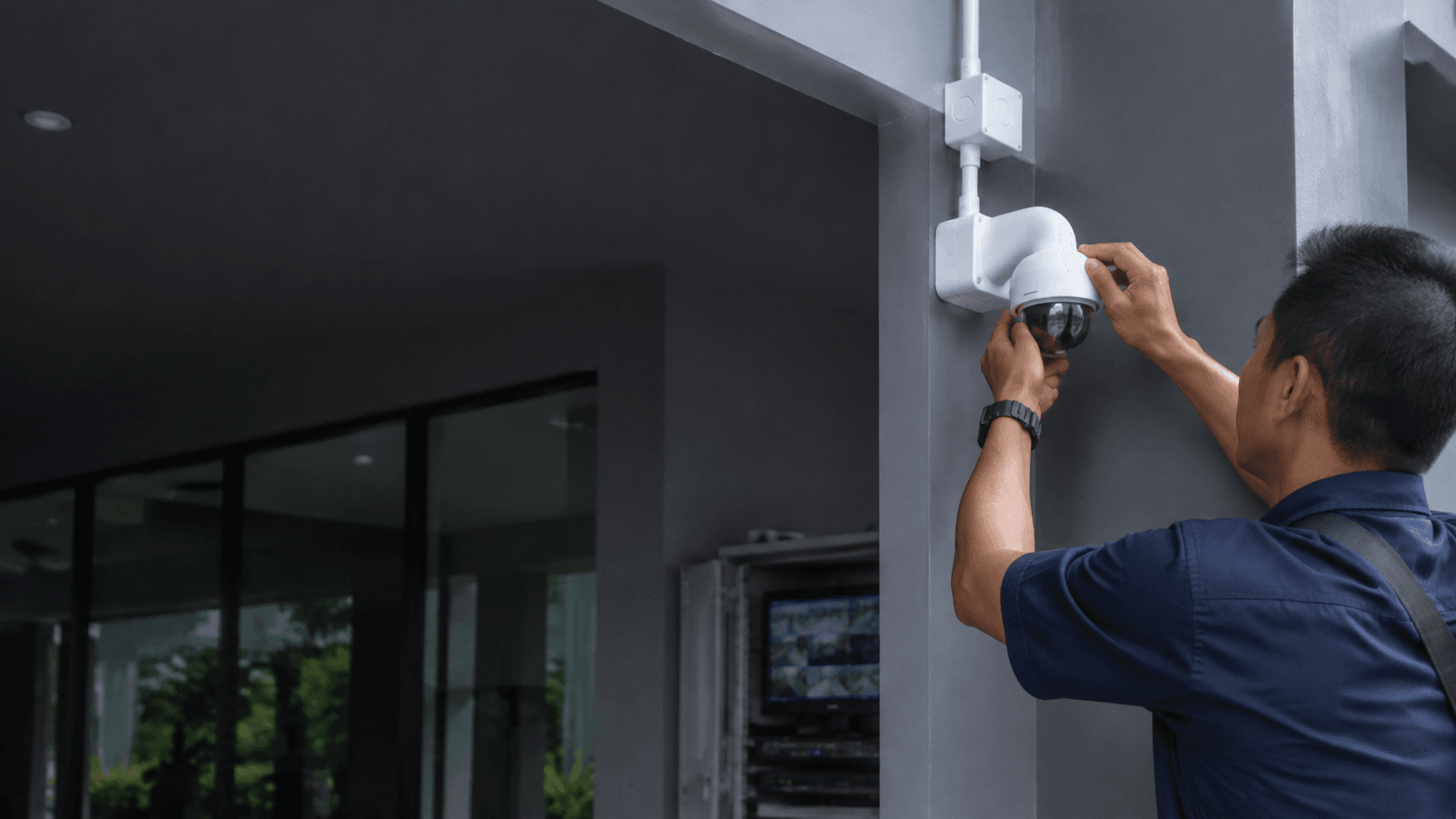
The exact-match query hikvision 4g camera describes a category rather than one product. Hikvision builds several 4G-connected models, and the pages that rank for this phrase are mostly product listings and support notes rather than explanations of when the connection type actually helps. That gap matters in Malaysia, where a site can sit well beyond the reach of a fibre drop but still fall inside mobile coverage.
This article covers what the 4G link changes, which sites suit it, what to compare before committing, and how a Sarawak installation is planned from survey to handover.
Hikvision 4g Camera: What the 4G Connection Changes
A wired camera reaches a recorder or the internet through a cable that carries both power and data. A Hikvision 4g camera replaces that cable path with a cellular radio and a SIM, so the video travels over the same mobile network a phone uses.
Three practical consequences follow.
- Site survey. Eyonic inspects the property, checks where coverage and power are available, and reviews the actual lighting conditions at each proposed camera position before confirming placement.
- System proposal. The survey findings become a written scope covering camera positions, recording, remote viewing and the connection arrangement.
- Installation. Cameras, mounting, power and the network link are installed and configured on site.
- Handover. The system is tested and the people who will use it are shown how to view footage and manage access.
The first change is that the camera no longer depends on a router or a fixed line. The second is that the connection becomes a subscription rather than a utility, because a SIM needs a data plan behind it. The third is that the recorder does not have to sit in the same building as the camera, since the link is wireless.
Hikvision documents activating and accessing 4G network cameras through Hik-Connect, its remote viewing platform. That is the mechanism behind mobile viewing: the camera or recorder registers with the platform, and the footage is reachable from a phone or computer away from the site.
Sites Where a Hikvision 4g Camera Fits Better Than Wired CCTV
The connection type is a fit question, not a quality question. A 4G camera is not automatically better than a wired one; it is better where a cable cannot reasonably reach.
Sites that tend to suit it include:
- Construction and plantation sites where the perimeter is far from any building.
- Farm and agricultural buildings with no broadband service.
- Remote gates, pump houses and storage yards visited infrequently.
- Temporary sites where the installation will move within a year or two.
- Buildings where the owner will not approve new cabling through finished walls.
Wired CCTV still wins where a cable run is short and the building already has internet. A fixed line is generally more stable and does not consume mobile data, so there is no reason to pay for a cellular link when a cable is available and permitted.
Solar power is the other half of the off-grid case. Hikvision has published an AOV SolarVu solar camera series aimed at sites with no wiring at all, and third-party retailers describe solar-powered 4G models for farms and unoccupied industrial sites. Where mains power is also absent, the camera has to draw from a panel and battery, which adds sizing questions that a powered site does not face.
What to Compare Before Choosing a Hikvision 4g Camera
Because the models differ, the comparison has to happen against the site rather than against a specification sheet alone.
Coverage at the exact mounting point. Mobile signal varies over a few metres and changes with building materials and terrain. A reading taken at the gate is not a reading taken at the camera bracket. This is the single most common reason a 4G camera underperforms after installation.
The data arrangement. A 4G camera consumes mobile data continuously while streaming and recording to a remote destination. The plan behind the SIM, and who manages it, matters as much as the camera. Data consumption depends on resolution, frame rate and how much of the day is streamed, so the plan should be sized against the intended use rather than chosen by habit.
Power. A camera near a power point is a straightforward installation. A camera on a pole with no supply needs a solar and battery arrangement, and that arrangement has to be sized for the site's sunlight and the camera's draw.
Lighting at the position. Eyonic advises checking actual lighting conditions before confirming placement for ColorVu-style cameras, which are designed to produce colour images in low light. A position that looks adequate in daylight can behave differently after dark, so the check belongs in the survey rather than after handover.
Recording and retention. Where footage is stored, and for how long, is a decision that has to be made before installation because it affects both hardware and the data plan.
Remote viewing. Hik-Connect access should be confirmed as part of the scope, including who holds the account and how access is shared with staff.
How Eyonic Plans a 4G Camera Installation in Sarawak
Eyonic Sdn Bhd is a security system supplier based in Sarawak that plans, supplies and installs CCTV and ELV systems for homes, offices, shops and industrial sites. The company's founder, Eric Yong, has worked in technical installation of digital security systems for commercial businesses in Sarawak for more than ten years.
The installation sequence above is the same one Eyonic uses for CCTV work generally, and the 4G element changes what the survey has to establish rather than the sequence itself. Coverage, power and lighting are checked at each candidate position, and the proposal is built from those findings.
Completed work in the state includes the Kuching Immigration Office, where the scope centred on arrival flow, staff areas, visitor movement and dependable daily operation, and KTA Sarawak Sdn Bhd, an engineering consultancy office in Kuching that needed support for staff movement, visitor handling, tidy cabling and clearer daily site control. Both are wired installations, so they illustrate the planning discipline rather than a 4G deployment specifically.
For sites outside fixed broadband coverage, Eyonic also handles Starlink internet installation in Sarawak. That is worth raising during the survey, because a satellite link and a 4G camera solve the same connectivity problem in different ways, and the better choice depends on the site.
Questions to Settle Before Installation Day
Will the camera work if mobile coverage is weak at the mounting point? Not reliably. Coverage should be measured at the position, not assumed from a nearby reading. If signal is marginal, an alternative position, a different connection method or a wired run may be the better answer.
Who owns and pays for the SIM? This should be settled in the proposal. A camera that stops reporting because a prepaid balance lapsed is a common failure mode, and it is avoidable by deciding responsibility up front.
What happens during a network outage? A 4G camera depends on the mobile network. Local recording on a card or recorder keeps footage available on site during an outage, while remote viewing is unavailable until the network returns. Whether that trade-off is acceptable depends on what the footage is for.
Does the site have power at the camera position? If not, the solar and battery arrangement has to be part of the scope from the start rather than added later.
How many people need remote access? Access should be planned with the same care as the camera positions, particularly where staff change over time.
Practical Next Step With Eyonic
The useful starting point is the site itself. Share the location, the property type and the system required with Eyonic on WhatsApp at +60 11-5111 7959, and the next step is a survey that establishes coverage, power and camera positions before any hardware is specified.
Eyonic's published packages cover a Hikvision CCTV package, a Hikvision alarm system and an autogate package, each at RM 1,599. Those packages describe camera supply and setup, basic recording configuration and mobile viewing handover for the CCTV option, but they are not a 4G camera package, so a 4G scope has to be quoted against the survey findings.
For a site with no fixed line and no realistic cable route, the survey is what determines whether a Hikvision 4g camera is the right answer or whether a satellite link, a wired run or a repositioned camera serves the property better.