
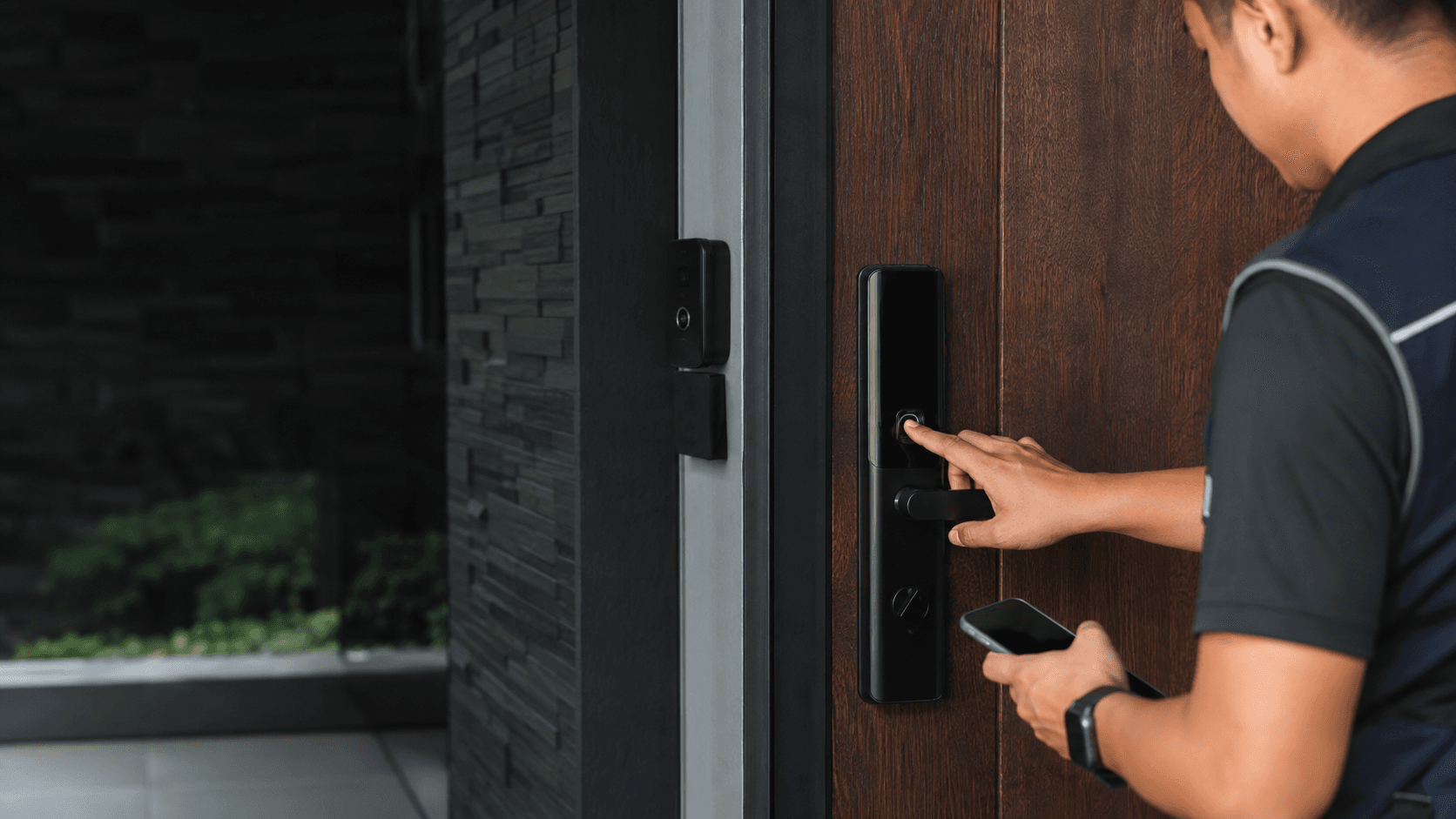
The exact-match query electronic locks for main door describes a lock fitted to the primary entrance of a home, office, or shop. That entrance carries the heaviest daily traffic in the building, so the lock has to survive constant use while still letting the right people in quickly. Eyonic Sdn Bhd, a security system supplier in Sarawak, Malaysia, plans, supplies, and installs these locks alongside CCTV and ELV systems for homes, offices, shops, and industrial sites.
Three numbers frame the decision. Eyonic's published packages for a Hikvision CCTV system, a Hikvision alarm system, and an autogate setup each sit at RM 1,599. A completed public-office project in Kuching carried an approximate budget of RM 12,000 to RM 28,000, and an engineering consultancy office project in Kuching carried an approximate budget of RM 8,000 to RM 18,000. Those figures show how widely a door-access scope can range once cameras, alarms, and access hardware are combined.
Electronic Locks For Main Door. What Matters Before You Choose
The main door is not the same as an interior door. It faces weather, delivery traffic, family or staff movement, and the occasional attempted forced entry. A lock that works well on a bedroom door can fail quickly on a main entrance if the door frame is warped, the strike plate is loose, or the door is exposed to direct rain.
Eyonic's own product review notes that smart locks work best when the door condition, user roles, and backup method are reviewed before installation. For business use, the same review states that Eyonic usually checks whether a standalone smart lock or an access-control panel is more appropriate. That check matters because a main door serving ten staff members has different requirements from a main door serving one household.
Four practical questions shape the choice:
- Confirm the door type, thickness, and frame condition, since a weak frame undermines any lock fitted to it.
- List who needs entry and how often, because user count decides whether a standalone lock or a managed access-control panel fits better.
- Decide the backup entry method, such as a mechanical key or a second credential, so a dead battery or network outage does not lock out the owner.
- Check power and connectivity at the door, since battery life, Wi-Fi reach, and wiring routes affect which models can be installed cleanly.
Each step is a physical check, not a preference. A door that cannot close squarely will not hold a deadbolt reliably, and a main door with no power nearby limits which access-control hardware can be fitted without new cabling.
Choosing the Right Electronic Locks For Main Door
Electronic locks for main door fall into a few broad families, and the family matters more than the brand. Standalone smart locks combine the lock body, keypad, and reader in one unit and suit a single entrance with a modest number of users. Access-control setups separate the reader, the controller, and the locking hardware, which suits offices, shops, and sites where permissions change often.
Eyonic's product review describes smart lock door access as good for controlled convenience when user permissions and backup entry are planned properly. That phrasing points to the real trade-off: convenience is easy to demonstrate, but permission management and backup entry are what determine whether the lock still works well after the first month.
For a business main door, the deciding factor is usually how often the user list changes. A shop with two owners and a handful of staff can run a standalone lock with individual codes. An office with rotating staff, contractors, and visitors usually needs a panel that logs entries and revokes access without reissuing codes.
What is electronic locks for main door?
Electronic locks for main door are locking devices fitted to a building's primary entrance that grant or deny entry using an electronic credential rather than a cut key alone. Common credentials include a numeric code, a key card, a fingerprint, or a mobile app. Many models also retain a mechanical key or a second credential as a fallback, which is why backup entry is part of the planning rather than an afterthought.
The term covers both a self-contained smart lock and the locking hardware inside a larger access-control system. The distinction matters because the two are installed, powered, and managed differently, even though both sit on the same main door.
Practical Considerations for Electronic Locks For Main Door
Installation quality decides how long the lock lasts. A main door that is exposed to rain, sun, or coastal air in Sarawak needs hardware suited to that exposure, and a door that swells in humid weather needs the strike and frame checked before the lock is fitted. Eyonic's installation process for its security work follows a site survey, a system proposal, installation, and handover, and the same sequence applies to door access work.
Battery and power behaviour is the most common source of complaints. A battery-powered lock on a busy main door drains faster than the same lock on a quiet interior door, and a mains-powered access-control lock depends on a stable supply. Planning a backup entry method before installation avoids the situation where a flat battery or a power cut leaves the main door unusable.
User management is the second common source of friction. A standalone lock with shared codes becomes a problem when someone leaves and the code is not changed. An access-control panel solves that by letting individual credentials be revoked, but it costs more and needs a controller, wiring, and someone to manage the user list.
Eyonic's completed work for the Kuching Immigration Office focused on arrival flow, staff areas, visitor movement, and dependable daily operation. That project shows the kind of environment where door access is judged by how reliably it handles a steady stream of people rather than by how many features it lists.
How door condition affects the choice
A main door that closes squarely and has a solid frame can take most lock types. A door that has dropped, warped, or been repaired around the old lock may need the frame or strike adjusted first, because an electronic lock still relies on the same mechanical bolt engaging the same opening. Checking this before purchase avoids buying hardware that cannot be fitted properly.
Door thickness and material also matter. Metal, solid timber, and glass doors each need different fixing methods, and a glass main door usually needs a different hardware family entirely. A site survey resolves these questions faster than any product listing.
How user count affects the choice
A household main door with a handful of regular users fits a standalone smart lock well. An office or shop main door with staff, cleaners, contractors, and visitors usually fits an access-control panel better, because permissions change and entries need to be logged. Eyonic's review of smart lock door access makes the same point: for business use, the choice between a standalone lock and a panel is a planning decision, not a product preference.
Making an Informed Choice About
The safest approach is to treat the main door as part of the building's wider security setup rather than as a single purchase. A lock controls who enters. Cameras record what happens at the entrance. An alarm system covers the perimeter and interior. Eyonic supplies and installs all three, which means the door hardware, camera placement, and alarm zones can be planned together instead of added in separate visits.
Eyonic's founder, Eric Yong, has worked in the industry for more than ten years and is experienced in the technical installation of digital security solutions for commercial businesses in Sarawak. That background is relevant to main door work because the installation details, not the product box, decide whether the lock performs reliably.
Budget expectations should be set before hardware is chosen. Eyonic's published packages for a Hikvision CCTV system, a Hikvision alarm system, and an autogate setup each sit at RM 1,599, which gives a reference point for a single-system scope. Larger combined projects run higher: the Kuching Immigration Office project carried an approximate budget of RM 12,000 to RM 28,000, and the KTA Sarawak Sdn Bhd office project carried an approximate budget of RM 8,000 to RM 18,000.
For a main door on its own, the practical sequence is a site survey, a proposal that names the lock type and backup method, installation, and a handover that covers user setup and battery or power expectations. That sequence matches how Eyonic runs its security installations, and it keeps the decision grounded in the actual door rather than in a product description.
Share your location, property type and required system with Eyonic on WhatsApp at +60 11-5111 7959 for the next practical step.