
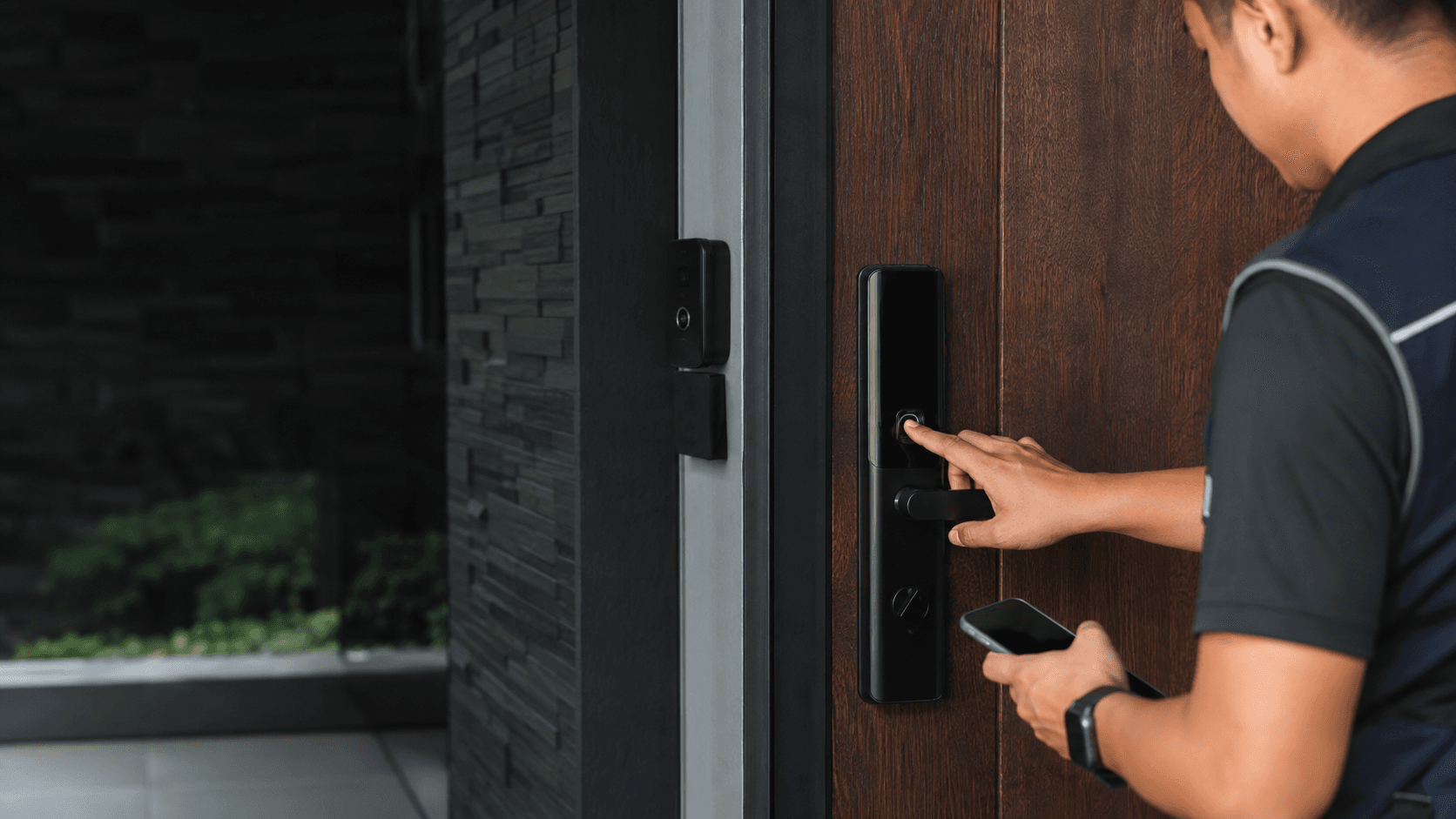
Most buyers start with the reader and work backwards. They compare fingerprint access against keypad entry, card, app control and a physical key, then discover the door decides more than the feature list does. A fingerprint smart door lock only performs as well as the door it sits on and the access rules behind it.
Eyonic Sdn Bhd, a security system supplier in Sarawak, reviews smart lock door access on the position that door condition, user roles and backup method should be checked before installation. That order matters, because a lock that suits a solid timber office door may not suit a hollow-core bedroom door, and a household of three has different access needs from a shop with rotating staff.
Fingerprint Smart Door Lock. What the Choice Really Turns On
The decision turns on three things that have nothing to do with brand badges: whether the door can carry the lock, who is allowed through it, and what happens when the primary method fails. Fingerprint access is the convenience layer. Door condition and backup entry are the load-bearing parts.
Fingerprint access suits people who want to stop carrying keys and stop hiding a spare under a pot. It reads a finger rather than a code, so there is nothing to share, forget or watch someone type. That is the appeal, and it is real.
The trade-off is that a fingerprint is a single credential tied to a single person. When that person is unavailable, or the finger is wet, dirty or injured, entry depends on whatever else the lock accepts. A lock with fingerprint access alone is a lock with one point of failure. A lock with fingerprint access plus keypad entry, a card, app control and a mechanical key has five.
That is why the useful question is not whether fingerprint access works. It is what else the lock does when it does not.
How Fingerprint Access Fits With Keypad, Card, App and Key Backup
Each entry method answers a different situation. Fingerprint access handles the everyday case for people who live or work there. Keypad entry handles the visitor, the contractor and the family member who arrives without a registered finger. A card or fob handles staff who should not be given a permanent code. App control handles the person who needs to let someone in from elsewhere. A mechanical key handles the day the electronics do not cooperate.
These methods are not interchangeable, and treating them as a checklist misses the point. A keypad code can be shared, which is useful for a cleaner and risky for a permanent resident. A card can be handed over and taken back, which suits shift staff. A mechanical key cannot be revoked, so it belongs in a controlled place rather than a drawer full of copies.
For business use, the choice between a standalone smart lock and an access control panel is a real fork. A standalone smart lock manages one door and its own user list. An access control panel manages many doors, shared rules and a central record. A shop with one staff entrance can run a standalone lock. An office with a front door, a store room and a server room usually cannot.
Eyonic's review position reflects that split: for business use, the check is whether a standalone smart lock or an access-control panel is more appropriate. Getting that wrong is expensive, because a standalone lock cannot grow into a multi-door system later.
What each method is actually for
Fingerprint access is for the people who pass through the door most days. Keypad entry is for temporary or shared access that can be changed. Card or fob access is for staff who need a revocable credential. App control is for remote management and for seeing what happened. A mechanical key is the fallback that does not depend on power, a network or a working sensor.
Remote viewing and lock history belong to the same layer. They tell the owner who came through and when, which matters more in a workplace than in a home. A household rarely reviews lock history. A shop with staff turnover often does.
Door Condition, User Roles and Backup Entry Before Installation
Door condition is the first filter, and it is the one buyers most often skip. A lock body has to fit the existing cut-out, the door has to be thick enough and solid enough to hold the hardware, and the frame has to accept the strike. A door that is warped, thin, or already fitted with an incompatible mortise may need work before any lock is mounted.
User roles come next. A home needs a short list of permanent users and a way to admit occasional visitors. A shop needs a longer list with people joining and leaving, which means the lock must support adding and removing users without reissuing everything. A public office needs a clearer separation between staff areas and visitor movement, because the door is doing two jobs at once.
Backup entry is the third check, and it is the one that decides whether a lock is safe to rely on. If the battery runs down, if the fingerprint reader stops responding, or if the network drops, the door still has to open for the people who are authorised to open it. That is a design question, not a maintenance question.
Eyonic's Kuching Immigration Office project shows the shape of this thinking in practice: the work focused on arrival flow, staff areas, visitor movement and dependable daily operation. A door that separates staff from visitors is doing access control, not just convenience, and the backup method has to match that responsibility.
Where a Fingerprint Smart Door Lock Fits in a Wider Security Setup
A door lock is one layer. It controls who comes through a specific opening. It does not see the perimeter, the car park or the corridor, and it does not record what happens after someone is inside.
That is where the rest of the setup sits. CCTV covers the approach and the interior. An alarm system covers intrusion and raises the alert. An autogate covers vehicle entry. A keyphone intercom covers the conversation at the door before it opens. Each answers a different question, and a lock answers only one of them.
The practical link is the entry sequence. A visitor arrives, is seen on camera, is spoken to over the intercom, and is then admitted. A fingerprint smart door lock handles the last step. If the earlier steps are missing, the lock is doing more work than it was designed for.
Eyonic supplies and installs CCTV, alarm, autogate, keyphone intercom and ELV systems alongside smart lock door access, which means the entry point can be planned as part of one setup rather than bolted on afterwards. The company's stated focus is practical, user-friendly solutions for homes, offices, shops and industrial sites.
Practical Checks Eyonic Runs Before Recommending a Lock
The checks below follow the same sequence Eyonic uses for its installation work: site survey, system proposal, installation and handover. The survey stage is where most of the risk is removed, because a lock that fails the door check never reaches the proposal.
- Inspect the door and frame for thickness, solidity, existing cut-outs and strike alignment, and confirm the lock body will fit without weakening the door.
- Confirm the entry methods required, covering fingerprint access, keypad entry, card, app control and a mechanical key, and check which of them the door position can support.
- Map user roles, separating permanent users from temporary ones, and decide whether the site needs a standalone smart lock or an access control panel.
- Agree the backup entry method and test it, so the door still opens when the battery runs down, the reader fails or the network drops.
- Check how the lock sits with the wider setup, including camera coverage of the approach, alarm zones and intercom at the door.
- Walk through installation and handover, covering user enrolment, permission changes and what to do when a credential stops working.
The handover step is where most problems surface later. A lock that nobody knows how to administer becomes a lock with one user and a growing list of people waiting outside.
What the survey cannot settle
Some questions need the manufacturer's datasheet for the specific model, not a site visit. Sensor type, user capacity, power source and door compatibility limits sit with the product documentation. Eyonic's own review page is the internal reference for how door condition, user roles and backup method are assessed, and the product datasheet is the reference for the hardware limits.
Where a site has a fire door, a regulated building requirement or a landlord's restriction, that needs a primary source before any lock is specified. A lock that compromises a fire door's function is not a convenience upgrade.
Questions Buyers Ask Before Installing
Will a fingerprint smart door lock work on any door? No. Door thickness, solidity, existing cut-outs and frame alignment all constrain what can be fitted. A survey is the only reliable way to know before purchase.
What happens when the fingerprint fails? Entry falls back to whatever other methods the lock supports, which is why keypad entry, a card, app control or a mechanical key should be confirmed before installation rather than assumed.
What happens when the battery runs down? The backup method decides this. A lock with a mechanical key or an external power option behaves differently from one without, and the answer belongs in the survey, not in the manual after the door is shut.
Is a standalone smart lock enough for a business? It depends on the number of doors and how often users change. One door with a stable user list can run standalone. Multiple doors or frequent staff changes usually point to an access control panel.
Can a fingerprint smart door lock be added to an existing CCTV setup? The lock and the cameras serve different purposes, so the useful question is whether the approach to the door is covered and whether the entry sequence is complete. That is a placement question, and Eyonic's own guidance on camera work is to check actual conditions on site before confirming placement.
How long does installation take? That depends on the door, the lock and whether the frame needs work. It is confirmed at survey rather than quoted in advance.
What does a lock cost in Malaysia? Pricing for a fingerprint smart door lock is not published here. Eyonic's evidenced package pricing sits at RM 1,599 for the Hikvision CCTV package, RM 1,599 for the Hikvision alarm system and RM 1,599 for the autogate package, and lock pricing is confirmed against the specific door and model.
Share your location, property type and required system with Eyonic on WhatsApp at +60 11-5111 7959 for the next practical step.