
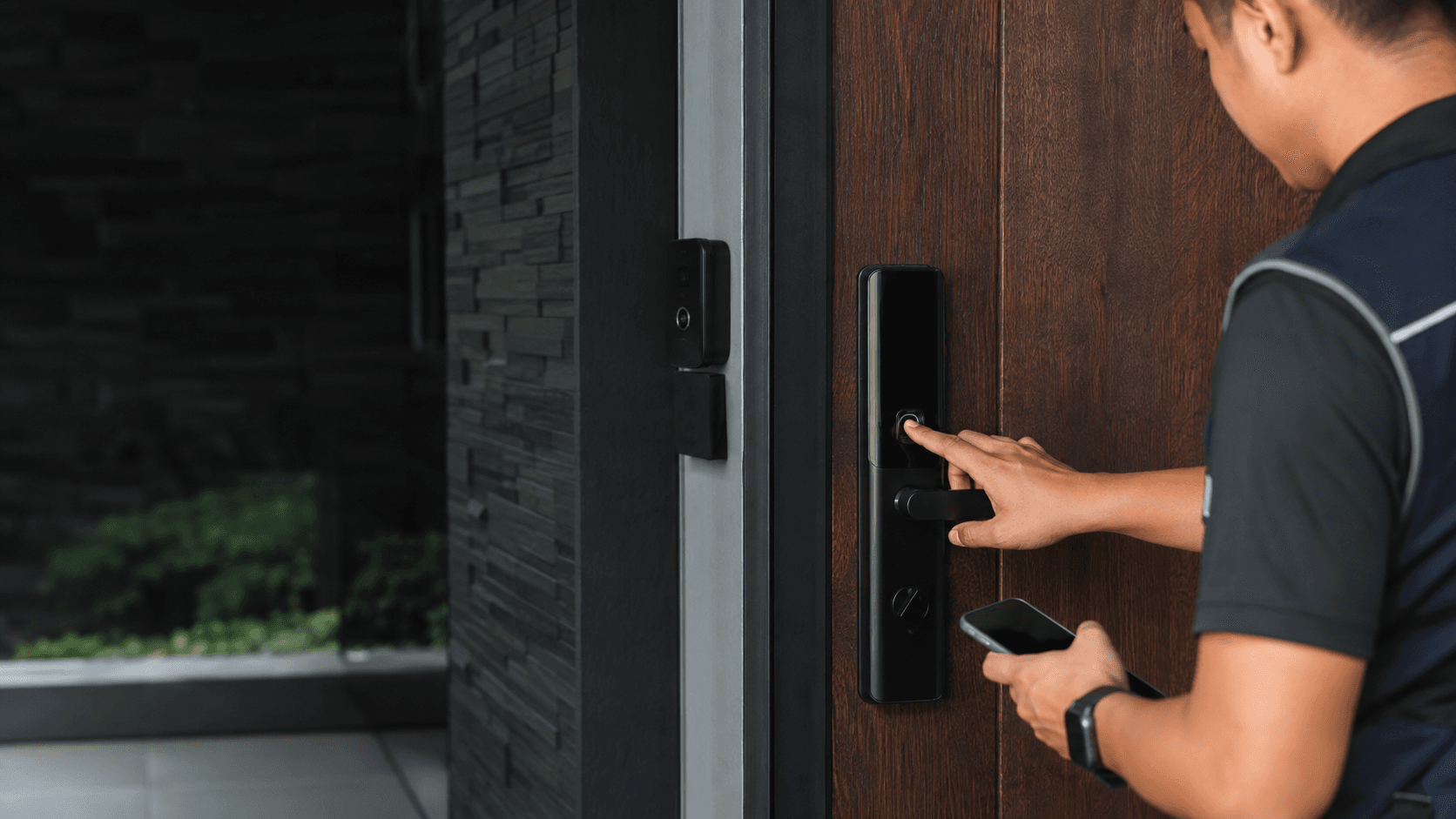
Eyonic Sdn Bhd, a security system supplier in Sarawak, reviews those three items before recommending hardware, and treats a standalone smart lock and a full access-control panel as different answers to different doors. The same review logic applies whether the door belongs to a family home in Kuching or a public office counter.
What a smart lock for main door review actually covers
A main door is the highest-traffic opening in most Malaysian properties. It is also the door most likely to be a heavy metal grille-and-wood combination, a double-leaf entrance, or a gate-adjacent unit rather than the single timber slab that overseas buying guides assume.
Eyonic's own product review position is that smart locks work best when door condition, user roles and backup method are reviewed before installation, and that for business use the choice between a standalone smart lock and an access-control panel should be checked rather than assumed. That is a fit question, not a brand question.
Three practical consequences follow from that position:
- Door condition is checked first, because a lock body, mortise, or surface-mount housing has to sit on the existing door and frame without forcing the door to be rehung.
- User roles are listed next, because a household of four and an office with rotating staff, cleaners, and delivery access need different permission structures.
- A backup entry method is agreed before installation, so the door can still be opened when a battery is flat, the network is down, or a phone is lost.
- Handover testing is completed with the people who will actually use the door, not only with the person who placed the order.
That sequence is the same one Eyonic applies to its other security work. The documented CCTV installation process runs through site survey, system proposal, installation, and handover, and the same four stages map cleanly onto a door access job.
Door condition and user roles decide the fit
Door condition is the constraint that most often changes the recommendation. A door that closes cleanly, has a sound frame, and already carries a working lock body is a different starting point from a door that has swollen, dropped on its hinges, or relies on a padlock and hasp.
User roles matter just as much. A single household typically needs one administrator and a small number of recurring users. A shop, office, or clinic needs a way to add and remove access as staff change, and often needs a record of who entered and when. Eyonic's review guidance notes that for business use the company usually checks whether a standalone smart lock or an access-control panel is more appropriate, because the two handle multiple users and audit trails differently.
Two documented Eyonic projects show the kind of movement pattern that shapes that decision. The Kuching Immigration Office project focused on arrival flow, staff areas, visitor movement, and dependable daily operation. The KTA Sarawak Sdn Bhd project supported staff movement, visitor handling, tidy cabling, and clearer daily site control. Both are movement-and-permission problems, which is exactly what a main door lock has to solve at a smaller scale.
Where a standalone lock stops being enough
A standalone smart lock suits a door with a small, stable user group and no requirement to review entry history centrally. Once a site needs scheduled access, temporary credentials for contractors, or a record that can be checked after an incident, the door becomes part of an access-control conversation rather than a lock purchase.
That is a scope decision, not a quality judgement. A well-fitted standalone lock on a home main door is a complete solution. The same lock on a staff entrance with rotating shifts is an incomplete one.
Smart lock for main door checks before installation
The pre-installation checks are the part most buyers skip, and the part that determines whether the finished door feels convenient or annoying. Each check produces a decision that has to be made before hardware is ordered.
Door condition determines whether the existing lock can be replaced in place or whether the door needs preparation first. User roles determine how many credentials are needed and who administers them. Backup entry determines what happens on the worst day. Handover testing determines whether the people using the door can actually operate it without calling for help.
For a business site, the same checks feed into a proposal. Eyonic's documented process places a site survey before the system proposal, which means the door is inspected before a recommendation is written rather than after. The Kuching Immigration Office work was scoped around arrival flow and dependable daily operation, which are survey findings rather than catalogue features.
Why the survey comes before the model
Lock compatibility depends on the door in front of the installer, not on a specification sheet. Frame depth, existing cut-outs, door thickness, and whether the door is timber, metal, or glass all change what can be fitted without modification.
Eyonic applies the same principle to camera work, where the company recommends checking actual lighting conditions before confirming placement rather than relying on a general rule. Door access follows the same logic: confirm the physical situation first, then choose the hardware.
Backup entry and daily routine
Backup entry is the single most important design decision on a main door, because the main door is the one that cannot be left unusable. A backup method has to be independent of the primary method, and it has to be usable by someone who is not carrying a phone.
Common backup approaches include a mechanical key override, a physical keypad code, and an external power point for a depleted battery. The right choice depends on who needs access and how the property is used. A rental unit with short-stay guests needs a different backup plan from a family home where the same people use the door every day.
Daily routine is the second half of the same question. A door that is locked and unlocked a dozen times a day puts different demands on a lock than a door used twice. A door that is the only entrance for a business also has to keep working during a delivery, a staff changeover, or a power interruption.
Eyonic's review guidance frames smart lock door access as good for controlled convenience when user permissions and backup entry are planned properly. That wording is deliberate. the convenience is real, and it depends on the planning.
Edge cases worth naming before purchase
Several situations change the recommendation. A main door that is also the only fire escape route needs a backup that works without power. A door shared with a rented unit needs permissions that can be revoked cleanly when a tenancy ends. A door exposed to direct rain needs hardware suited to that exposure. A property with unreliable mains power needs a backup that does not depend on the same supply.
None of these are reasons to avoid a smart lock. They are reasons to settle the answers before the hardware is chosen.
Installation and handover in Sarawak
Installation quality decides whether a smart lock for main door performs as intended. A lock that is slightly misaligned with the strike plate will bind, drain batteries faster, and generate complaints that look like product faults but are fitting faults.
Eyonic's documented installation sequence runs through site survey, system proposal, installation, and handover. Applied to a door access job, that means the door is surveyed, a proposal is written against what was found, the hardware is installed and aligned, and the handover covers operation and testing with the people who will use the door.
Handover is where user roles become concrete. Administrators are shown how to add and remove access. Recurring users are shown the everyday unlock method. The backup method is demonstrated rather than described, so it is known to work before it is needed.
Eyonic is based in Sarawak and works across homes, offices, shops, and industrial sites, with completed projects for government and engineering consultancy clients. The Kuching Immigration Office and KTA Sarawak Sdn Bhd projects both sit in that public and commercial category, where dependable daily operation matters more than feature count.
What handover should include
A useful handover covers the everyday unlock method, the backup method, how to add or remove a user, what the low-battery indication looks like, and who to contact when something stops working. It also confirms that the door closes and locks cleanly with the new hardware in place.
For a business site, handover should also confirm that the permission structure matches how the site actually operates, including any temporary or scheduled access.
Questions to settle before buying
Most of the risk in a smart lock for main door purchase sits in unanswered questions rather than in the hardware itself. Settling these before ordering removes the common causes of a disappointing result.
Is the existing door sound enough to carry the new lock without preparation work? Who needs access, and how often does that list change? What is the backup method, and who can use it? Who will install and align the hardware, and who will test it with the actual users? For a business, does the site need entry records or scheduled access that a standalone lock does not provide?
Eyonic's documented packages for CCTV, alarm, and autogate are each priced at RM 1,599 and each include supply, setup, and handover. Door access is reviewed on the same supply-and-handover basis, with the scope set by the survey rather than by a fixed package.
Where a property needs door access alongside cameras, alarms, or an autogate, the sensible sequence is to survey the whole entry and movement picture once and then decide which systems are needed. The Kuching Immigration Office project was scoped around arrival flow, staff areas, and visitor movement, which is a whole-entry view rather than a single-device view.
Share the location, property type, and required system with Eyonic on WhatsApp at +60 11-5111 7959 to move from questions to a surveyed recommendation.