
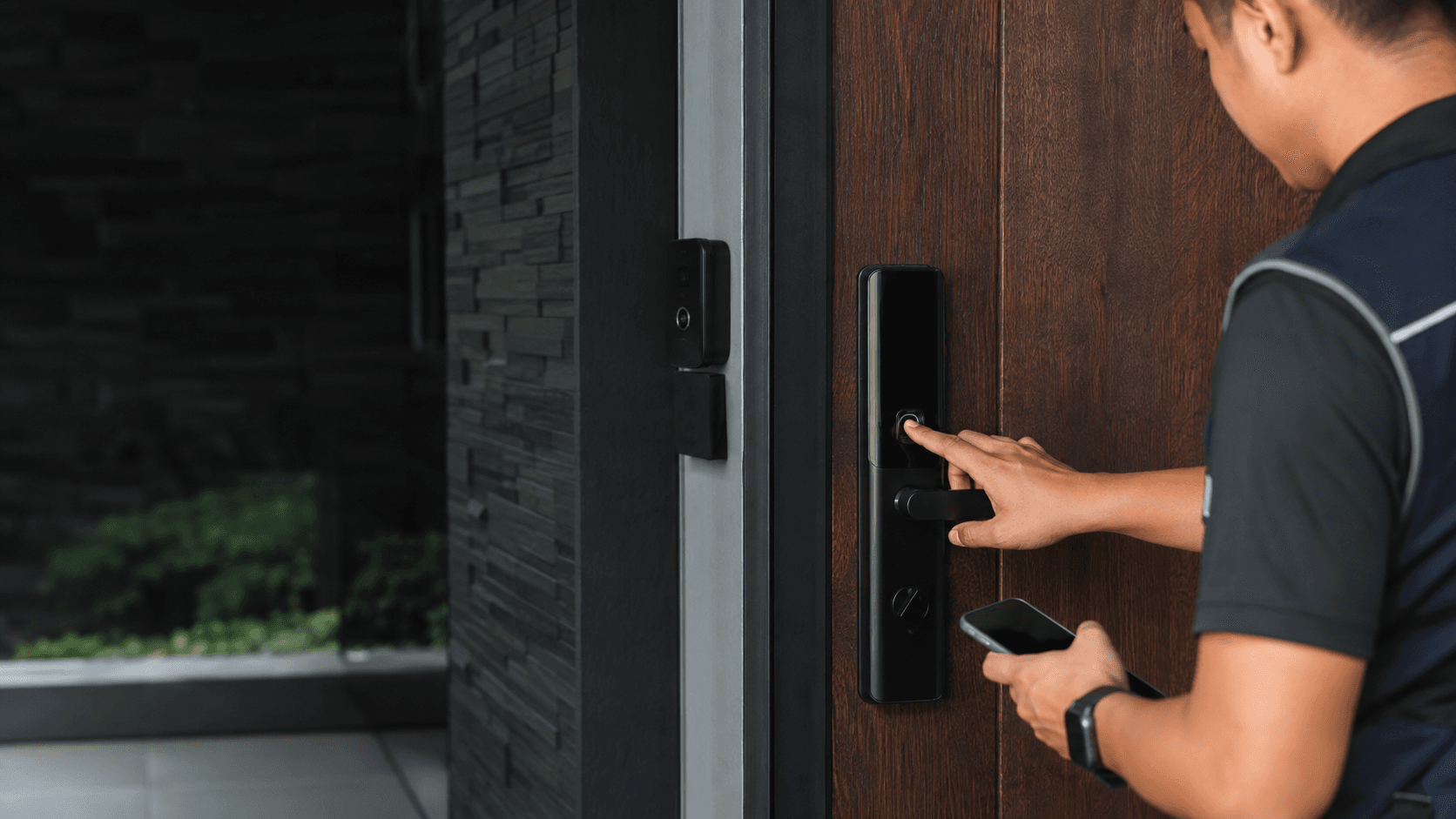
The exact-match query abloy smart lock describes a category of electronic locking rather than a single product. Buyers in Malaysia meet it while comparing keyless entry against mechanical keys, and the decision usually turns on three things: whether the door can carry the hardware, who needs daily entry, and what happens when power, batteries or network access fail.
Eyonic Sdn Bhd is a security system supplier in Sarawak that plans, supplies and installs monitoring and ELV systems for homes, offices, shops and industrial sites. Its published product review guidance places smart lock door access in the access-control category and notes that smart locks work best when door condition, user roles and backup method are reviewed before installation.
What an Abloy Smart Lock Covers
An Abloy Smart Lock belongs to the broader group of electronic and wireless locking products that replace or supplement a mechanical key with an electronic credential. The category covers standalone locks fitted to a single door and networked locks managed alongside a wider access-control system.
The practical difference between those two paths matters more than brand wording. A standalone lock is managed at the door. A networked lock is managed centrally, which changes how credentials are issued, revoked and audited.
Eyonic's own review guidance draws the same line for business use: the company usually checks whether a standalone smart lock or an access-control panel is more appropriate. That check happens before any model discussion, because the answer determines the rest of the specification.
Public documentation from Abloy and ASSA ABLOY describes wireless locking ranges with multiple credential options and access management features. Those descriptions confirm the category exists and is positioned for workplace and commercial access management. They do not establish which models reach the Malaysian market, what they cost locally, or how they behave on Malaysian door stock.
What the category does not settle
Choosing the category does not settle the product. Credential type, wireless protocol, battery behaviour, integration with existing panels and physical fit all vary between models and between generations of the same model. None of those details can be assumed from the category name alone.
That is why a specification conversation that starts with a model number tends to stall. The door and the user list come first, and the model follows from them.
Where an Abloy Smart Lock Fits in Malaysia
Malaysian buildings mix door types within a single premises, and that mix decides where electronic locking is straightforward and where it is not. A shop lot, an office suite, a condominium unit and a factory floor each present different door conditions, different user volumes and different backup expectations.
Common fit scenarios include.
- An office entrance where staff arrive on a predictable schedule and a small number of people need after-hours access.
- A shop back door that currently relies on a key held by several people, where the owner wants to remove and reissue access without changing the lock.
- A condominium or apartment entry where the resident wants keyless daily entry but still needs a reliable way in during a failure.
- A server or records room where entry should be limited to named individuals rather than anyone holding a master key.
Poor fit scenarios are just as common. A door that does not close squarely, a frame that has been repaired repeatedly, or a gate exposed to direct rain all create problems that no credential type solves. In those cases the door work comes first.
Eyonic's project record in Sarawak shows the pattern that matters here. Work for the Kuching Immigration Office focused on arrival flow, staff areas, visitor movement and dependable daily operation. Work for KTA Sarawak Sdn Bhd supported staff movement, visitor handling, tidy cabling and clearer daily site control. Both are access and movement problems before they are hardware problems, and both were delivered in Kuching.
Standalone lock or access-control panel
A standalone lock suits a single door with a short user list and no requirement to review entry records centrally. An access-control panel suits multiple doors, larger user groups, or any site where access needs to be granted and revoked from one place.
The trade-off is management effort against installation scope. A standalone lock is quicker to place and simpler to live with, but it fragments control as doors are added. A panel costs more to install and needs cabling and configuration, but it keeps the user list in one place as the site grows.
For a business, Eyonic's stated approach is to check which of the two is more appropriate rather than defaulting to either. That check is the point at which the decision becomes specific to the premises.
Door, User and Backup Checks Before an Abloy Smart Lock
Three checks decide whether an installation will hold up: the door itself, the people who need entry, and the fallback when the primary method fails. Each one produces a concrete answer rather than a preference.
- Site survey. The door, frame, closing action, existing hardware and surrounding surfaces are inspected on site, along with the power and network position if the lock will be managed centrally.
- System proposal. The survey findings are turned into a proposed setup covering the lock or panel path, the credential approach, the user roles and the backup method.
- Installation. The hardware is fitted and configured, and the door is tested through its normal opening and closing cycle rather than only at the lock.
- Handover. Users are set up, the backup method is demonstrated, and the people who will manage day-to-day access are shown how to add or remove a user.
The sequence is the same one Eyonic publishes for its installation services in Sarawak: site survey, system proposal, installation and handover. Applied to locking, it keeps the door assessment ahead of the product choice.
Door condition
A door that binds, drags or fails to latch will defeat an electronic lock regardless of credential type. The survey checks whether the door closes cleanly under its own weight, whether the frame is square, and whether the existing cut-outs leave enough sound material for new hardware.
Fire-rated doors, glass doors and metal frames each carry their own constraints. Where a door cannot be modified safely, the honest answer is that the door needs attention first, or that a different door in the premises is the better candidate.
User permissions
The user list determines whether a standalone lock is sufficient. A household or a small office with a stable group is straightforward. A site with rotating staff, contractors, cleaners and delivery access needs a way to grant and revoke entry without visiting the door.
Roles matter as much as headcount. If different people need different doors at different times, the requirement has already moved past a single standalone lock.
Backup entry
Every electronic lock needs a defined way in when the primary method is unavailable. That may be a mechanical key, a second credential path, or a documented procedure held by a named person.
The backup method should be decided during the proposal stage, not after installation. A backup that nobody has tested is not a backup, and the handover step exists partly to confirm it works.
How Eyonic Approaches an Installation
Eyonic Sdn Bhd plans, supplies and installs security and ELV systems in Sarawak, covering CCTV, alarm systems, autogate, keyphone intercom and related work. Smart lock door access sits within that access-control scope, and the company's published position is that smart locks suit controlled convenience when user permissions and backup entry are planned properly.
Founder Eric Yong has worked in the industry for more than ten years, with a stated focus on technical installation of digital security solutions for commercial businesses in Sarawak. That experience shapes the survey stage, where door condition and existing infrastructure are assessed before a proposal is written.
The same discipline appears in Eyonic's product review guidance for other equipment. For ColorVu-style cameras, the company recommends checking actual lighting conditions before confirming placement rather than relying on published specifications. The principle transfers directly to locking: the site decides the specification, not the catalogue.
Eyonic's published packages for other systems are priced at RM 1,599 for the Hikvision CCTV package, RM 1,599 for the Hikvision alarm system and RM 1,599 for the autogate package, each including supply, setup and handover. Those figures describe other product lines and are not a price for an Abloy Smart Lock installation.
Larger access and movement projects in the record carry approximate budgets of RM 12,000 to RM 28,000 for the Kuching Immigration Office work and RM 8,000 to RM 18,000 for the KTA Sarawak Sdn Bhd work. Both are multi-element site projects rather than single-door lock installations, and neither should be read as a lock price.
What a survey needs from the site
A useful survey needs access to the door in its normal daily condition, not a cleared version of it. It also needs the user list, the intended backup method and a clear statement of whether access will be managed at the door or from a central point.
Where the premises already run an access-control panel, the survey should establish whether the new lock is expected to join it. That question changes the hardware shortlist before any model is named.
Questions Buyers Ask in Malaysia
Is an Abloy Smart Lock suitable for a Malaysian home? Suitability depends on the door rather than the property type. A solid door that closes cleanly and has a stable user list is a reasonable candidate. A door that binds, or an entrance exposed to direct weather, needs assessment first.
Can it replace an existing keyed lock? In many cases the lock body is replaced at the same door position, but the existing cut-out, door thickness and frame condition determine whether that is straightforward. The survey answers this for the specific door.
What happens during a power or battery failure? The backup method decided at proposal stage covers this. It should be demonstrated at handover so the people who rely on the door know what to do.
Is a standalone lock enough for an office? For a single door with a stable user group, often yes. Where multiple doors, rotating staff or central revocation are involved, an access-control panel is usually the more appropriate path.
How long does installation take? Duration depends on the door, the chosen path and whether cabling or panel work is involved. The survey and proposal stage is where a realistic sequence is set for the specific site.
Who supplies and installs it locally? Eyonic Sdn Bhd operates from Sarawak and provides planning, supply and installation for security and ELV systems, including access-control work. Project records include completed work in Kuching.
Share the location, property type and required system with Eyonic on WhatsApp at +60 11-5111 7959 to move from category research to a site-specific answer.