
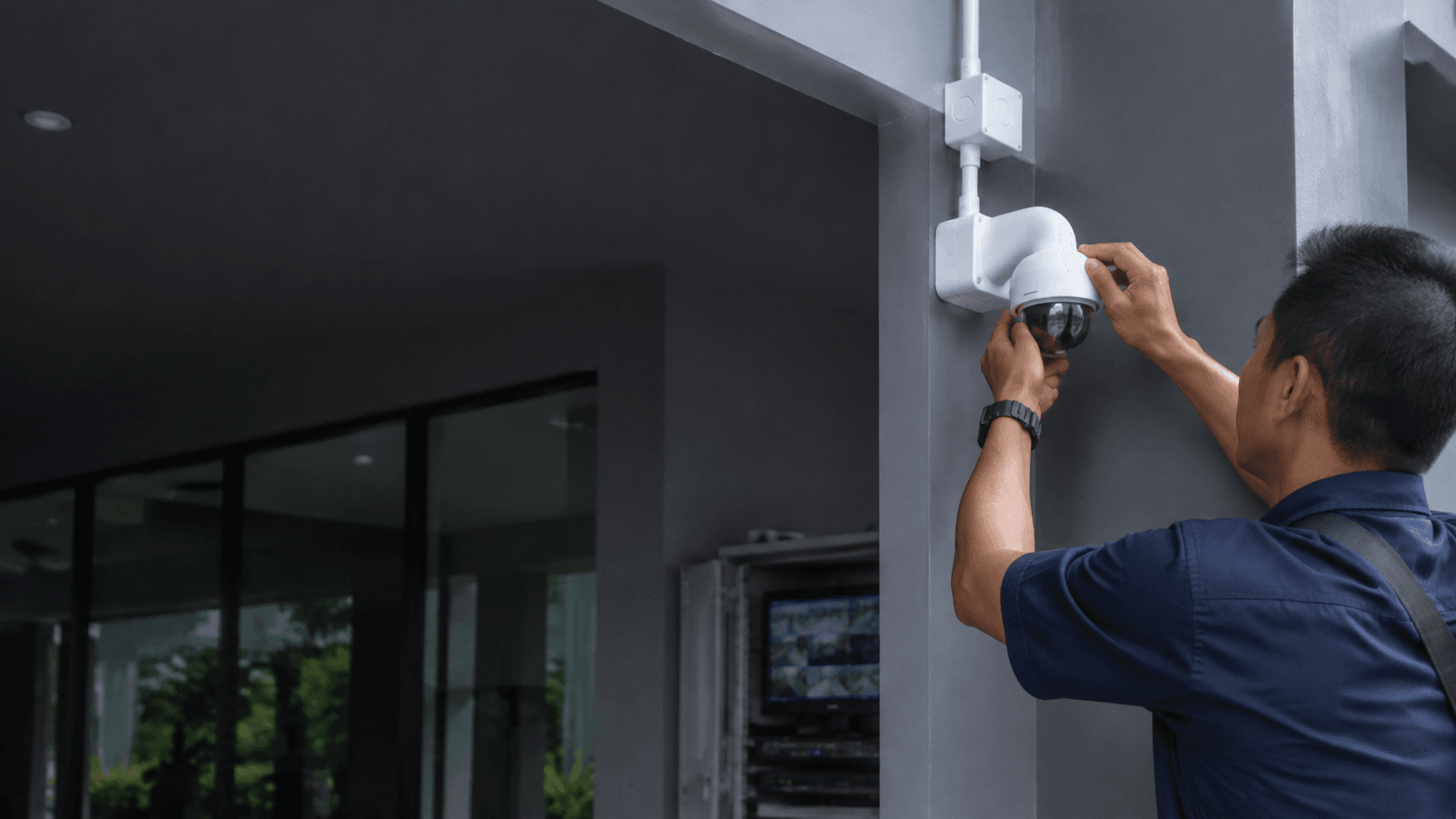
The brand sits in a different category from the wired CCTV and alarm packages most Malaysian properties already run. Eufy is built around cameras that record to a local base station, an app that carries alerts to a phone, and a choice between watching alerts yourself or paying a monitoring service. That structure shapes who it suits, what it costs to keep running, and how much of the work a property owner can realistically do alone.
What an Eufy Security System covers
A Eufy Security System combines three jobs that are usually split across separate devices: watching an area, recording what happens, and raising an alert when something moves. Cameras handle the watching. A base station or hub handles the recording and keeps footage on storage inside the property rather than in a vendor cloud by default. The app handles alerts, live view and playback.
That combination is why the product line is often described as a home security system rather than a camera range. A camera alone gives a recording. A system adds the alerting layer, the storage layer and the user accounts that decide who can see what.
Two limits matter before anything else. First, a camera-based system sees; it does not physically stop entry the way a locked gate or a barred window does. Second, a self-monitored system depends on someone responding to the alert. If nobody checks the phone at 2am, the recording still exists but the response does not.
eufy security system camera and storage options
Eufy's own product pages describe the range in terms of privacy control, smart detection, expert monitoring and easy setup, with local data storage positioned as the privacy feature. Competitor reviews of the same brand consistently separate the range into cameras, a base station, and an alarm kit with sensors. Those are the three parts worth understanding, because each one changes the cost and the effort.
Cameras
Cameras divide by how they get power and where they point. Battery and solar models avoid cabling but need charging or enough sunlight. Wired models avoid charging but need a cable route. Indoor models watch rooms; outdoor models watch entrances, driveways and perimeter lines. Placement decides usefulness far more than resolution does, and Eyonic's own guidance on ColorVu-style cameras is to check actual lighting conditions before confirming placement rather than assuming a night-time result from a specification sheet.
Base station and local storage
The base station is the part that makes local storage possible. Footage lands on storage in the property instead of a subscription cloud, which removes a monthly fee and keeps recordings on site. The trade-off is physical. if the base station is stolen or destroyed, the recordings go with it. A cloud plan solves that but adds a recurring cost and moves footage off site.
Alarm kit and sensors
An alarm kit adds entry sensors, a siren and a control panel. This is the part that turns a camera system into something closer to a conventional alarm. It also introduces the question of whether the new kit should replace an existing alarm panel or sit alongside it, and that question has no generic answer.
When an Eufy Security System suits a property
The fit depends on three things. whether the property already has cabling, whether anyone is willing to respond to alerts, and whether the owner wants a monthly bill.
A system like this tends to suit a property where running new cable is difficult or expensive, where the owner wants to check in remotely without a monitoring contract, and where the site is small enough that a handful of cameras covers the real risk points. A terrace house, a small office, a shop lot or a single-unit rental can fall into that group.
It tends to suit less well where coverage needs are wide and continuous, where the site has no reliable power or internet at the camera positions, or where the requirement is a monitored response with a contractual obligation attached. A large industrial yard with long perimeter runs is a different problem from a house with one gate and one car porch.
There is also a middle case worth naming. A property can run a self-monitored camera layer for awareness and keep a separate alarm or autogate system for physical control. Those two layers do different jobs, and treating them as one purchase usually leads to disappointment on one side or the other.
What to compare before choosing an
Comparison shopping on this category usually collapses into brand-versus-brand arguments that do not answer the practical questions. The useful comparison is between configurations, not logos.
- Confirm the property type and the areas that actually need coverage, then count how many cameras that implies.
- Check the real lighting at each proposed camera position before confirming placement, including how the scene looks at night.
- Decide between local storage on a base station and a cloud subscription, and note that the two carry different risks.
- Confirm app access and user roles, including who can view live footage, who can download clips, and how access is removed when someone leaves.
- Confirm installation, testing and handover, including who runs the cable if any is needed and who verifies the alerts actually fire.
Two of those steps are routinely skipped. Lighting is often assumed from a product listing rather than checked on site, and user roles are often left at whatever the default is. Both cause problems later, and both are cheap to settle before installation rather than after.
Self monitoring versus professional monitoring
Self-monitoring means alerts arrive on a phone and the response is the owner's. It carries no recurring monitoring fee and no third party watching. Professional monitoring means a service receives the alert and acts on it, which adds a recurring cost and a dependency on that service being available in the property's location.
The decision is not about which is better. It is about whether anyone is reliably available to act on an alert. A household with someone home most of the time and a phone always on is a different case from a vacant unit or a site with no on-site staff.
Local storage versus cloud
Local storage keeps footage in the property and avoids a subscription. Cloud storage survives the loss of the device but adds a recurring cost. A property can run both, and some do, but the reason should be a specific risk rather than a preference for having everything.
Compatibility with existing systems
This is where most Malaysian properties hit a real question. A home may already have an alarm panel, an autogate motor and a keyphone intercom, each installed at different times. Whether a new camera system integrates with those, sits beside them, or replaces one of them depends on the specific models involved. That is a site-specific check, not a general one, and it should be settled before purchase rather than after delivery.
Installation handover and local support
Eyonic's documented installation process runs through site survey, system proposal, installation and handover. That sequence matters more for a camera system than it might appear, because the survey is where lighting, coverage and cable routes get settled, and the handover is where the owner learns what the alerts mean and how to review footage.
Eyonic's project record includes work for the Kuching Immigration Office, covering arrival flow, staff areas, visitor movement and dependable daily operation, and an office setup for KTA Sarawak Sdn Bhd covering staff movement, visitor handling, tidy cabling and clearer daily site control. Both are examples of the same underlying pattern: the value sits in coverage decisions and clean installation, not in the box.
For a self-install product, the handover step is the one most often lost. A system that is mounted and powered but whose alerts have never been tested is not yet a working system. Testing means triggering a sensor or walking through a camera's field of view and confirming the alert arrives, then confirming the recording is retrievable.
Local support is the other variable. A product bought online and installed without local involvement leaves the owner to handle firmware issues, app changes and hardware faults alone. That is a legitimate choice for some buyers and a poor one for others, and it is worth deciding deliberately rather than discovering it later.
Costs and next practical step
Eyonic publishes three packages at RM 1,599 each: a Hikvision CCTV package covering camera supply and setup, basic recording configuration and mobile viewing handover; a Hikvision alarm system covering control panel and sensors, siren and zone setup, and user testing and handover; and an autogate package covering motor recommendation, remote-control setup and safety testing and handover. Those are wired, professionally installed systems rather than Eufy products, and they are useful as a reference point for what a locally installed and handed-over system costs.
Larger project budgets on Eyonic's record run from RM 8,000 to RM 18,000 for an office setup and RM 12,000 to RM 28,000 for a public office installation. Those figures cover multi-area sites with cabling and handover, not a single-camera addition.
For a Eufy Security System specifically, the cost structure is different: equipment up front, no installation labour if self-installed, and a subscription only if cloud storage or professional monitoring is chosen. No verified Malaysian pricing for Eufy equipment or subscriptions is available here, so any figure quoted from a foreign review should be treated as indicative rather than local.
The practical next step is to settle the site questions first. Coverage areas, lighting at each position, storage choice, user roles, and whether the new system needs to work with an existing alarm, autogate or intercom. Share your location, property type and required system with Eyonic on WhatsApp at +60 11-5111 7959 for the next practical step.