
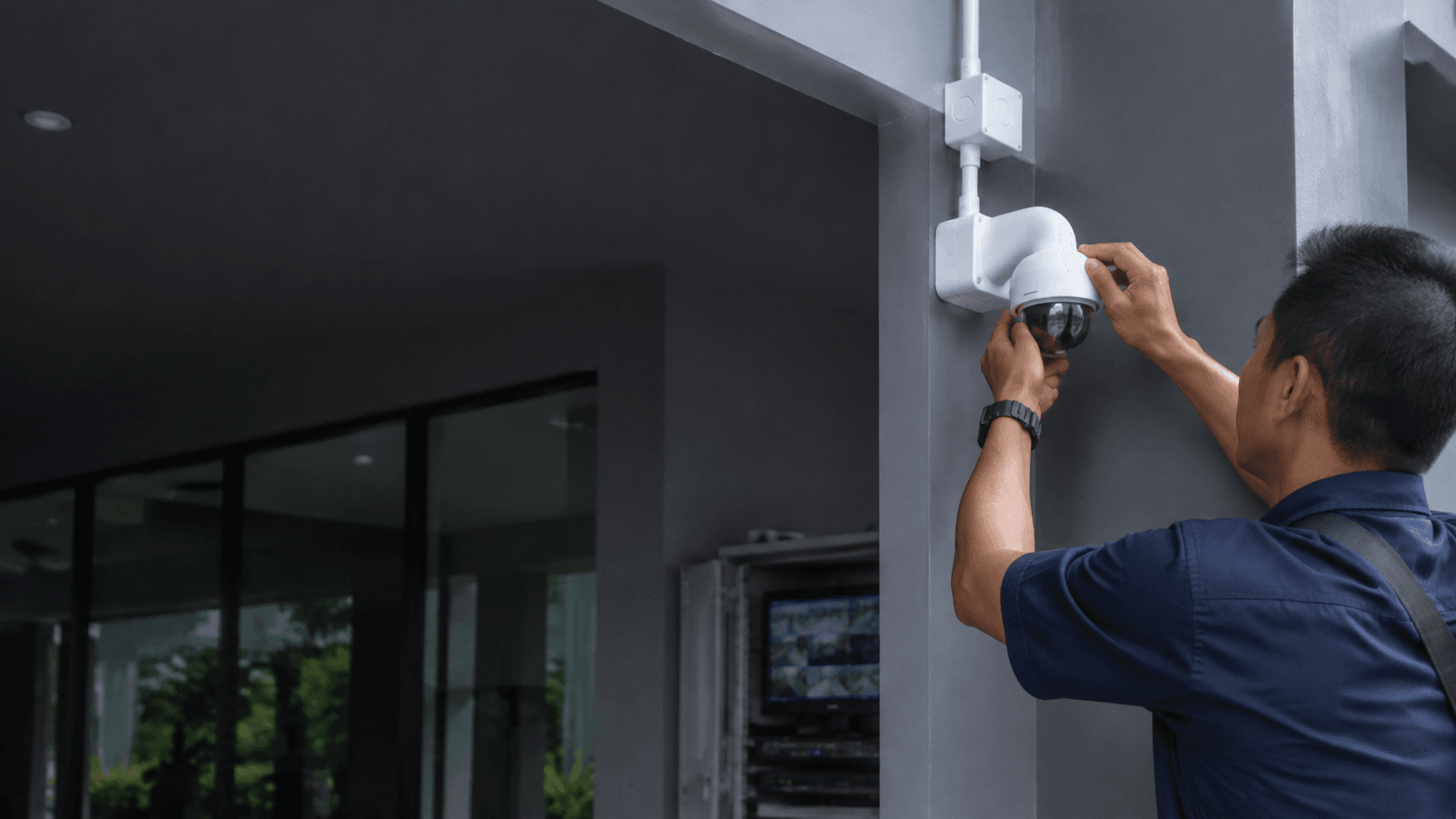
Arlo builds cameras that carry their own illumination, so the same unit that records also lights the area it watches. That combination changes where a camera can usefully go, because the light and the lens share one position. Buyers in Malaysia researching an arlo spotlight camera are usually weighing three things at once: what the light adds after dark, whether the property's lighting suits that kind of unit, and what has to happen before anyone drills a hole in a wall.
This page covers those three questions in order, then sets out the practical sequence Eyonic follows on an installation, and closes with the questions buyers ask most often.
What the Arlo Spotlight Camera Adds After Dark
A spotlight camera does two jobs from one housing. It records, and it throws light on the scene at the moment motion is detected. The light is not decorative. It changes what the sensor can capture, and it changes what a person approaching the property experiences.
The second effect is often the one buyers underestimate. A camera that records in darkness documents an event. A camera that switches on a bright light as someone walks past may prevent the event. For a shopfront, a side gate or a back lane, that difference matters more than resolution figures on a box.
There is a trade-off. A light that triggers on every passing cat, every car headlight sweep and every moving branch will fire often enough that neighbours notice and the owner starts ignoring alerts. Placement and sensitivity settings decide whether the spotlight behaves as a deterrent or as a nuisance.
Night visibility depends on more than the camera
Night visibility is a property of the whole scene, not just the device. Ambient light from a street lamp, a porch light or a neighbouring sign changes how much work the camera's own illumination has to do. A position that looks dark in the afternoon may be perfectly readable at night once existing lighting is accounted for, and a position that looks bright may be washed out by a lamp directly in frame.
Eyonic recommends checking actual lighting conditions before confirming placement for ColorVu-style cameras, and the same discipline applies to any camera that carries its own light source. The check is done on site, at the hours that matter, not from a floor plan.
Lighting Conditions Decide Where an Arlo Spotlight Camera Works
Placement is the single decision that most affects whether an arlo spotlight camera performs as expected. The unit needs a view of the approach, a surface that can carry its weight and mounting type, and a light path that is not blocked by the same object the camera is mounted on.
Four conditions tend to decide the outcome:
- Existing light at the target hours. A position that is already lit by a street lamp or shop sign may need less from the camera's own spotlight, while a genuinely dark lane asks more of it.
- Reflective surfaces in frame. Glass, polished tile, wet tarmac and metal shutters bounce light back into the lens and can flatten the image at the exact moment the spotlight fires.
- Mounting height and angle. Too high and the light lands beyond the subject; too low and the unit is within reach. The angle also decides whether faces or only the tops of heads are captured.
- Power and network reach. Battery-powered and plug-in models have different constraints, and Wi-Fi signal at the mounting point is not the same as Wi-Fi signal inside the building.
Malaysian conditions add their own edge cases. Monsoon rain, direct afternoon sun on a west-facing wall, and heavy foliage that grows back within weeks all affect a position that looked correct on installation day. A camera mounted under a deep eaves overhang may stay dry but lose the view of the approach; one mounted on an exposed wall gains the view and takes the weather.
Property type changes the answer
A terrace house with a narrow frontage has different options from a corner shop with an open five-foot way, and both differ from a factory lot with a long perimeter. For a house, the useful positions are usually the front gate approach, the car porch and any side or rear access. For a shop, the counter, the entrance and the stock or back-door route carry most of the value. For an industrial site, the perimeter and the loading area dominate, and a single spotlight camera rarely covers enough ground on its own.
Eyonic's work for the Kuching Immigration Office focused on arrival flow, staff areas, visitor movement and dependable daily operation. That project shows the pattern. the camera positions followed the movement of people through the building, not a preference for any particular model.
Arlo Spotlight Camera Compared With Other Camera Types
The arlo spotlight camera sits in a category of its own, between a plain camera and a floodlight unit. Understanding the neighbours helps clarify what is being bought.
A standard outdoor camera records with infrared or low-light colour and adds no illumination of its own. It is cheaper, draws less power and is less conspicuous, but in a genuinely dark position it captures less detail and does nothing to discourage an approach.
A floodlight camera throws far more light than a spotlight camera and covers a wider area, at the cost of a larger housing, higher power demand and a much more visible presence. On a residential wall, a floodlight unit can be intrusive; on a commercial yard, it is often the right tool.
A wired camera with a fixed power and network run avoids battery and signal questions entirely, and suits positions where cabling can be routed tidily. A battery-powered unit avoids the cable run but introduces charging or battery-replacement into the maintenance routine.
None of these is universally better. The deciding factors are the lighting at the position, whether power and network can reach it, how visible the owner wants the camera to be, and who will maintain it.
A Practical Order of Work for Camera Placement
Eyonic's CCTV installation process runs through four stages, and the order matters because each stage depends on the one before it.
- Site survey. The property is walked at the hours that matter, existing lighting is checked, mounting surfaces and cable routes are identified, and the movement of people and vehicles through the site is mapped.
- System proposal. Camera positions, camera types, recording setup and remote viewing are set out against the surveyed conditions, so the proposal reflects the property rather than a standard package.
- Installation. Cameras are mounted, cabling is routed, the recorder is configured and the network is set up so the system is reachable from a phone or desktop.
- Handover. The owner is shown how to view live and recorded footage, how alerts behave, and what routine attention the system needs.
The survey stage is where most of the value sits. A camera placed without checking the actual lighting at the actual hours is a guess, and a guess that has to be corrected later costs more than the survey would have.
What to prepare before the survey
A survey moves faster when the owner can describe the concern rather than the product. Useful inputs include which areas have been a problem, what hours matter most, whether the property is occupied overnight, who will check footage and how often, and whether the building already has a recorder or network the new cameras should join.
It also helps to know the constraint that will not move. A rented shop unit may not permit new cable runs. A heritage shophouse facade may restrict mounting. A gated community may have rules about visible equipment. These are better raised at the survey than discovered on installation day.
Questions Buyers Ask in Malaysia
Does the spotlight camera need a subscription? Arlo cameras are commonly used with cloud storage plans, and the terms of those plans vary by market and change over time. Buyers should confirm the current plan options and what happens to recordings without one before committing, rather than relying on a review written for another country.
Can it work without Wi-Fi? Remote viewing depends on a network connection at the camera's position. A mounting point with weak signal will produce unreliable live view and delayed alerts even if the camera itself is working correctly, so signal at the exact position should be tested rather than assumed from indoor coverage.
Is a spotlight camera enough on its own? For a single entrance or a small shopfront, one well-placed unit can cover the main approach. For a long perimeter, multiple floors or a site with vehicle movement, a single camera leaves gaps, and the survey should establish what is actually covered.
What about recording and remote viewing? Eyonic plans, supplies and installs monitoring systems with camera placement, recording and remote viewing, so the recorder configuration and the phone or desktop viewing setup are part of the same scope as the cameras.
How does this fit alongside other security systems? Cameras are one layer. Eyonic also works on alarm systems, autogate packages, keyphone intercoms and Starlink internet installation, and these are often planned together so that a gate, an alarm zone and a camera view line up rather than being bought separately and reconciled later.
For buyers who want a starting point on cost, Eyonic's published packages are RM 1,599 for a Hikvision CCTV package covering camera supply and setup, basic recording configuration and mobile viewing handover, RM 1,599 for a Hikvision alarm system, and RM 1,599 for an autogate package. These are package prices for those systems, not a quotation for an Arlo Spotlight Camera, and any camera-specific pricing depends on the model, the number of units and the site conditions found at survey.
Share your location, property type and required system with Eyonic on WhatsApp at +60 11-5111 7959 for the next practical step.