
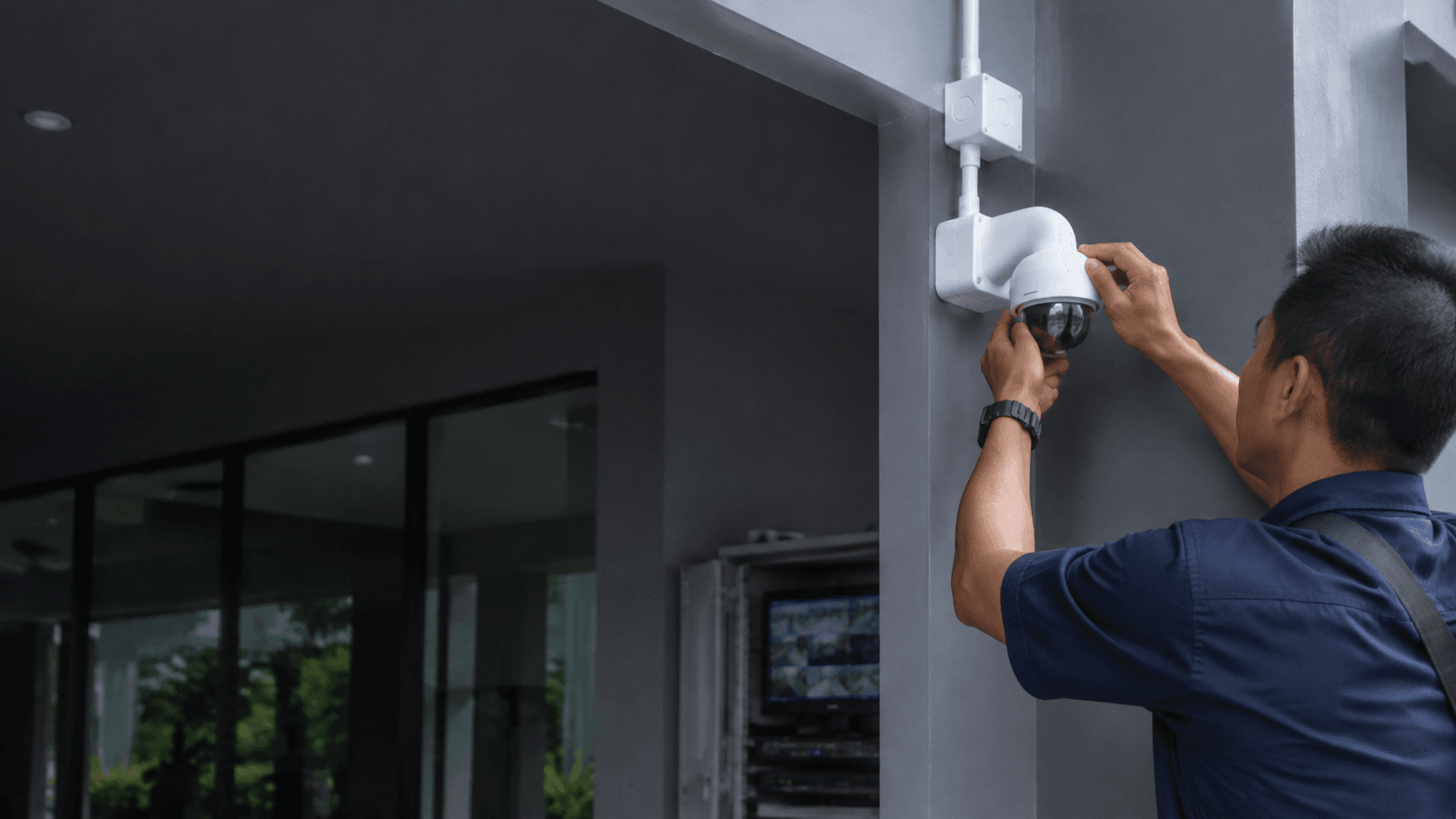
The monitor is the part of a surveillance setup that people actually look at. Cameras capture, a recorder stores, and the screen turns both into something a person can watch in real time. In Malaysia, that screen often sits at a guard post, a reception counter, a shop counter or an office desk where someone can glance at it during the working day.
Eyonic Sdn Bhd is a security system supplier in Sarawak that handles planning, supply and installation, and its founder Eric Yong has worked in the industry for more than 10 years, with a focus on technical installation of digital security solutions for commercial businesses in Sarawak.
What a cctv camera monitor does in a surveillance setup
A cctv camera monitor gives a continuous view of selected cameras without needing a phone, tablet or computer. That matters where staff cannot carry a device, where a shared screen keeps several people informed at once, and where a quick glance is faster than opening an app.
The screen does not record by itself. Recording happens on a recorder, and the monitor is a viewing surface connected to that recorder or directly to a camera. This is why a monitor decision usually follows the recorder decision, not the other way around.
Remote viewing covers a different need. Eyonic's CCTV service includes remote viewing alongside camera placement, recording and NVR setup, so a site can have both a local screen and phone access. The two are complementary. the local screen suits constant presence, while remote viewing suits owners and managers who are not always on site.
For a public office, the value is often operational rather than investigative. Eyonic's project for the Kuching Immigration Office focused on arrival flow, staff areas, visitor movement and dependable daily operation, which is the kind of setting where a fixed screen supports day-to-day coordination.
Cctv camera monitor placement and viewing needs
Placement decides whether a screen gets used or ignored. A monitor that faces a walkway, catches window glare or sits below eye level tends to be checked less often than one positioned where staff already stand or sit.
Lighting is the other half of the problem, and it applies to the camera side as much as the screen side. Eyonic recommends checking actual lighting conditions before confirming placement for ColorVu-style cameras, because a position that looks fine in daylight can behave differently after dark. The same walk-through logic applies to the screen: a spot that is readable at noon may wash out under evening interior lighting.
Viewing needs vary by property type. A shop counter usually needs a small number of cameras visible at once, with the screen close to the till. An office reception may need entrance and lobby views. An industrial site may need several areas watched from one point, which pushes the decision toward a larger screen or more than one display.
There is a practical limit worth naming. A single screen showing many camera tiles makes each view smaller, and detail drops as tiles increase. Where detail matters, the usual answer is fewer cameras per screen or a second display rather than a bigger single screen.
How a cctv camera monitor connects to cameras and recorders
Connection depends on what the monitor is plugged into. In a recorder-based setup, cameras reach the recorder and the recorder feeds the screen. In a direct setup, a camera feeds the screen without a recorder in between, which suits a single-view checkpoint but not multi-camera recording.
Because the supplied evidence does not cover specific monitor input types, resolutions or compatibility between particular monitors and particular recorders, those details should be confirmed against the actual recorder documentation before any purchase. The safe sequence is to settle the recorder first, then match the display to the outputs that recorder provides.
NVR setup is part of Eyonic's CCTV service, which means the recorder configuration and the viewing arrangement are handled together rather than as separate purchases. That reduces the chance of a screen arriving with no matching output on the recorder.
What to check before confirming a cctv camera monitor
Most monitor problems trace back to decisions made before the screen was chosen. Working through the following sequence keeps the display tied to the rest of the system.
- Site survey — walk the property, note camera positions, lighting conditions and where staff actually stand.
- System proposal — agree camera count, recorder type, recording duration and how the views will be watched.
- Installation — mount cameras, run cabling, configure the recorder and connect the display.
- Handover — confirm live viewing, playback and mobile access work, and that the people who use the screen know how to use it.
Eyonic's CCTV installation process follows these four stages: site survey, system proposal, installation and handover.
Two constraints are worth settling early. The first is power and cabling at the screen position, since a monitor needs both a supply and a signal path. The second is who watches the screen and when, because a display that nobody is assigned to watch adds cost without adding coverage.
Budget expectations should be set against the whole system rather than the screen alone. Eyonic's published package pricing starts at RM 1,599 for a Hikvision CCTV package covering camera supply and setup, basic recording configuration and mobile viewing handover. Larger or more complex sites sit well above that: Eyonic's Kuching Immigration Office project carried an approximate budget of RM 12,000 to RM 28,000, and the KTA Sarawak Sdn Bhd office project carried an approximate budget of RM 8,000 to RM 18,000.
Where local installation support fits
Surveillance hardware is widely available, but the work that decides whether a system performs is local: surveying the site, choosing positions, running cable tidily and configuring recording and viewing so the setup is usable on day one.
Eyonic works across homes, offices, shops and industrial sites in Sarawak, and its project record includes a public office in Kuching and an engineering consultancy office in Kuching that needed staff movement, visitor handling, tidy cabling and clearer daily site control. Those are the kinds of sites where a fixed screen earns its place.
For readers comparing options, the useful question is not which monitor is cheapest but whether the supplier will survey the site, propose a system that matches the property, install it and hand it over with the viewing arrangements tested. A screen bought separately from the rest of the system often ends up as the part that does not quite work.
Sharing the location, property type and required system with Eyonic on WhatsApp at +60 11-5111 7959 is the next practical step for a Sarawak site.
Common questions about a cctv camera monitor
Is a dedicated monitor necessary if remote viewing already works? Not always. Remote viewing covers owners and managers who move around, while a fixed screen suits sites with someone present who needs a constant view. Many setups use both.
Can a normal television or computer screen be used? The supplied evidence does not establish which displays are compatible with which recorders, so this should be confirmed against the recorder's outputs before purchase.
How many cameras can one screen show? A recorder can feed multiple camera views to one display, but each added tile reduces the size of every view. Where detail matters, fewer cameras per screen or a second display works better than enlarging a single screen.
Does the monitor affect recording quality? No. Recording quality is set by the cameras and the recorder. The screen affects how clearly recorded and live footage can be watched, not how it is stored.
What should be decided first? The recorder and camera positions. The display is then matched to the recorder's outputs and to where staff will actually watch it.