
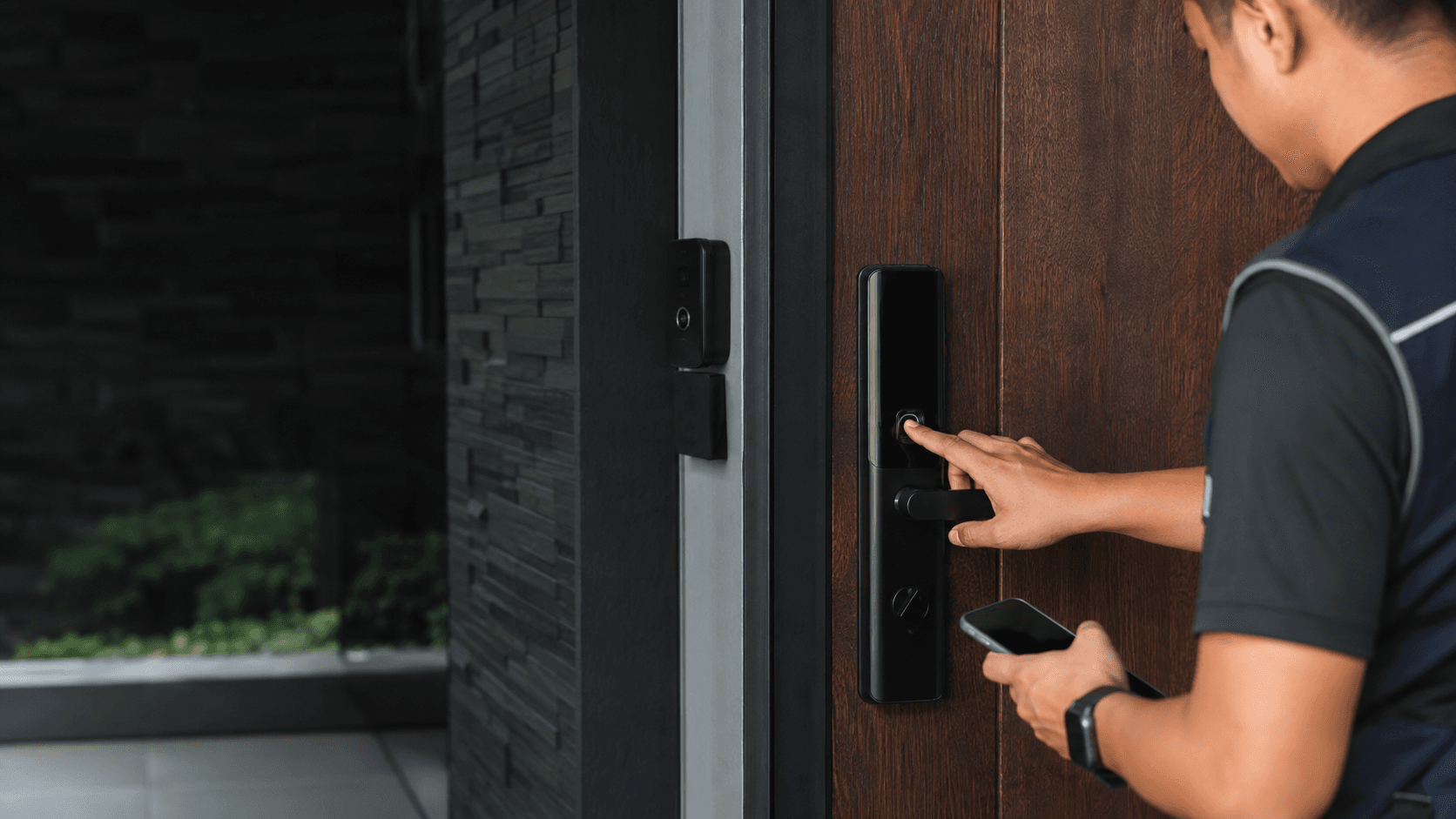
That pairing is the reason this model sits apart from a plain keyless deadbolt. A deadbolt reports whether the bolt was thrown. A door sensor reports whether the door itself is open or closed. Put both on the same entry and the app can distinguish a door that was unlocked and left ajar from one that was unlocked and pushed shut.
Malaysian buyers researching the ultraloq u bolt pro wifi smart lock with door sensor are usually weighing three things at once: what the hardware actually does, whether it fits the door already installed, and whether anyone locally can supply and fit it. This page works through those in order.
What the Ultraloq U Bolt Pro Wifi Smart Lock With Door Sensor combines
The product is a smart deadbolt with built-in Wi-Fi, sold alongside a door sensor. Built-in Wi-Fi matters because it removes the separate bridge that older Ultraloq models needed for remote access. The lock talks to the network directly.
Access is handled through several methods rather than one. Across the published Ultraloq material and independent reviews, the recurring set is:
- Fingerprint read at the lock itself.
- Keypad code entered on the touchpad.
- Mobile app control over Wi-Fi or Bluetooth.
- Auto-unlock triggered by proximity.
- Physical backup key.
- Apple Watch or smartwatch unlock.
Ultraloq's own product pages describe the U-Bolt Pro WiFi as carrying a 360-degree fingerprint reader, remote management, and ANSI Commercial Grade 1 certification. Those are manufacturer claims about the U-Bolt Pro WiFi line. They are not independent test results, and they should be read as the brand's own positioning rather than a verified third-party finding.
The door sensor is the part most buyers under-examine. A sensor is a separate radio device with its own battery and its own mounting position. It is not built into the deadbolt body. That distinction shapes everything about how the system behaves day to day.
How the lock and door sensor work together day to day
The lock and the sensor answer different questions, and the value comes from reading them together.
The deadbolt knows its own state. It knows a valid fingerprint was read at 9:14am, that the bolt retracted, and that it re-extended on the auto-lock timer. What it cannot know is whether the door was actually pushed open or whether someone unlocked it and walked away.
The door sensor knows physical position. Mounted on the frame with a magnet on the door, it reports open and closed. Combined with the lock, the app can show a sequence rather than a single event: code accepted, bolt retracted, door opened, door closed, bolt extended.
That sequence is what makes the combination useful for a few specific situations.
A door that is unlocked but not fully closed is the classic case. Without a sensor, the lock reports a secure state because the bolt is thrown. With a sensor, the open state is visible. For a rented unit, a shop back entrance, or a home where a helper or family member comes and goes, that gap is the practical difference.
Entry records also become more meaningful. An access log that shows only unlock events tells part of the story. An access log that shows unlock plus door-open plus door-close tells whether the entry was actually used and whether it was left open afterwards.
There is a limit worth stating plainly. The sensor reports state, not identity. It cannot tell who opened the door, only that the door moved. Identity still comes from the lock's own credential record. The two data streams are complementary, not interchangeable.
Fitting the Ultraloq U Bolt Pro Wifi Smart Lock With Door Sensor to a Malaysian door
This is where most overseas product research breaks down, because the lock is designed around a North American deadbolt standard and Malaysian doors vary widely.
The lock replaces an existing deadbolt in a standard bore. That means the door needs a deadbolt cross-bore already cut, and the door thickness needs to fall inside the range the lock supports. Ultraloq publishes a thick door kit as a separate accessory, which indicates that standard thickness is not universal and that thicker doors need additional hardware.
Malaysian residential doors commonly fall into a few categories that behave differently:
- Confirm the existing deadbolt bore and backset before ordering anything.
- Measure door thickness at the edge, not at the face.
- Check Wi-Fi signal strength at the door with the door closed.
- Decide who needs a fingerprint, a code, or app access.
- Confirm the physical backup key will be stored somewhere reachable.
- Choose a sensor mounting position that survives the door's swing and frame clearance.
Solid timber doors, metal doors, and hollow-core doors all present different drilling behaviour. A metal door or a door with a metal frame can also interfere with radio signal between the lock and the sensor, and between the lock and the Wi-Fi access point.
Apartment main doors add another constraint. Many are fire-rated and cannot be modified without affecting the rating. A deadbolt swap that requires new boring may not be permitted. In that situation the lock is not a straightforward fit regardless of how well the product performs.
Grille doors and gate-mounted entries are a separate case again. A smart deadbolt is designed for a swinging door leaf, not a sliding grille or a gate. Ultraloq's own use-case list covers front doors, garage entries, side entries, offices, and short-stay rentals. It does not present the lock as a gate solution.
Power, Wi-Fi, and backup entry to plan for
Three dependencies decide whether the lock stays reliable after the first month.
Battery is the first. Ultraloq's product pages quote battery life figures in the range of eight months to about a year depending on model, with the U-Bolt Pro WiFi listed at up to one year. Those are manufacturer estimates under assumed usage. Real life depends on how often the lock is operated, how strong the Wi-Fi signal is, and how much the fingerprint reader is used. A weak signal at the door makes the radio work harder and shortens the interval. The U-Bolt Pro WiFi also carries a MicroUSB backup power point, which allows the lock to be powered temporarily if the batteries are flat.
Wi-Fi is the second. Built-in Wi-Fi removes the bridge, but it does not remove the need for coverage at the door. A door at the far end of a house, behind a metal frame, or on an external wall may sit at the edge of usable signal. Remote unlock and notifications depend on that link holding. If the signal is marginal, the lock still works locally by fingerprint, code, and key, but the remote features become unreliable.
Backup entry is the third, and it is the one that causes the most avoidable problems. The lock ships with a mechanical key. That key needs to live somewhere that is genuinely accessible when the batteries are dead and the phone is flat. A key locked inside the house is not a backup. For a rental unit, the backup key also needs to be somewhere the owner can reach without disturbing the tenant.
Access permissions deserve the same planning. A smart lock with app management lets codes and fingerprints be issued and revoked. For a household that is straightforward. For a business entry, the question of whether a standalone smart lock is the right tool at all is worth asking early. Eyonic's own smart lock review notes that smart locks work best when door condition, user roles, and backup method are reviewed before installation, and that for business use the choice between a standalone smart lock and an access-control panel should be checked first.
What to confirm before ordering the Ultraloq U Bolt Pro Wifi Smart Lock With Door Sensor
Several details about this exact configuration are not settled by the material available, and they should be confirmed with the seller before payment rather than assumed.
Whether the door sensor is bundled with the lock or sold as a separate accessory is the first. The product name implies a combination, but the exact box contents for this model should be confirmed in writing. A lock that arrives without the sensor changes the value of the purchase considerably.
Technical specifications are the second. Door thickness range, bore diameter, backset, battery type, and sensor range are all figures that need to come from the manufacturer's documentation for this specific model. They should not be inferred from a different model in the same series, because the U-Bolt, U-Bolt WiFi, U-Bolt Pro, and U-Bolt Pro WiFi are distinct products with different connectivity and different hardware.
Compatibility with the actual door is the third. A photograph of the door edge, the existing deadbolt, and the frame is usually enough for a supplier or installer to say whether the swap is straightforward or whether additional work is needed.
Warranty and support terms are the fourth. Warranty length, who honours it locally, and what happens if a component fails are all worth having in writing before ordering, particularly for a product sourced from overseas.
Price is the fifth. No verified price for this lock or for installation in Malaysia is available here, so any figure should come from a current local quotation rather than an assumption based on overseas listings.
Where local supply and installation support fit
A smart lock is a small job compared with a full security system, but it is still a job that benefits from someone checking the door before the order is placed.
Eyonic Sdn Bhd is a security system supplier in Sarawak that plans, supplies, and installs monitoring and access systems for homes, offices, shops, and industrial sites. The company's installation process runs through site survey, system proposal, installation, and handover. For a smart lock, the survey stage is where door thickness, bore, frame clearance, and Wi-Fi coverage at the entry get checked, and where the sensor mounting position is decided.
That sequence matters more than it sounds. A lock ordered before the door is measured can end up needing a thick door kit, a new bore, or a different model entirely. Checking first avoids the return.
Eyonic's project work has included the Kuching Immigration Office, where the focus was arrival flow, staff areas, visitor movement, and dependable daily operation, and KTA Sarawak Sdn Bhd, an engineering consultancy office in Kuching where staff movement, visitor handling, and tidy cabling were the priorities. Both are access-and-movement problems rather than lock problems, which is the right frame for deciding whether a single smart deadbolt is sufficient or whether the entry needs something more structured.
For a residential door, the practical path is straightforward. Share the door details, confirm the model and box contents, confirm the sensor is included, and have the fitment checked before installation. For a business entry with multiple staff and visitors, the more useful question is whether a standalone smart lock or an access-control panel suits the traffic, and that is worth settling before any hardware is ordered.
Share your location, property type and required system with Eyonic on WhatsApp at +60 11-5111 7959 for the next practical step.