
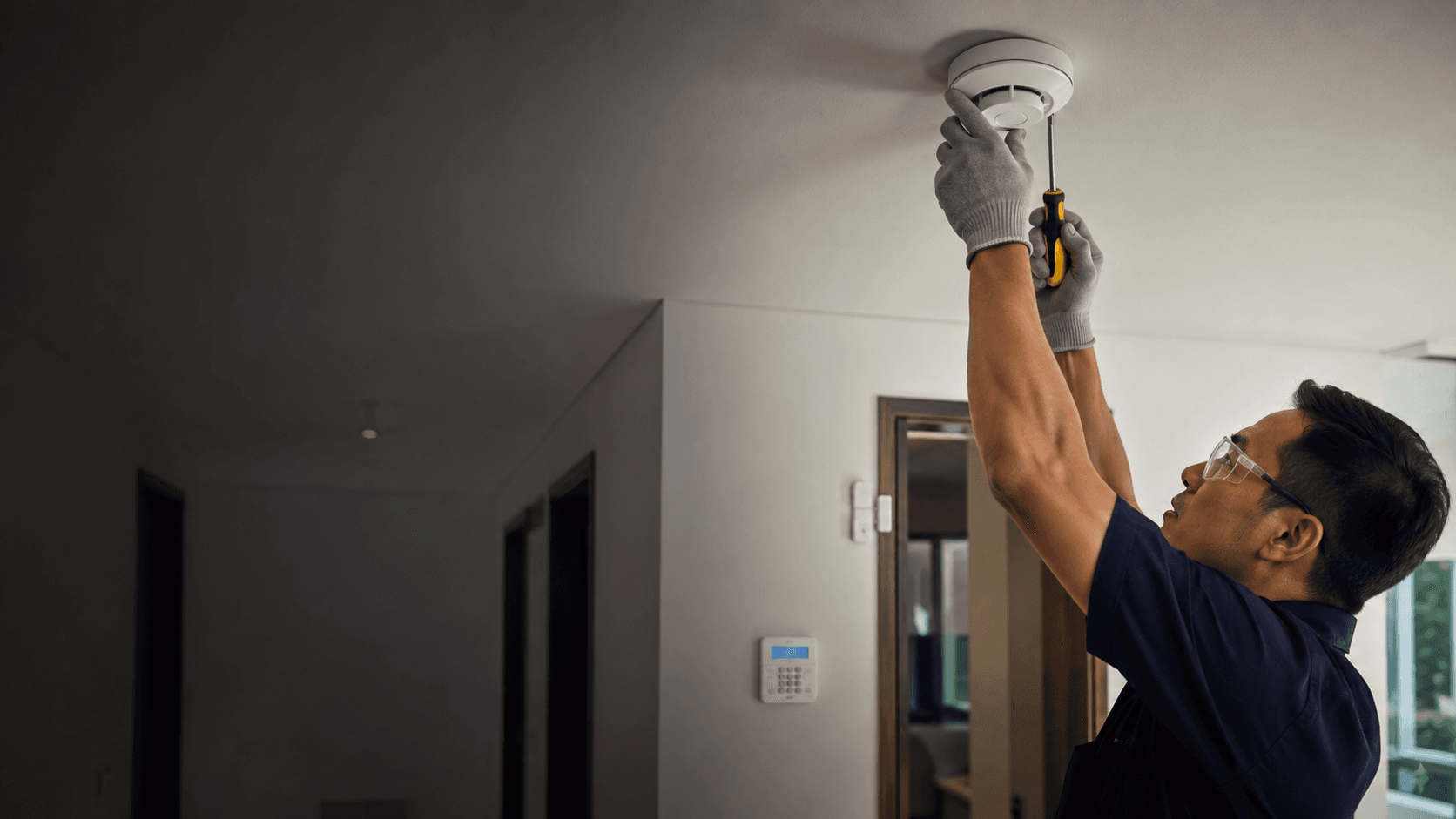
The exact-match query "driveway alarm with camera" describes a specific category: detection hardware that watches an entry point and a camera that shows what triggered the alert. Most buyers arrive at this query after a delivery went unnoticed, a gate opened without explanation, or a vehicle turned into the driveway after dark. The decision is rarely about the camera alone. It is about how detection, recording, alerting and gate control fit together on one property.
Driveway Alarm With Camera. What Matters Before Choosing
Three things decide whether a driveway setup works in practice: what the sensor actually detects, whether the camera can see that spot at night, and how the alert reaches a person inside the house or office.
Detection type matters more than camera resolution. A passive infrared sensor reacts to heat and movement, so it can trigger on people, animals and vehicles. An electromagnetic probe buried beside the driveway reacts to moving metal, so it mostly ignores pedestrians and weather. Beam sensors watch a line across the driveway and trigger when that line breaks. Each type produces a different false-alarm profile, and the wrong choice creates nuisance alerts that lead to the system being switched off.
Camera placement then has to match the detection zone. A camera aimed at the road instead of the driveway captures passing traffic rather than arrivals. A camera mounted too high loses facial detail at the gate. A camera facing the morning sun produces glare at exactly the hour when most departures happen.
Eyonic's installation process begins with a site survey and a system proposal before any hardware is fitted, which is where detection type, camera angle and cabling routes get settled. The same sequence applies to CCTV installation work in Sarawak, and it exists because driveway geometry varies far more than product catalogues suggest.
Choosing the Right Driveway Alarm With Camera
A practical selection sequence runs from the physical driveway outward to the alerting method, not from the product listing inward.
- Measure the distance from the detection point to the indoor receiver or router, and note whether any wall, gate or tree sits in that path.
- Decide what should trigger an alert: vehicles only, people only, or anything that crosses the driveway line.
- Check the actual lighting at the detection point after dark, including whether a porch light, street light or gate lamp already covers it.
- Confirm how the alert should arrive: an indoor chime, a phone notification, a recorded clip, or a combination.
- Confirm whether the camera needs to record continuously or only when the alarm triggers.
- Check whether the driveway has a gate or autogate that should respond to the same event.
- Confirm power availability at the detection point, or plan for battery or solar operation.
- Confirm who reviews footage and how long it is kept.
Eyonic's own guidance on ColorVu-style cameras is to check actual lighting conditions before confirming placement, because low-light performance claims and real night-time results diverge on many driveways. That check belongs at step three, before hardware is ordered.
What is a driveway alarm with camera?
It is a detection system paired with a camera at the same location. The detector decides when something has happened; the camera provides the visual record of what it was. Some products integrate both into one housing, and some pair a separate sensor with an existing CCTV camera on the same network. The integrated version is simpler to install. The separate version usually allows a better camera position, because the best detection point and the best viewing angle are often a few metres apart.
Wireless and wired options
Wireless driveway alarms avoid trenching across a driveway, which matters on paved or concreted surfaces where cutting is expensive and disruptive. The trade-off is range and interference: wireless range figures are quoted for open air, and walls, metal gates and dense planting reduce them. Wired systems are more reliable over distance but require a cable route, which is usually planned during the site survey rather than after installation.
Camera type and night performance
Resolution determines how much detail survives when a clip is reviewed later. A 2MP camera can identify a person at close range in good light; a higher-resolution camera holds more detail at the same distance. Night performance depends on available light and on whether the camera uses infrared or full-colour low-light technology. Full-colour night imaging needs some ambient light to work as intended, which is why the lighting check comes before placement.
Practical Considerations for Driveway Alarm With Camera
Several constraints appear repeatedly on real properties, and they are worth resolving before purchase rather than after.
False alerts. Moving foliage, heavy rain, insects near the lens and small animals all trigger motion-based detection. Narrowing the detection zone, lowering sensitivity, or switching to vehicle-specific detection reduces this. A system that alerts constantly stops being useful within a week.
Notification delay. A phone alert travels through the sensor, the hub, the network and the phone. On a slow connection the delay can be long enough that the visitor has already left. An indoor chime at the same time as the phone alert covers that gap.
Storage and retention. Local recording on a recorder keeps footage on the property and avoids subscription costs. Cloud recording survives theft of the recorder but usually carries an ongoing fee. The choice affects both budget and how long footage remains available after an incident.
Power at the detection point. Driveway sensors are often far from any power outlet. Battery and solar options remove the cabling problem but introduce battery replacement or charging into routine maintenance.
Integration with gates and alarms. A driveway event can trigger a gate, a siren, a light or a recording. Eyonic supplies and installs alarm systems, autogate systems and CCTV in Sarawak, so these functions can be planned as one system rather than three separate purchases with three separate apps.
Property type. A single-car driveway on a terraced house needs a different configuration from a long rural approach road. Long approaches usually need detection at the perimeter and a camera with enough resolution to identify a vehicle at that distance, which is a different product class from a short urban driveway.
What a costs
Eyonic's published package pricing is RM 1,599 for a Hikvision CCTV package covering camera supply and setup, basic recording configuration and mobile viewing handover; RM 1,599 for a Hikvision alarm system covering control panel and sensors, siren and zone setup, and user testing and handover; and RM 1,599 for an autogate package covering motor recommendation, remote-control setup and safety testing. A driveway setup that combines detection, camera coverage and gate control therefore spans more than one package, and the final scope depends on the site survey.
Larger projects sit in a different range. Eyonic's Kuching Immigration Office project, which covered arrival flow, staff areas, visitor movement and dependable daily operation, had an approximate budget of RM 12,000 to RM 28,000. The KTA Sarawak Sdn Bhd project, covering staff movement, visitor handling, tidy cabling and clearer daily site control, had an approximate budget of RM 8,000 to RM 18,000. Both are commercial office scopes rather than single driveways, and they show how much the total moves once multiple zones, cabling and handover are included.
Where a fits and where it does not
It fits properties where arrivals matter: homes with regular deliveries, premises with a gate that staff open manually, and sites where knowing that a vehicle has entered is more useful than reviewing footage hours later. It also fits rural properties where the approach is long and the house cannot see the road.
It fits less well where the driveway is shared with public traffic, where the detection point is beyond reliable wireless range without a repeater, or where nobody is available to respond to an alert. In those cases a recording-only camera system is often the more honest purchase, because the value comes from the record rather than the alert.
Installation and handover
Eyonic's process runs through site survey, system proposal, installation and handover. Handover is where the practical details get settled: which app shows the camera, which chime sounds for the driveway zone, how to review a clip, and what to do when an alert arrives while nobody is home. A system that is installed but not understood tends to be used less than it should be.
Making an Informed Choice About
The decision comes down to four questions with concrete answers. What should trigger an alert, and what should be ignored? Where is the best detection point, and can a camera see it clearly at night? How should the alert arrive, and how quickly? What happens to the footage afterwards?
Answering those four before choosing hardware avoids the most common failure: a system that detects everything, records everything and is trusted by nobody. Detection type, camera placement, alerting method and storage are the four levers, and they interact. A vehicle-specific probe paired with a well-placed camera and an indoor chime will outperform a higher-resolution camera aimed at the wrong spot.
For properties in Sarawak, the practical next step is a site assessment that covers driveway geometry, lighting after dark, power availability and how the driveway relates to the gate, the house and any existing alarm or CCTV equipment. Eyonic's founder Eric Yong has worked in technical installation of digital security solutions for commercial businesses in Sarawak for more than ten years, and the site survey exists precisely because those four variables differ on every property.
Share the location, property type and required system with Eyonic on WhatsApp at +60 11-5111 7959 for the next practical step.