
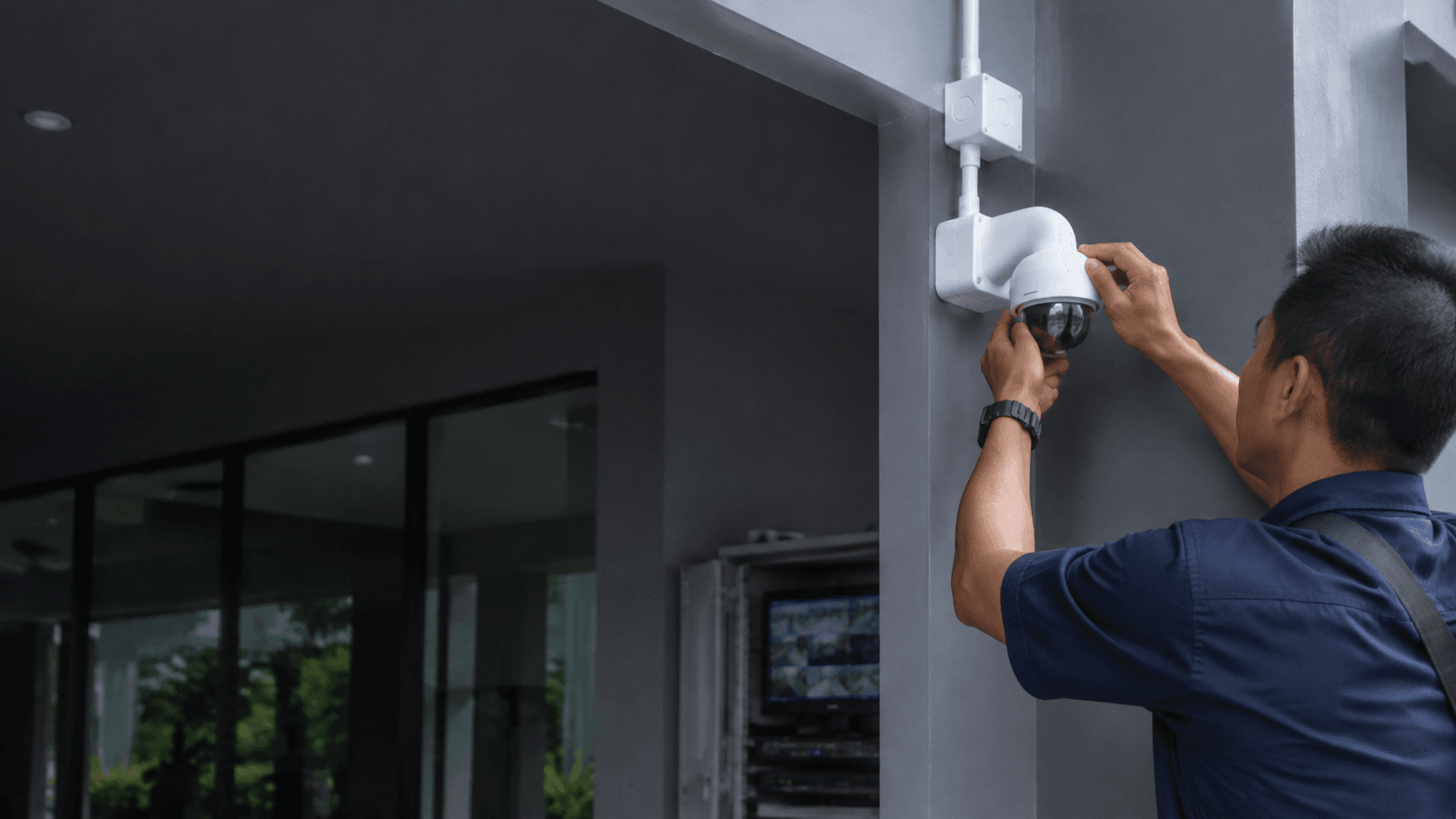
The front door is the busiest threshold on most Malaysian properties. Deliveries arrive, guests wait, family members leave and return, and strangers occasionally test a gate. A camera for front door duty has to work in that specific spot, not in a showroom. Eyonic Sdn Bhd, a security system supplier in Sarawak, plans, supplies and installs monitoring systems with camera placement, recording and remote viewing for homes, offices, shops and industrial sites.
Most published material on this topic is a product roundup. Across nine analysed pages, doorbell and video doorbell coverage dominates, with a median word count above 3,000 and a median heading count above 50. Only two of those pages used the exact phrase camera for front door at all. That leaves a gap for planning guidance rather than another list of devices.
Camera For Front Door. What the Setup Actually Involves
A front-door camera setup is a sequence of decisions about position, light, recording and viewing, made before any hardware is fixed to a wall. The order matters because a camera chosen first and positioned second usually ends up watching the wrong thing.
- Confirm the approach path — where a visitor actually walks, stands and waits before the door opens.
- Check lighting at the door at the hours that matter, including after dark and under porch or corridor light.
- Choose mounting height and angle so the face is captured before the person reaches the door.
- Confirm recording and storage — what is recorded, where it is kept, and for how long.
- Test remote viewing on the phone that will actually be used, from inside the property and away from it.
Eyonic's CCTV installation process follows a comparable shape: site survey, system proposal, installation, and handover. The survey stage is where the first three items above get settled, because the answers depend on the property rather than the catalogue.
Why the front door is the hardest camera position on most properties
Three conditions make the entrance awkward. The first is backlight. A camera facing outward from above a door looks toward the street, and in the late afternoon that means looking into the sun or into a bright sky while the visitor's face sits in shadow. The second is the approach angle. A camera mounted directly above the door sees the top of a head and a shoulder, not a face, because the person is already too close by the time they are in frame. The third is mixed lighting. A porch lamp, a corridor fluorescent, a gate light and a street lamp can all fall inside the same frame, and each one changes how the image is exposed.
These are placement problems, not resolution problems. A higher-specification camera in the wrong position still produces an unhelpful image, while a modest camera in the right position often produces a usable one.
What the Kuching Immigration Office project shows about entrance coverage
Eyonic completed a project for the Kuching Immigration Office focused on arrival flow, staff areas, visitor movement and dependable daily operation. The useful lesson for a home entrance is the framing: arrival flow and visitor movement were treated as things to be covered deliberately, not as a by-product of pointing a camera at a doorway. The approximate budget for that type of work was RM 12,000 to RM 28,000, which reflects a multi-camera public-office scope rather than a single residential entrance.
Camera For Front Door placement. height, angle and the approach path
Placement should follow the path a visitor takes, not the position of the door frame. Walk the approach from the street or gate to the door and note where a person pauses, where they turn, and where they wait after knocking or ringing.
A camera positioned to capture that pause point will usually record a face. A camera positioned to look straight down at the threshold will usually record a scalp. Where the door sits under a deep porch or recess, the camera often needs to sit slightly to one side and angled across the approach rather than centred above the door.
Height is a trade-off. Mounting higher reduces the chance of tampering and widens the view, but it also increases the downward angle and shortens the distance at which a face is still recognisable. Mounting lower captures faces better but puts the unit within easy reach. There is no single correct figure, because the answer depends on the length of the approach, the height of the gate, and whether the entrance is recessed or open.
Two edge cases are worth planning for. A long driveway means the camera may need to cover the gate as well as the door, which is usually two positions rather than one. A shared corridor or apartment entrance means the camera may be looking at common property, which changes what can reasonably be recorded and who needs to agree to it.
Lighting checks before confirming a camera for front door position
Lighting is the check most often skipped, and it is the one that decides whether night recording is useful. Eyonic recommends checking actual lighting conditions before confirming placement for ColorVu-style cameras, because the performance of a low-light camera depends on what light is genuinely present at the door rather than what the specification suggests.
The practical check is to stand at the intended camera position after dark and look at the entrance. If the visitor's face is lit by an existing lamp, the position is promising. If the face is in shadow while the background is bright, the camera will expose for the background and the face will stay dark. Adding or repositioning a light at the door is often more effective than changing the camera.
Two constraints are worth naming. A camera that relies on its own visible light source may be noticeable at night, which some households want and others do not. A camera that relies on an existing lamp may lose that advantage if the lamp is switched off, on a timer, or replaced with a different fitting. Both are reasons to confirm the lighting arrangement rather than assume it.
Recording, storage and remote viewing in daily use
Recording setup determines what is available after an incident. The two questions that matter are where footage is stored and how long it is kept. Local recording on a recorder keeps footage on the property and does not depend on an internet connection, but it can be lost if the unit itself is taken. Cloud or app-based storage keeps footage off-site but depends on a working connection and, in many cases, an ongoing subscription.
Remote viewing is the feature most likely to disappoint if it is not tested properly. The test is not whether the app opens at home on the same network. The test is whether live view and playback load on the phone that will actually be used, from outside the property, on mobile data. A weak upload speed at the property will limit remote viewing regardless of the camera.
Storage duration is a sizing decision rather than a fixed number. A busy entrance with frequent movement generates more recorded events than a quiet one, and the retention period that is useful depends on how quickly a household would notice a problem. This is worth deciding before installation rather than after the recorder fills.
planning steps before installation
The planning sequence below is the one that prevents most rework. It also matches the survey-first approach Eyonic uses, where the site is reviewed before a system is proposed.
- Walk the approach path at the times of day that matter and note where visitors pause.
- Check the lighting at the door after dark, including which lamps are actually switched on.
- Decide the mounting position and angle, accepting the trade-off between height and face capture.
- Confirm recording and storage, including where footage lives and how long it is kept.
- Test remote viewing from outside the property on the phone that will be used day to day.
Two further points sit outside the sequence. Cabling and power need to be confirmed before a position is finalised, because a position with no practical route for cable or power is not a real option. And where a camera covers an area shared with neighbours or the public, the scope of recording is worth agreeing in advance rather than discovering afterwards.
For households in Sarawak comparing options, the practical next step is to share the location, property type and required system with Eyonic on WhatsApp at +60 11-5111 7959. A survey-based proposal follows from that, which is a more reliable basis for a decision than a specification sheet.