
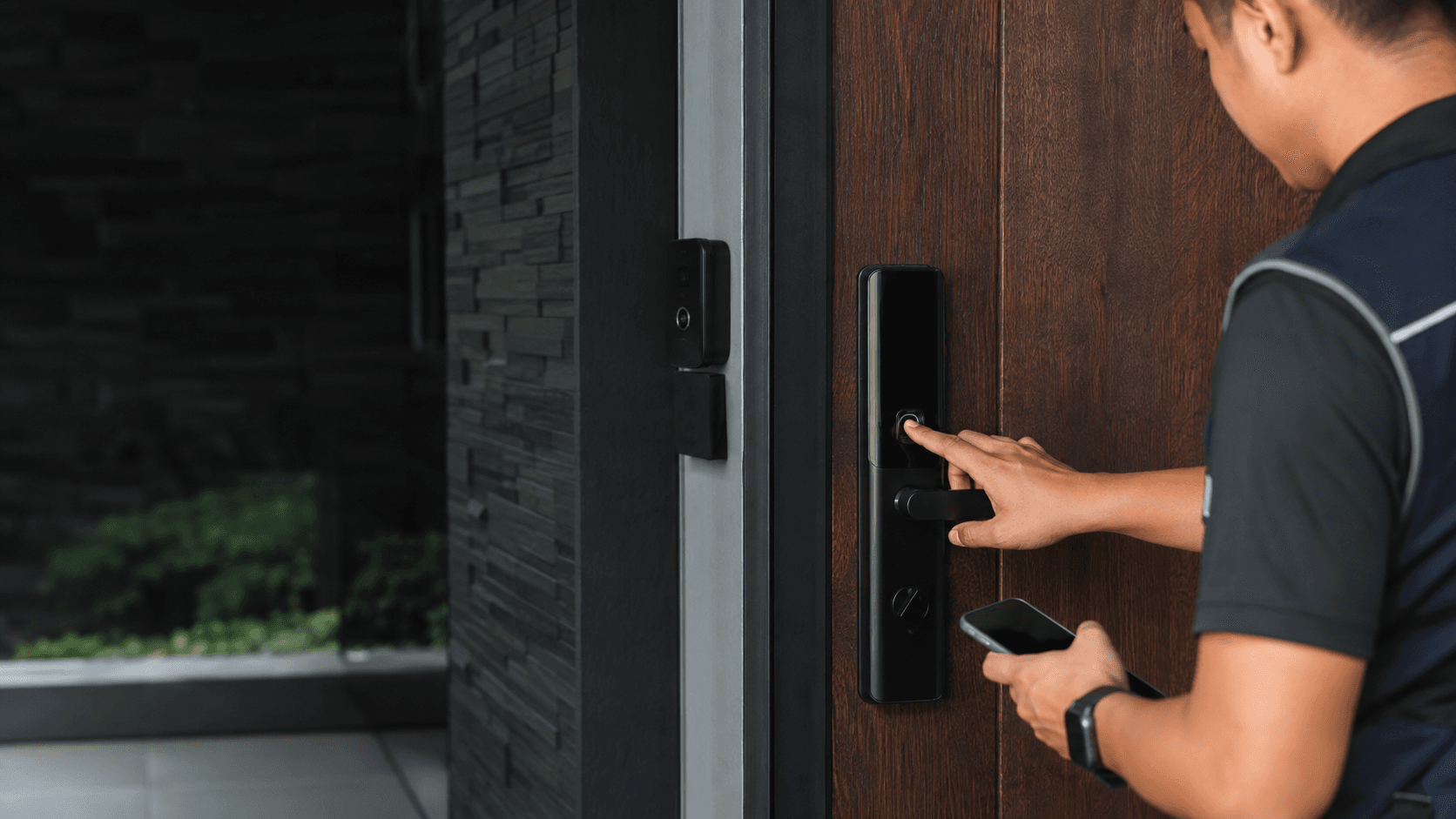
The exact-match query wifi magnetic door lock describes a system rather than a single product. The magnet holds the door shut while power flows, and the WiFi module decides when that power stops. Competitor listings in this space commonly describe kits built around 400 lb, 600 lb, and 1200 lb holding force magnets, paired with a receiver, remote, keypad, or app module. Those figures come from the competitor pages reviewed for this topic, not from a single manufacturer standard.
Wifi Magnetic Door Lock. What Matters Before Choosing
Four decisions shape whether a wifi magnetic door lock works in daily use: how the door is built, how the lock behaves when power fails, who needs entry, and what happens when the network drops.
- Check the door and frame. A surface-mounted magnetic lock needs a solid header and a door that closes flush against the magnet face.
- Confirm the holding force suits the opening. Lighter interior doors and heavier external or high-traffic doors call for different magnet ratings.
- Decide fail-safe or fail-secure behaviour. Most electromagnetic locks release when power is cut, which matters for fire escape routes.
- Plan the entry methods. App control, wireless remote, keypad, RFID card, and exit button are separate components that must be wired together.
- Plan the backup path. A lock that depends on WiFi alone leaves no way in during an outage unless a mechanical or manual release exists.
- Confirm power supply and wiring route before installation, since the magnet, receiver, and controller each need a stable supply.
Eyonic's own product review notes that smart locks work best when door condition, user roles, and backup method are reviewed before installation, and that business use often requires checking whether a standalone smart lock or an access-control panel is more appropriate. That same logic applies to a wifi magnetic door lock, because the magnet is only one part of the assembly.
What Is a Wifi Magnetic Door Lock?
A wifi magnetic door lock is an access-control assembly in which an electromagnet holds a door closed and a WiFi-connected module controls the current that keeps the magnet energised. When the module receives an unlock command, power to the magnet stops and the door can be pushed open.
The magnet itself is simple. An electromagnet bonded to the door frame meets a metal armature plate fixed to the door. While current flows, the two faces hold together with a rated force. Cut the current and the door releases immediately. The WiFi layer sits upstream of that circuit, usually as a receiver or controller that accepts commands from a phone app, a wireless remote, or a scheduled rule.
This is why the phrase covers so much ground. A kit sold as a wifi magnetic door lock may include a 400 lb magnet, a 2.4GHz WiFi receiver, a power adapter, an exit button, and a remote. A larger kit may use a 600 lb or 1200 lb magnet with a keypad, proximity cards, and a motion sensor for request-to-exit. The magnet rating and the control hardware are chosen separately, then combined.
How the unlock path works
An unlock command travels from the app or remote to the WiFi module, which switches the relay feeding the magnet. Power drops, the armature releases, and the door opens. Most kits also include a wired exit button inside the secure side so someone leaving does not need a phone. Some include a motion sensor that triggers release as a person approaches from inside.
Why the magnet rating is not the whole story
Holding force describes how much pull the magnet resists, not how secure the opening is overall. A door with a weak frame, a poor seal, or an exposed hinge side can be defeated regardless of magnet rating. The competitor kits reviewed here range from 400 lb to 1200 lb, and the higher ratings appear on kits intended for heavier or external doors.
Choosing the Right Wifi Magnetic Door Lock
Selection comes down to matching the magnet, the control method, and the failure behaviour to the actual door and the people who use it.
| Configuration | Holding force | Entry methods | Best fit |
|---|---|---|---|
| Basic app and remote kit | 400 lb | Smartphone app, wireless remote, exit button | Interior office or storeroom door with light traffic |
| Keypad and RFID kit | 400 lb | App, outdoor keypad, RFID reader, touchless switch | Outdoor or staff entrance where not everyone carries a phone |
| Higher-force kit | 600 lb | App, remote, keypad, proximity cards | Heavier door or busier entry point |
| Heavy-duty kit | 1200 lb | App, remote, keypad, proximity cards, motion sensor | External or high-security door needing stronger holding force |
Two trade-offs appear repeatedly across these listings. Higher holding force usually means a larger, heavier magnet that needs more mounting support. More entry methods mean more wiring and more components that can fail independently, so a kit with app, keypad, RFID, and remote has more to maintain than a kit with an app and a button.
Fail-safe behaviour and escape routes
Electromagnetic locks are typically fail-safe: they release when power is lost. That is an advantage on an escape route, because a power cut or fire alarm does not trap anyone inside. It is a disadvantage where the door must stay locked during an outage, because the door becomes open unless a separate mechanical lock or battery backup is fitted. This is a design decision, not a product feature, and it should be settled before purchase.
Network dependence and backup entry
A wifi magnetic door lock that relies on WiFi for every unlock has a single point of failure. If the router, the internet connection, or the module goes down, app control stops working. Kits that include a wireless remote, keypad, or wired exit button keep the door usable in that situation. Eyonic's review guidance on smart locks makes the same point in different words: user permissions and backup entry need to be planned properly, not added afterwards.
Practical Considerations for Installation
Installation quality decides whether the system lasts. The magnet must sit square to the armature plate, the door must close fully against it, and the wiring must reach both the magnet and the controller without strain.
Power is the most common constraint. The magnet, the WiFi module, and any keypad or reader each draw current, and they are usually fed from a single supply near the door. If the supply is undersized or the cable run is long, the magnet may hold weakly or the module may reset. Checking the supply rating against the combined load before installation avoids most of these problems.
Door condition matters as much as the electronics. A warped door, a loose frame, or a gap at the magnet face reduces holding force no matter what the rating says. Eyonic's approach to security work begins with a site survey and a system proposal before installation, which is the same sequence that suits a magnetic lock: confirm the opening, confirm the power route, then specify the hardware.
For sites in Sarawak, humidity and outdoor exposure are worth planning for. Kits intended for outdoor use are described as such in competitor listings, and an indoor-rated magnet fitted to an exposed gate will not perform the same way. Eyonic's completed work at the Kuching Immigration Office focused on arrival flow, staff areas, visitor movement, and dependable daily operation, which reflects the kind of planning that access control on a busy public entrance requires.
Where a fits well
It suits doors that need controlled convenience rather than heavy physical security: office internal doors, staff entrances, storerooms, and gates where the main goal is knowing who enters and being able to release the door remotely. It also suits sites where running a card reader to every door is impractical but a phone-based release is useful.
Where it fits poorly
It is a weak choice for a main entrance that must stay locked during a power cut, for a door with a poor frame or a large gap, or for a site with unreliable WiFi and no alternative entry method. In those cases a standalone smart lock or a wired access-control panel may be the better fit, which is the comparison Eyonic's own review guidance recommends for business use.
Making an Informed Choice About
The decision sequence is short. Confirm the door can take a surface-mounted magnet. Choose a holding force that matches the door weight and traffic. Decide whether fail-safe release is acceptable for that opening. Pick the entry methods that match the people using the door. Then confirm the power supply and the backup path before anything is ordered.
Buying a kit online is straightforward, but the kit is only the hardware. The parts that determine whether a wifi magnetic door lock works day to day are the door condition, the wiring, the power supply, and the fallback when the network is unavailable. A site survey and a written proposal before installation resolve those questions while they are still cheap to change.
For properties in Sarawak, Eyonic Sdn Bhd plans, supplies, and installs security and ELV systems, including access control and smart lock work, with a process built around site survey, system proposal, installation, and handover. Share your location, property type and required system with Eyonic on WhatsApp at +60 11-5111 7959 for the next practical step.