
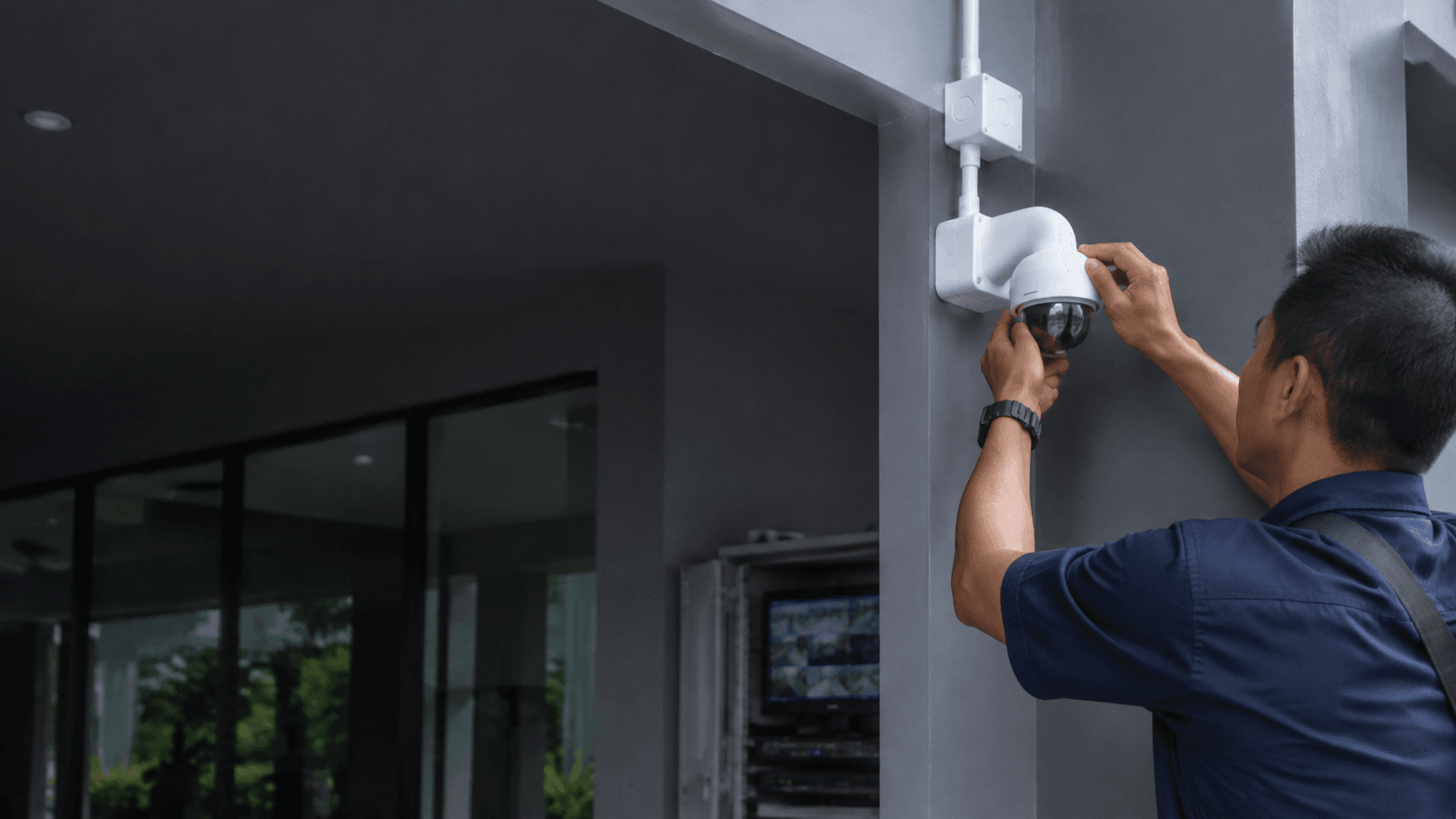
The device itself is a small camera and speaker unit mounted where a doorbell normally sits. It shows who is at the entrance, lets a household or staff member speak to a visitor, and records what happens at the front door. That combination is what separates it from a plain chime.
Most of the buying advice online comes from American review sites that rank models by resolution, subscription tiers and app ecosystems. Those details matter, but they are not the whole decision for a Malaysian property. What usually decides whether a smart home video doorbell works well is the entrance itself: where the camera can actually see, how the unit gets power, how it connects to the rest of the security setup, and who installs and hands it over.
Smart Home Video Doorbell. What It Does at the Front Door
A smart home video doorbell covers the gap between a doorbell and a camera. A conventional doorbell tells someone inside that a visitor has arrived. A video doorbell shows that visitor, carries a conversation, and keeps a record.
Three functions do most of the work:
- Seeing the entrance. The camera faces the approach path, so a visitor, a delivery or a vehicle is visible before the door opens.
- Speaking to the visitor. Two-way audio allows a short exchange without walking to the door.
- Recording and remote viewing. Footage can be reviewed later, and live or recorded views can be checked from a phone.
Those three functions map onto the everyday events at a Malaysian entrance: a delivery rider leaving a package, a visitor arriving unannounced, a family member coming home late, or staff at a shop front watching who walks in. The value is not the gadget. It is having a clear view and a record of the entrance at the moments that matter.
One limit is worth stating plainly. A doorbell camera sees a narrow slice of the property. It covers the door and the immediate approach, not a gate, a car porch, a side lane or a back entrance. Where those areas matter, the doorbell is a supplement to wider camera coverage rather than a replacement for it.
How a Smart Home Video Doorbell Fits an Existing Security Setup
A doorbell camera rarely stands alone. It usually joins a CCTV system, an alarm system, an intercom or an autogate, and the fit between them decides how useful the whole setup becomes.
Eyonic plans, supplies and installs monitoring systems with camera placement, recording and remote viewing for homes, offices, shops and industrial sites. That scope is the natural home for a doorbell camera, because the same recording and remote-viewing decisions apply.
Where the doorbell sits in the wider system
Think of the entrance as one zone among several. A gate camera watches the road and the driveway. A doorbell camera watches the door and the person standing at it. An alarm system covers intrusion at doors and windows. An intercom handles unit-to-unit or gate-to-house communication. An autogate controls vehicle entry.
When these are planned together, the entrance zone gets consistent recording and one place to review footage. When they are bought separately, the result is often several apps, several recordings and no single view of what happened.
What integration actually requires
Integration is mostly about three practical questions. Does the doorbell record to the same recorder as the other cameras, or to its own storage? Does remote viewing happen in one app or several? Does the entrance camera share power and cabling routes with nearby equipment, or does it need its own supply?
Answers depend on the property, not on a product list. A terrace house with an existing recorder has different options from a shop lot with no cabling at all. This is why a survey comes before a proposal rather than after.
Lighting at the entrance
Eyonic recommends checking actual lighting conditions before confirming placement for ColorVu-style cameras. The same discipline applies at a door. A porch light that stays on all night, a covered walkway, a reflective wall and a dark recess all change what a camera can see. Placement should follow the real light at the entrance, not an assumption about it.
What to Check Before Choosing a Smart Home Video Doorbell
Most published comparisons focus on resolution, field of view, night vision, storage and subscriptions. Those are legitimate considerations, and they are also the areas where a buyer can be misled by a specification sheet that says nothing about the actual entrance.
Four checks matter more than any single number.
- Site survey. Confirm where the camera can be mounted, what it will see, how it will be powered and how it will connect.
- System proposal. Match the doorbell to the existing or planned recording, alarm, intercom and gate equipment rather than treating it as a standalone purchase.
- Installation. Mount, wire, configure recording and set up remote viewing so the entrance zone behaves like the rest of the system.
- Handover. Walk through live view, playback, alerts and everyday use so the people who rely on it know how it works.
That sequence is the same one Eyonic uses for CCTV installation work in Sarawak, and it exists because the failure mode is predictable: a device that is mounted correctly but configured badly, or configured well but placed where it cannot see.
Power and wiring
Doorbell cameras generally fall into wired and battery categories, and the choice affects installation more than it affects picture quality. A wired unit needs a suitable supply at the door. A battery unit avoids that constraint but introduces charging or replacement into the routine. Neither is automatically better; the entrance decides.
Storage and subscriptions
Recording can sit on a local recorder or in a cloud service, and cloud services commonly involve a recurring fee. Local recording keeps footage on equipment at the property. Cloud recording is easier to reach remotely but depends on the service and its terms. The right answer depends on how long footage needs to be kept and who needs to see it.
Evidence and Practical Fit
Remote viewing depends on a working internet connection at the property. Where the connection is weak or intermittent, remote viewing degrades even if the camera itself is fine. This is worth confirming during the survey rather than discovering after installation.
Property constraints
Rented premises, shared entrances and stratified properties can restrict what may be mounted and where. Those constraints are property-specific, and they are best settled before any drilling or cabling begins.
Installation and Handover in Sarawak
Eyonic Sdn Bhd is a security system supplier in Sarawak, Malaysia, specialising in CCTV and ELV systems, with planning, supply and installation for homes, offices, shops and industrial sites. The founder, Eric Yong, has been in the industry for more than 10 years and works on technical installation of digital security solutions for commercial businesses in Sarawak.
Entrance coverage is not a new problem in that work. Eyonic completed a project for the Kuching Immigration Office focused on arrival flow, staff areas, visitor movement and dependable daily operation. A doorbell camera addresses a smaller version of the same question: who is arriving, and is there a reliable record of it.
A second project, for KTA Sarawak Sdn Bhd, involved a practical office setup in Kuching to support staff movement, visitor handling, tidy cabling and clearer daily site control. Visitor handling and tidy cabling are exactly the two things that decide whether an entrance camera looks deliberate or improvised.
For a residential property, the same logic applies at a smaller scale. The entrance is the busiest point of arrival, and it is also the point where cabling is most visible and most likely to be done badly.
Costs Packages and Practical Budget Ranges
Eyonic publishes three packages at RM 1,599 each. The Hikvision CCTV Package covers camera supply and setup, basic recording configuration and mobile viewing handover. The Hikvision Alarm System covers a control panel and sensors, siren and zone setup, and user testing and handover. The Autogate Package covers motor recommendation, remote-control setup, and safety testing and handover.
Those packages describe the shape of the work rather than a doorbell price. A doorbell camera is usually part of a broader entrance or monitoring scope, so the relevant figure is the project budget, not a single device price.
For larger scopes, published project budgets give a sense of scale. The Kuching Immigration Office project sits in an approximate budget range of RM 12,000 to RM 28,000. The KTA Sarawak Sdn Bhd project sits in an approximate range of RM 8,000 to RM 18,000. Both are commercial office scopes rather than single-door residential work, and both include more than one zone of coverage.
Three practical cost drivers apply to any entrance camera project. The first is whether cabling already exists at the door. The second is whether the doorbell must integrate with an existing recorder, alarm or intercom. The third is how many zones the property needs covered, since a doorbell alone rarely satisfies a whole property.
Common Questions About Planning
Is a enough on its own
For a single entrance with no other coverage, it can be the starting point. For a property with a gate, a car porch or a back entrance, it covers only the door and the immediate approach. Wider coverage needs additional cameras.
Wired or battery
Wired units need a suitable supply at the door and avoid routine charging. Battery units avoid the wiring constraint but add maintenance. The entrance and its existing wiring decide which is practical.
Does it need a subscription
Only if recording is kept in a cloud service that charges a recurring fee. Local recording avoids that recurring cost but keeps footage on equipment at the property.
Can it work with an existing CCTV system
Often, but it depends on the recorder and how the system was built. This is one of the questions a site survey answers before any equipment is proposed.
What happens at handover
Handover covers live view, playback, alerts and everyday use, so the people relying on the entrance camera can operate it without guesswork. Eyonic applies the same handover step across its CCTV, alarm and autogate packages.
For a property in Sarawak, the practical next step is to share the location, property type and required system with Eyonic on WhatsApp at +60 11-5111 7959.