
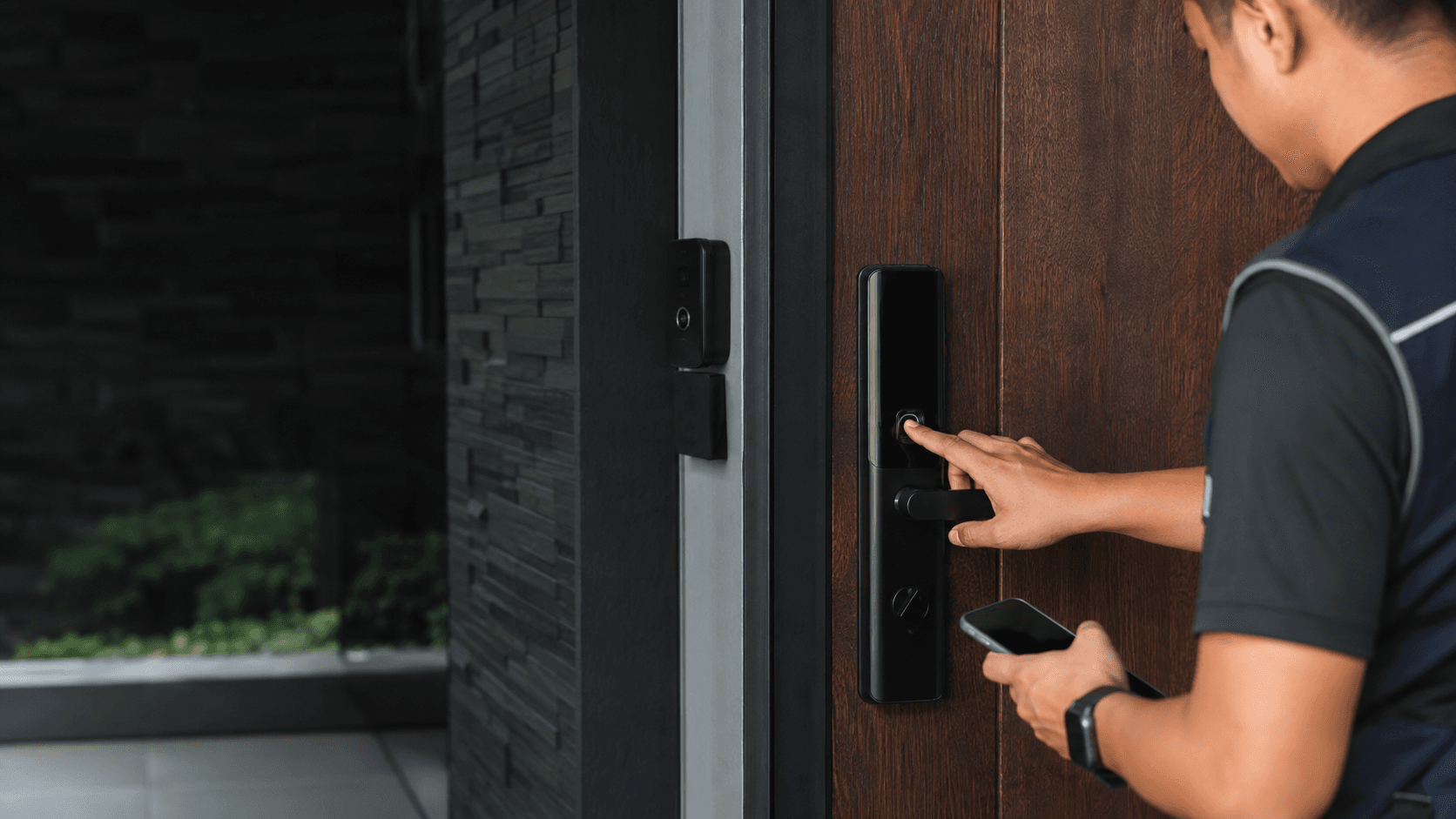
The exact-match query storefront smart lock describes a narrow category of hardware: locks built for commercial glass entrances rather than residential timber doors. The distinction matters because the door, not the lock, usually decides what fits.
Storefront Smart Lock. What Matters Before Choosing
Most storefront doors in Malaysia are aluminum narrow-stile frames holding tempered glass. The lock sits inside a shallow pocket cut into that narrow frame, which leaves very little room for electronics, batteries, and a motor. That single constraint explains why so many residential smart locks cannot be fitted to a shoplot entrance without fabrication work.
Eyonic's own product review notes that smart locks work best when door condition, user roles, and backup method are reviewed before installation. For business use, the same review states that Eyonic usually checks whether a standalone smart lock or an access-control panel is more appropriate. That check is the practical starting point, because a shop with one staff entrance and a shop with twenty shift workers need different answers.
A short decision sequence keeps the evaluation grounded:
- Confirm the door type and frame width, since narrow-stile aluminum limits which lock bodies fit.
- Measure the existing lock pocket, backset, and bolt throw against the replacement's published dimensions.
- List who needs entry and at what times, separating staff, management, and occasional visitors.
- Decide the backup entry method before installation, not after a battery or network failure.
- Choose between a standalone smart lock and a wider access-control panel based on user count and audit needs.
- Verify power, wiring, and network reach at the door position during a site survey.
What Is a Storefront Smart Lock?
A storefront smart lock is a locking device for a commercial glass entrance that accepts a digital credential instead of, or alongside, a physical key. Credentials commonly take the form of a keypad code, a card, a fingerprint, or a mobile app command. The lock still performs the mechanical job of the hardware it replaces: it throws or retracts a latch, deadlatch, or deadbolt inside the door frame.
Two broad families exist. Replacement-mechanism locks drop into the existing mortise pocket and reuse the original door preparation. Add-on and panel-based systems mount additional hardware at the door and are managed through a separate controller. The first suits a single entrance with modest user counts; the second suits multi-door sites where access rights must be changed centrally.
Competitor listings in this category show how much the hardware varies. Published product names reference Adams Rite MS1850S replacement bodies, hook bolts, deadlatches, deadbolts, and mortise cylinders, and several listings describe drill-free installation as a selling point. Those names are useful vocabulary when describing an existing lock to a supplier, because the original lock body often determines the replacement.
Choosing the Right Storefront Smart Lock
The choice usually narrows to three questions: what is already in the door, how many people need access, and what happens when the electronics fail.
Door condition and existing hardware
An aluminum glass door with a working mortise lock body is the simplest case, because a replacement mechanism can reuse the same pocket. A door with a damaged or non-standard pocket, a poorly aligned frame, or a failing closer adds labour before any smart hardware is fitted. Eyonic's review guidance places door condition first for this reason.
User roles and access control
A single-owner shop can operate on one or two codes. A retail floor with rotating shifts, a back-of-house entrance, and delivery access needs per-user credentials that can be revoked individually. When the user list grows or when entry records must be reviewed, a panel-based access-control system generally fits better than a standalone lock.
Backup entry and failure modes
Every electronic lock needs a mechanical or alternate path in. A key override cylinder, a physical key kept off-site, or a second entrance are the usual options. Battery-powered locks add a maintenance schedule; mains-powered locks add a dependency on the building supply. Neither is automatically better, but the failure plan should exist before the lock is installed.
Practical Considerations for Installation
Installation quality decides whether a storefront smart lock stays reliable through daily commercial use. A door that is opened hundreds of times a day punishes misalignment far faster than a home entrance does.
Eyonic's CCTV installation process follows site survey, system proposal, installation, and handover. The same sequence applies to door hardware: the survey confirms the frame, the pocket, the power path, and the network path before anything is ordered. Skipping the survey is the most common reason a lock arrives and does not fit.
Power and connectivity deserve early attention. Battery locks avoid cabling but require scheduled replacement. Mains-powered locks need a supply route to the door, which may mean surface trunking on a glass frontage. Networked locks need either a wired connection or reliable wireless coverage at the entrance; a shop with thick walls or a distant router may need a closer access point.
Physical durability also matters. A storefront entrance is exposed to weather, dust, and constant handling. Hardware rated for exterior commercial use lasts longer than hardware designed for interior residential doors, and the difference shows up in the first year of operation.
Eyonic's completed work in Sarawak includes a public office project in Kuching focused on arrival flow, staff areas, visitor movement, and dependable daily operation, and an office setup for an engineering consultancy in Kuching supporting staff movement, visitor handling, and tidy cabling. Both illustrate the same principle: entry hardware is planned around how people actually move through a building, not around the lock alone.
Making an Informed Choice About Hardware
Cost depends on the door, not just the device. A replacement mechanism that reuses the existing pocket is the least invasive option. A door that needs a new pocket, a new closer, or new cabling carries additional labour and parts. Published competitor pricing in this category varies widely by lock type and finish, so a like-for-like comparison should match the lock body, credential type, and power source.
For readers comparing options in Malaysia, the useful next step is a site assessment rather than a product shortlist. Door measurements, frame width, existing lock model, user count, and backup requirements are the inputs that determine which lock is appropriate. Eyonic's founder, Eric Yong, has worked in technical installation of digital security solutions for commercial businesses in Sarawak for more than ten years, and the brand's stated approach is to plan, supply, and install systems for homes, offices, shops, and industrial sites.
Share the location, property type, and required system with Eyonic on WhatsApp at +60 11-5111 7959 for the next practical step.