
The phrase covers two connected jobs: protecting the network that carries the devices, and choosing the devices themselves. Both matter, because a camera that streams over Wi-Fi is only as dependable as the router behind it, and a hardened router still cannot record what no camera sees.
Wifi Home Security. What Matters Before You Choose
Most buyer guides jump straight to brand rankings. The more useful starting point is the property itself: how it is built, how it is used, and what the network can realistically carry.
Three constraints decide most installations.
- Confirm what the network can carry. Cameras and doorbells stream continuously, so the router's coverage and stability matter more than its headline speed.
- Confirm what needs watching. Entry points, arrival flow, and staff or visitor areas shape camera placement far more than a generic four-camera rule.
- Confirm how alerts should travel. An alarm panel and a camera system answer different questions, and some properties need both.
- Confirm who responds. Recording without a person or process to act on it produces footage, not security.
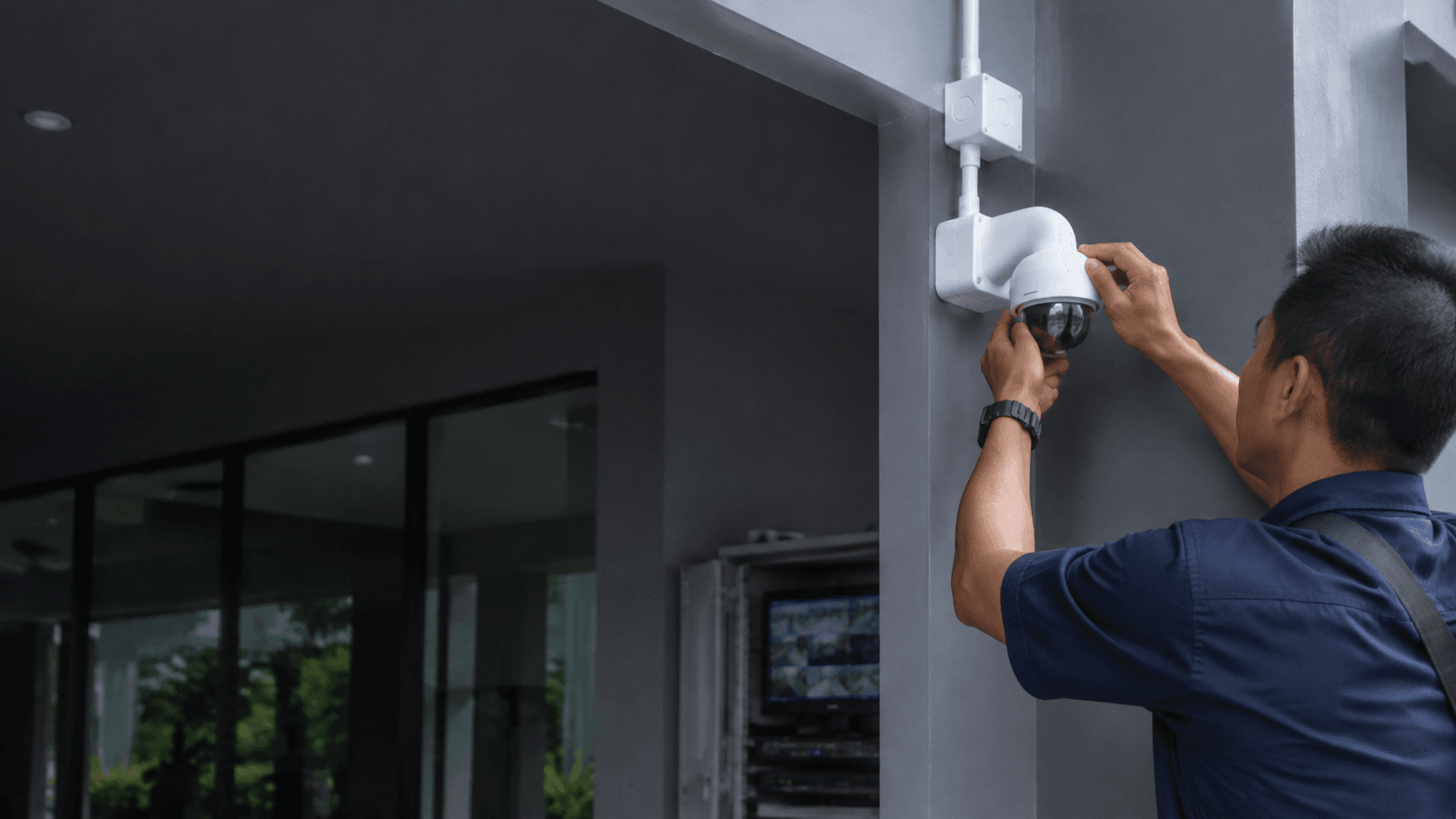
Eyonic's own installation sequence follows a similar logic: site survey, system proposal, installation, and handover. The survey exists because camera placement depends on the actual building, not a floor plan alone.
What Is Wifi Home Security?
Wifi home security is a setup where cameras, sensors, alarms, or smart locks communicate over a home wireless network rather than dedicated cabling to a recorder. The router becomes part of the security system, not just an internet connection.
That distinction has practical consequences. A wireless camera needs power or a battery, a stable signal at its mounting point, and enough bandwidth to stream without dropping frames. A wired camera needs a cable run but does not compete for Wi-Fi airtime.
Two failure modes appear repeatedly in real installations. The first is a camera mounted where the signal is weak, producing stuttering footage at exactly the moment it is needed. The second is a router left on default settings, which turns every connected device into an entry point. Guidance from CISA and the FTC both centre on the same basics: change default credentials, use current encryption, and keep firmware updated.
Wireless, Wi-Fi, and Cellular Are Not the Same Thing
Wireless sensors often use radio frequency to reach a hub, while the hub itself may use Wi-Fi, cellular, or both to send alerts. A system marketed as wireless can therefore still depend on a working internet connection unless it has cellular backup. That distinction decides whether alerts still arrive during a broadband outage.
Choosing the Right Wifi Home Security
The right configuration depends less on brand preference and more on the property type and how it is used.
| Property situation | Practical fit | Main trade-off |
|---|---|---|
| Terrace house or apartment | Wireless cameras plus a smart lock or alarm panel | Signal strength varies between floors and through walls |
| Shop or office with public entry | Camera coverage on arrival flow and visitor areas, with recording | Needs planned placement rather than plug-in positioning |
| Site with unreliable broadband | System with cellular backup for alerts | Ongoing subscription or SIM cost |
| Property with existing cabling | Wired cameras on a recorder | Installation work, but no competition for Wi-Fi bandwidth |
Eyonic's completed work for the Kuching Immigration Office followed this pattern: coverage focused on arrival flow, staff areas, and visitor movement, with dependable daily operation as the goal rather than maximum camera count. A similar project for KTA Sarawak Sdn Bhd in Kuching centred on staff movement, visitor handling, and tidy cabling.
For homes, the equivalent questions are simpler but the same shape. Which door is used most? Where does a delivery arrive? Which window is least overlooked from the street? Those answers determine placement, and placement determines whether the footage is useful.
Where Wireless Fits and Where It Does Not
Wireless suits rented property, retrofits, and locations where running cable is impractical or expensive. It struggles where walls are thick, where many devices share one access point, or where a camera must record continuously at high resolution. In those cases a wired camera on a recorder is often the more reliable answer, even though installation takes longer.
Best Wireless Home Security Systems Of 2026
Published rankings for 2026 consistently place ADT, SimpliSafe, and Vivint at the top of the wireless category, with Cove and Frontpoint appearing as lower-cost or easier-setup alternatives. Those rankings weigh professional monitoring, contract terms, and equipment breadth.
That framing suits buyers in markets where those providers operate. In Sarawak, the practical comparison looks different: equipment availability, installation support, and whether a local team can attend the site matter more than a subscription tier.
Eyonic supplies and installs Hikvision cameras and alarm systems, with packages listed at RM 1,599 for a Hikvision CCTV package, RM 1,599 for a Hikvision alarm system, and RM 1,599 for an autogate package. Each package covers supply, setup, and handover rather than equipment alone.
Larger projects scale beyond those figures. Eyonic's completed office work has carried approximate budgets of RM 8,000 to RM 18,000 for an engineering consultancy site and RM 12,000 to RM 28,000 for a public office, reflecting camera count, cabling, and site complexity rather than a fixed rate.
What the Rankings Do Not Cover
International rankings rarely address installation quality, which is where most wireless systems succeed or fail. A well-chosen camera mounted badly underperforms a modest camera mounted well. Eyonic's own guidance on ColorVu-style cameras makes the same point: check the actual lighting conditions at the location before confirming placement, because low-light performance depends on what is really there at night.
Practical Considerations for
Several details decide whether a system works six months after installation.
Network capacity comes first. Each streaming camera consumes bandwidth continuously, and a router already serving a household can reach its limit quickly. Separating cameras onto their own network segment, or using a guest network for smart devices, reduces both congestion and exposure.
Power and backup come second. Battery cameras need a maintenance routine, and a system that depends on mains power and broadband will go dark in an outage unless it has backup. That is a design decision, not an afterthought.
Physical placement comes third. A router locked in a metal cabinet or placed at the far corner of a building weakens every wireless device downstream. Central placement and a secure physical location both help.
Access control comes fourth. Smart locks work best when door condition, user roles, and a backup entry method are reviewed before installation. For business premises, the choice between a standalone smart lock and a full access-control panel depends on how many people need different levels of access.
Common Edge Cases
Rented property limits drilling and cabling, which pushes most renters toward wireless cameras and battery devices. Older buildings with thick walls may need additional access points before cameras can stream reliably. Properties with frequent power interruptions need backup considered at the design stage. Sites where multiple parties need footage access need user permissions planned before handover, not after.
Making an Informed Choice About
A workable decision comes down to matching the system to the property rather than to a ranking. Wireless cameras and alarms cover most homes well when the network is stable and placement is planned. Wired systems remain the stronger choice where reliability matters more than installation convenience.
For readers in Sarawak, the practical next step is a site survey, because placement, signal, and lighting cannot be judged from a distance. Eyonic's process runs from survey through proposal, installation, and handover, with the survey determining what the proposal should contain.
Share your location, property type and required system with Eyonic on WhatsApp at +60 11-5111 7959 for the next practical step.