
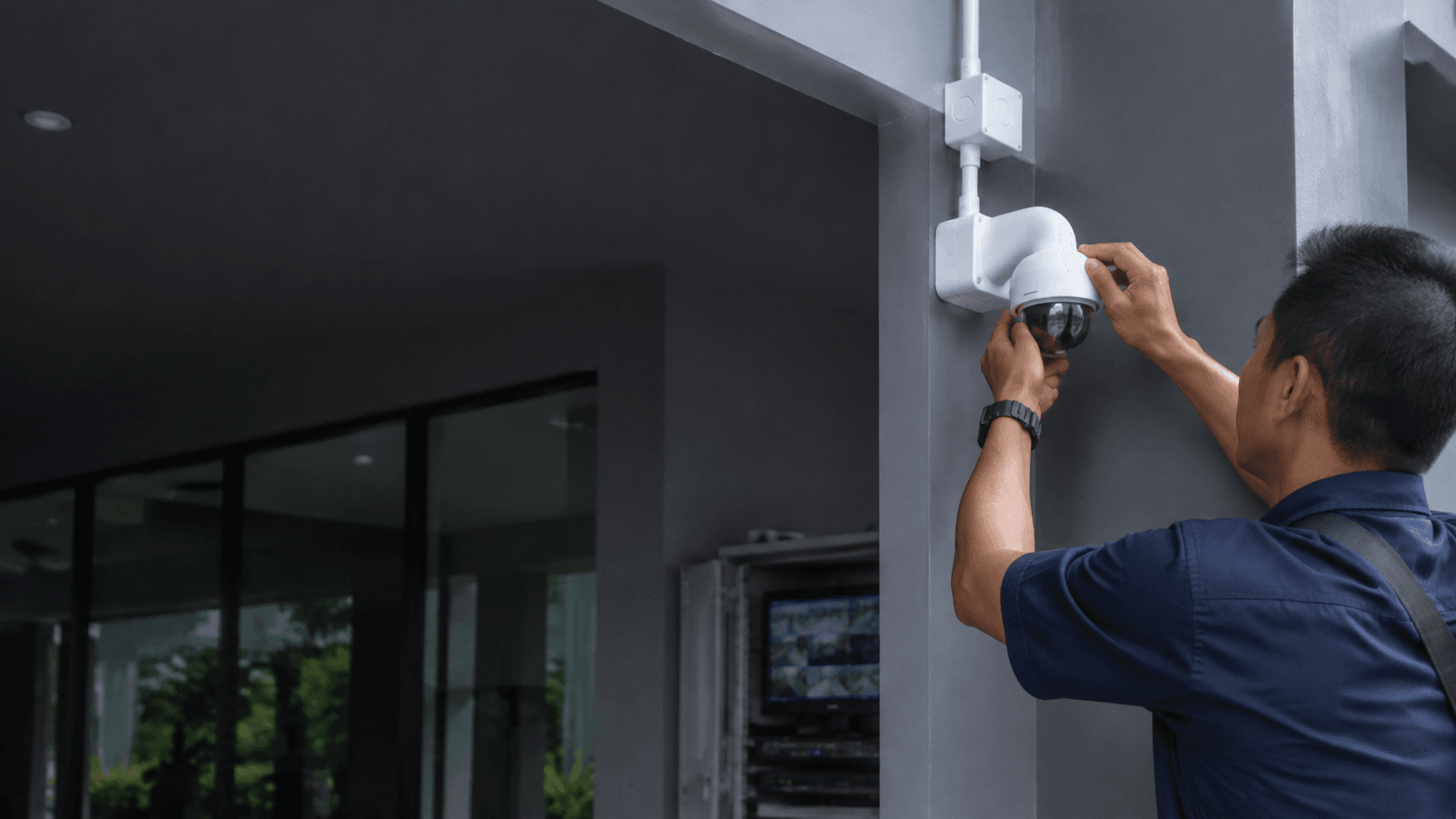
Buyers comparing options in Malaysia usually want to know what arrives in the box, who decides where each camera points, how recordings are stored, and what happens on the day the system goes live. The sections below work through each of those questions using Eyonic's own package, project, and installation evidence.
CCTV Camera Package. What Buyers Get
The Eyonic Hikvision CCTV Package is listed at RM 1,599 and covers three things: camera supply and setup, basic recording configuration, and mobile viewing handover. That is the full published scope of the entry package, so a buyer should treat it as the starting point rather than a fixed specification.
What the package does not publish is equally useful to know. There is no stated camera count, resolution, lens, sensor, storage capacity, or channel count attached to the RM 1,599 figure, and no published warranty length or service response time. Those details are settled per site rather than assumed from a catalogue line.
Eyonic's wider CCTV service description covers planning, supply, and installation of monitoring systems with camera placement, recording, and remote viewing for homes, offices, shops, and industrial sites. The package sits inside that service rather than replacing it.
What a CCTV camera package includes
A working package normally resolves into four layers: the cameras themselves, the recorder that stores footage, the cabling and power that connect them, and the configuration that lets someone view the result remotely. Eyonic's published package language names camera supply and setup, basic recording configuration, and mobile viewing handover, which maps onto the last three layers plus the hardware itself.
Anything beyond that — additional cameras, longer cable runs, larger storage, or access control — is a scope decision made against the site, not a default inclusion.
Camera Placement and Lighting Checks
Placement is the decision that most affects whether a package performs. Eyonic lists camera placement as a distinct part of its CCTV service, which means the position of each camera is planned rather than inherited from wherever a cable already runs.
Lighting is the check that most often changes a plan. Eyonic's guidance on ColorVu-style cameras is to verify actual lighting conditions before confirming placement, because a camera chosen for low-light colour performance only delivers that benefit where the real light level supports it. A corridor lit at night behaves differently from an unlit back lane, and the same camera model may be the right answer in one position and the wrong one a few metres away.
Practical placement questions that shape a proposal include which approach routes matter most, whether staff or visitor areas need separate coverage, and whether a camera will be looking into a light source for part of the day.
Recording, Storage and Remote Viewing
Recording configuration and NVR setup are named parts of Eyonic's CCTV service, alongside remote viewing. In practice this means the recorder is configured as part of the installation rather than shipped in a default state.
Remote viewing is handed over as a working capability. The published package wording is "mobile viewing handover", which indicates the viewing setup is demonstrated and passed to the user rather than left as a manual task.
Storage capacity is not published for the RM 1,599 package, so retention length cannot be stated in advance. Retention depends on how many cameras are recording, what resolution they run at, and how the recorder is configured — all of which are settled during the site survey and proposal stage.
How installation and handover work
Eyonic's CCTV installation process runs through four stages, and the sequence matters because each stage constrains the next.
- Site survey — the property is assessed before any equipment is specified.
- System proposal — the survey findings are turned into a proposed system.
- Installation — cameras, recording, and cabling are installed and configured.
- Handover — the working system, including mobile viewing, is passed to the user.
The survey stage is what allows a package to be quoted honestly. Without it, camera count and placement are guesses, and the RM 1,599 entry package cannot be matched to a specific building with any confidence.
Costs and Project Budgets in Malaysia
Eyonic publishes three packages at RM 1,599 each: the Hikvision CCTV Package, the Hikvision Alarm System, and the Autogate Package. The CCTV package at that price covers camera supply and setup, basic recording configuration, and mobile viewing handover.
Larger work sits well above the entry package. Two completed Eyonic projects give a sense of the range for office and public-building installations:
- The Kuching Immigration Office project carried an approximate budget of RM 12,000 to RM 28,000.
- The KTA Sarawak Sdn Bhd project carried an approximate budget of RM 8,000 to RM 18,000.
Those figures describe the scope of those two projects, not a price list. A single shop unit and a public office with arrival flow, staff areas, and visitor movement to cover are different problems, and the budget gap between RM 1,599 and RM 12,000 reflects that difference in scale rather than a markup.
What drives the budget upward
Camera count is the obvious driver, but it is rarely the only one. Cable routing through finished walls, the number of separate areas needing coverage, whether recording retention needs to be longer, and whether the site needs tidy cabling as a visible outcome all move the number.
The KTA Sarawak project is a useful example of the last point: the brief called for a practical office setup in Kuching supporting staff movement, visitor handling, tidy cabling, and clearer daily site control. Tidy cabling is a labour and planning cost, not a hardware cost, and it does not appear in a package price.
How Eyonic Approaches a
Eyonic Sdn Bhd is a security system supplier in Sarawak working on CCTV and ELV systems, with planning, supply, and installation for homes, offices, shops, and industrial sites. The founder, Eric Yong, has more than ten years in the industry and works on technical installation of digital security solutions for commercial businesses in Sarawak.
The Kuching Immigration Office project shows how the approach translates to a live site. The requirement was practical support for a public office focused on arrival flow, staff areas, visitor movement, and dependable daily operation — four different coverage priorities in one building, which is why placement planning precedes equipment selection.
Two constraints are worth stating plainly. Eyonic's published project evidence places work in Sarawak, so a buyer outside that area should confirm coverage before planning around it. And because camera count, storage, and retention are not published for the RM 1,599 package, the honest next step is a site survey rather than a specification comparison.
For a buyer weighing a CCTV camera package, the useful questions are what the site actually needs covered, how lighting behaves at night in each position, and how long footage needs to be kept. Those three answers determine the system far more than any single specification line.
Share the location, property type, and required system with Eyonic on WhatsApp at +60 11-5111 7959 to move from comparison to a surveyed proposal.