
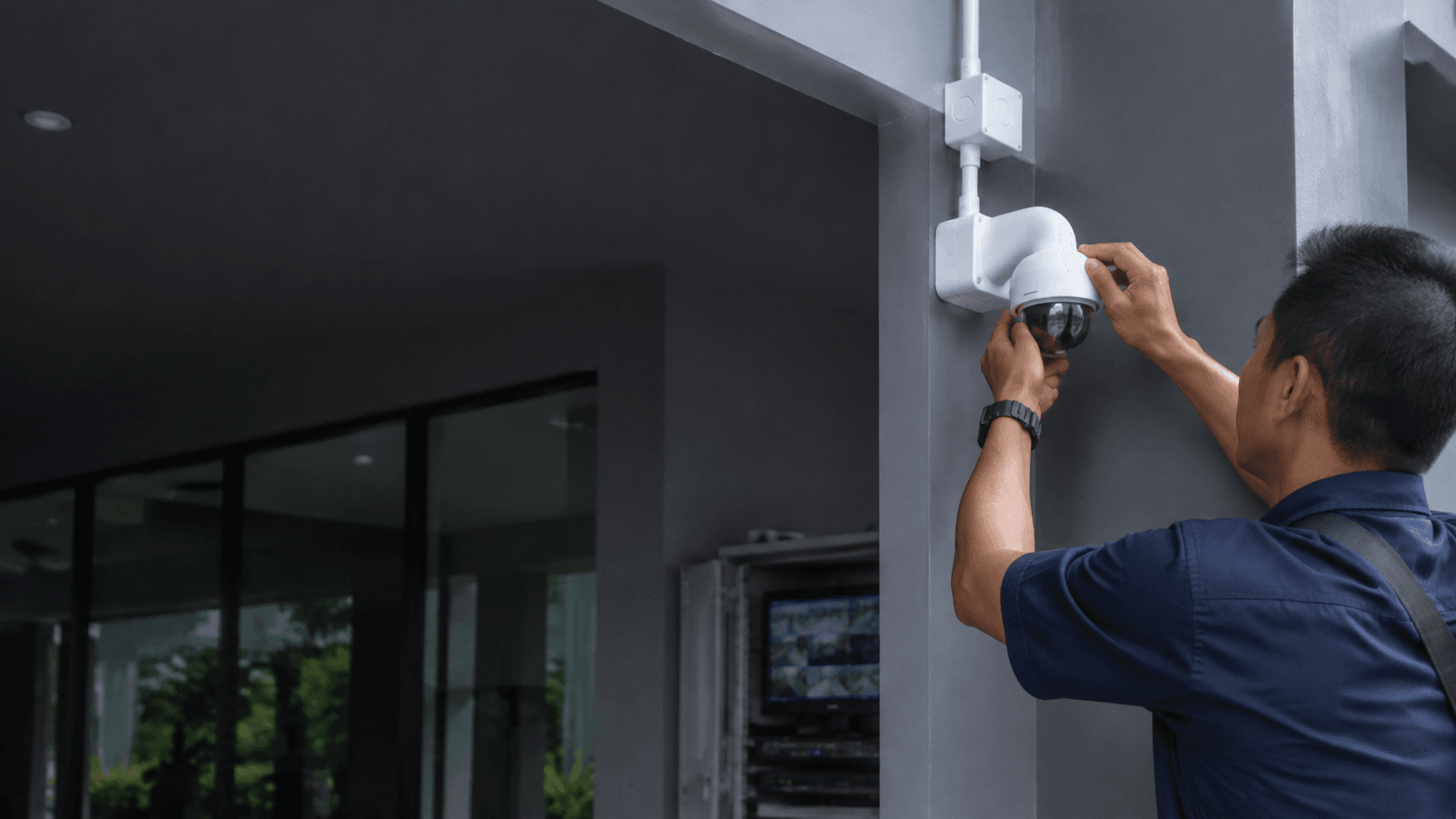
The practical work starts long before a camera is fixed to a wall. Placement decides what a system can actually see, and lighting decides whether that view stays usable after dark. Eyonic, a security system supplier in Sarawak, plans, supplies and installs monitoring systems with camera placement, recording and remote viewing for homes, offices, shops and industrial sites.
Most homeowners begin with a rough idea of how many cameras they want. A better starting point is a short list of what needs watching: the gate, the car porch, the front door, a side lane, a back yard. Each of those views has its own angle, height and light problem, and each one changes the camera and cabling that suits it.
Cctv For Home Use. What the Setup Actually Involves
A home CCTV setup is a chain of decisions rather than a single purchase. The chain runs from what needs to be seen, to where a camera can physically sit, to how the picture is recorded and how it is viewed afterwards. Weakness at any link shows up later as a blind spot, a washed-out night image or footage nobody can find when it matters.
Eyonic's CCTV installation process includes site survey, system proposal, installation and handover. That sequence matters because the survey is where placement and lighting get tested against the real property, and the proposal is where the camera count, recorder and cabling approach get fixed before any drilling begins.
- Site survey — the property is walked through to identify entry points, existing cabling routes and actual lighting conditions at each proposed camera position.
- System proposal — the survey findings are turned into a camera count, recorder choice and cabling plan for the property.
- Installation — cameras, recorder and cabling are fitted according to the agreed placement.
- Handover — recording configuration and mobile viewing are set up and explained so the system can be used day to day.
The handover stage is often treated as an afterthought, but it decides whether the system gets used properly. A recorder that is running but never checked, or a mobile app that was never opened, leaves a homeowner with hardware and no working habit around it.
Where cameras usually go in a Malaysian home
Terrace houses, semi-detached homes and apartments present different problems. A terrace house typically has a narrow frontage, a car porch and a side lane, so a small number of well-angled cameras can cover the main approaches. A semi-detached or corner unit has more exposed sides, which usually means more positions to consider. Apartments and condominiums are constrained by management rules and shared corridors, so the practical scope is often limited to the entrance and any area the owner controls.
Common positions include the front gate or porch, the main door, a side or back passage, and any external area where vehicles or stored items sit. The exact count depends on the property, and no fixed number applies to every home.
Lighting checks before fixing camera positions
Eyonic recommends checking actual lighting conditions before confirming placement for ColorVu-style cameras. This is a placement step, not a product step. A position that looks clear in daylight can face a streetlight, a reflective wall or a dark corner at night, and those conditions change what the camera records after dark.
The check is worth doing on site rather than from a plan. Standing at the proposed position after dark, or at least noting what light sources fall across it, reveals glare and shadow that a daytime walkthrough misses. Moving a camera a short distance or changing its angle is far cheaper before installation than after.
Recording, Storage and Remote Viewing Basics
Recording is handled by a recorder that stores footage from the cameras, and NVR setup is part of the installation service Eyonic provides. The recorder is the part of the system that keeps working quietly in the background, and its location matters for both cabling and access.
Remote viewing lets footage be checked from a phone rather than only at the recorder. Eyonic includes remote viewing in its monitoring systems, and mobile viewing handover is part of the Hikvision CCTV Package. The practical value of remote viewing depends on the home's internet connection and on the app being configured correctly during handover.
Storage duration is a common question and a common source of disappointment. How long footage is kept depends on the recorder's storage and on how the system is configured, and that configuration is set during installation rather than assumed afterwards.
What a home CCTV installation includes
Eyonic's CCTV Security Systems service covers planning, supply and installation of monitoring systems with camera placement, recording and remote viewing. The Hikvision CCTV Package is priced at RM 1,599 and covers camera supply and setup, basic recording configuration, and mobile viewing handover.
That package describes the core of a home installation. Camera supply and setup covers the hardware and its fitting. Basic recording configuration covers the recorder being set to record as intended. Mobile viewing handover covers the app being connected and shown to the user. What the package does not specify is camera count, resolution or storage capacity, so those details need to be confirmed against the property rather than assumed from the price.
For larger or more complex properties, the scope grows. Eyonic's project work has included the Kuching Immigration Office, where the focus was arrival flow, staff areas, visitor movement and dependable daily operation. That kind of coverage planning — mapping movement through a space rather than counting cameras — is the same thinking that applies to a home with several entry points.
Costs and Next Practical Steps
The clearest published figure for a home setup is the Hikvision CCTV Package at RM 1,599, which covers camera supply and setup, basic recording configuration and mobile viewing handover. Eyonic also lists a Hikvision Alarm System at RM 1,599 and an Autogate Package at RM 1,599, so a homeowner weighing CCTV alongside an alarm or gate motor can see the three side by side.
Beyond that package, cost depends on the property. Camera count, cable runs, recorder capacity and the number of entry points all move the figure, and none of those can be settled accurately without seeing the site. Published project budgets on Eyonic's own project pages sit in a different range because they cover larger commercial and public premises rather than a single home.
The practical next step is to gather three details before approaching any supplier: the property type, the areas that need coverage, and whether an alarm or gate system is also being considered. Those three answers are what turn a general enquiry into a usable proposal.
Share your location, property type and required system with Eyonic on WhatsApp at +60 11-5111 7959 for the next practical step.