
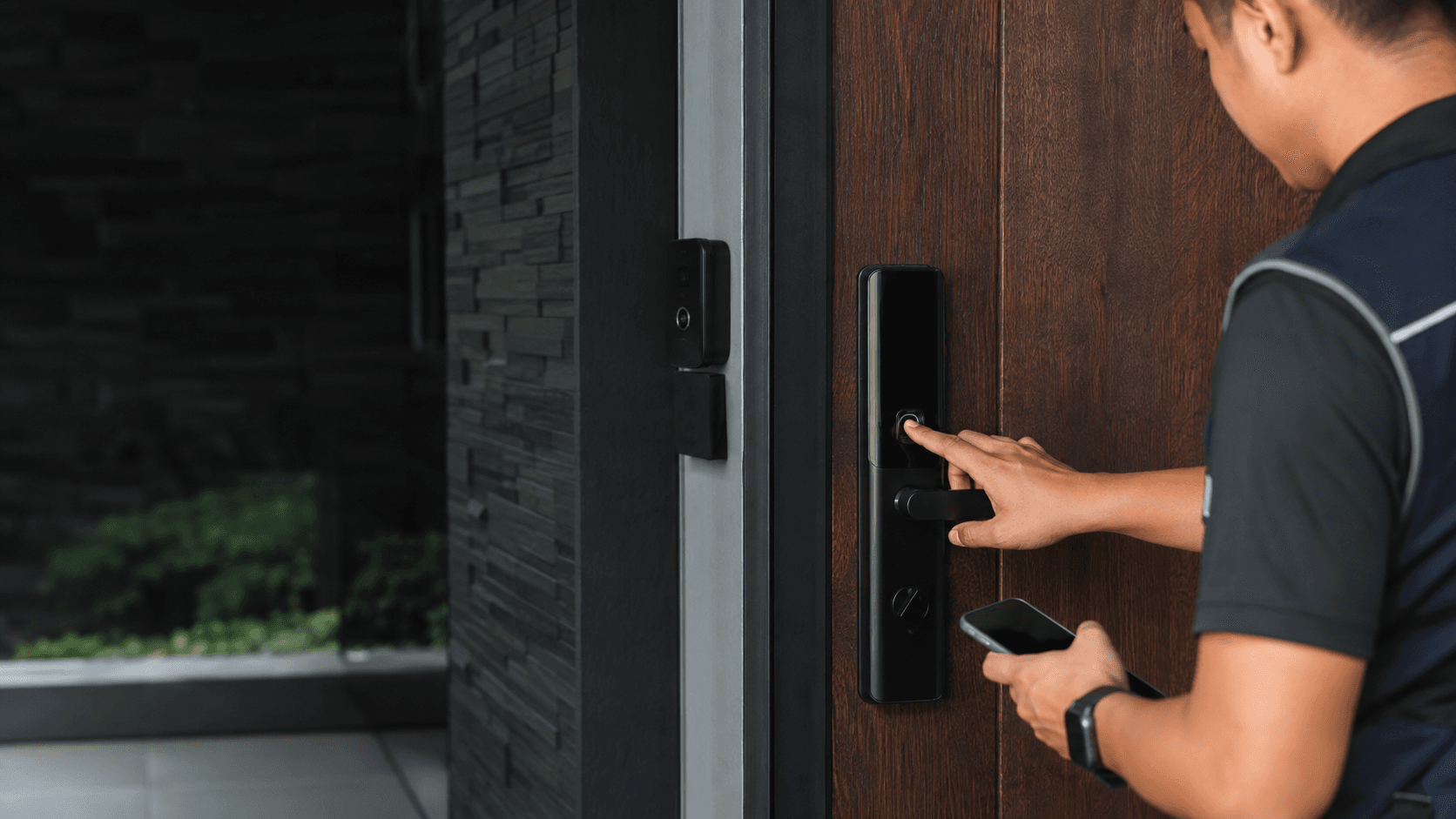
The term covers keypad-controlled locking hardware fitted to an exterior door of a business premises — a shop lot, office, workshop or industrial unit — where staff, visitors and after-hours arrivals need to get in without a physical key changing hands. In Malaysian commercial practice the hardware usually sits somewhere between two poles: a standalone smart lock that manages its own users, and a lock that reports to an access-control panel managing many doors and many people.
Eyonic Sdn Bhd, a security system supplier in Sarawak, states that smart locks work best when the door condition, user roles and backup method are reviewed before installation, and that for business use it usually checks whether a standalone smart lock or an access-control panel is more appropriate.
Commercial Exterior Keypad Door Lock: what the term covers
A commercial exterior keypad door lock is a locking device on an outward-facing door that grants entry when a correct code is entered, instead of or alongside a mechanical key. The commercial part of the phrase matters more than the keypad part. A residential keypad lock is judged on convenience for a household. A commercial one is judged on who is allowed in, when, and what happens when the code is shared, lost or abused.
Three practical distinctions separate the categories:
- Standalone versus panel-managed. A standalone lock stores its own user codes and schedules. A panel-managed lock is one door on a wider access-control system, where credentials and permissions are administered centrally.
- Exterior versus interior. An exterior door faces weather, street traffic and after-hours risk. The same lock model fitted to an interior store room is a different proposition.
- Keypad-only versus multi-credential. Some hardware accepts only a PIN. Others accept a PIN plus a card, fob or mobile credential. The choice follows how many people need access and how often that list changes.
Because no verified technical specifications are available for specific models in this category, this page does not quote IP ratings, finishes, credential types, power arrangements, door thickness ranges or fire ratings. Those details belong on a manufacturer datasheet for a named model, not in a general comparison.
Door condition and user roles decide the hardware route
The door itself often settles the question before any brand is discussed. A hollow metal door with an existing mortise preparation, an aluminium-framed glass storefront, a timber office door and a roller shutter each accept different hardware families. A lock that fits one may not fit another without modification, and modification changes cost and lead time.
User roles are the second filter. A premises with five staff who all need the same access is a different problem from one with a rotating roster, contractors, delivery drivers and visitors who should reach a reception area but not a stock room. Where the access list is short and stable, a standalone lock with individual codes can be sufficient. Where the list is long, changes weekly, or needs an audit trail of who entered and when, a panel-managed arrangement is usually the more workable route.
Backup entry is the third check, and it is the one most often skipped. Every keypad lock depends on something — a battery, a power supply, a network, a controller. The question is what happens on the morning the code does not work and a queue is forming at the door. A mechanical key override, a second entry point, or a documented manual release procedure answers that question before it becomes an incident.
Where a standalone lock is usually enough
A single exterior door, a small and stable group of users, no requirement to review entry records, and a clear mechanical backup. This is the scenario where a standalone smart lock delivers controlled convenience without the overhead of a managed system.
Where an access-control panel is usually the better route
Multiple doors that should share one credential, staff turnover that requires frequent permission changes, a need to see who entered and when, or a requirement to integrate entry with other building systems. In these cases a single keypad lock solves one door and creates a second, separate access list to maintain.
How a site survey, proposal, installation, and handover sequence runs
Eyonic's published installation process for security systems follows four stages: site survey, system proposal, installation, and handover. The same sequence applies to door access work, because the decision depends on the physical door and the people using it rather than on a catalogue page.
- Site survey. The door, frame, existing locking, power availability, traffic pattern and user roles are examined on site. This is where the standalone-versus-panel question is normally answered.
- System proposal. The recommended hardware route and scope are set out for the property, based on what the survey found rather than on a generic package.
- Installation. Hardware is fitted, credentials or codes are configured, and the door is tested in normal use.
- Handover. Users are shown how the entry works, how codes or credentials are managed, and what to do when entry fails.
The order matters. Confirming hardware before the survey risks specifying a lock that does not suit the door, or a standalone unit where the site actually needs central control. The survey is also the point at which the backup method is agreed, so it is not improvised later.
Where keypad entry sits alongside CCTV, alarm, and autogate systems
Door access is one layer of premises security, not the whole of it. A keypad lock decides who comes through a door. A CCTV system records what happens at and around that door. An alarm system responds to intrusion when the premises should be empty. An autogate controls vehicle entry at the perimeter.
These layers answer different questions, and a gap in one is not covered by strength in another. A keypad lock with no camera gives no record of who actually walked in behind the person who entered the correct code. A camera with no controlled door records an event but does not prevent it. For a premises with both staff and visitor movement, the combination is what produces a usable picture of daily operation.
Eyonic's work for the Kuching Immigration Office focused on arrival flow, staff areas, visitor movement and dependable daily operation — the same concerns that shape door access decisions in offices, shops and industrial sites. A separate project for KTA Sarawak Sdn Bhd addressed staff movement, visitor handling, tidy cabling and clearer daily site control. Both illustrate that entry hardware is chosen against how a site actually runs, not in isolation.
Eyonic's published package pricing covers a Hikvision CCTV package at RM 1,599, a Hikvision alarm system at RM 1,599, and an autogate package at RM 1,599. No equivalent verified pricing exists for keypad lock hardware or installation, so no figure is quoted here for door access work.
What Eyonic reviews before confirming a commercial door setup
Eyonic's stated position is that smart locks work best when the door condition, user roles and backup method are reviewed before installation, and that for business use it usually checks whether a standalone smart lock or an access-control panel is more appropriate. Those three checks translate into a short pre-confirmation list.
- Door condition. Whether the existing door, frame and locking preparation accept the intended hardware, and whether any modification is needed.
- User roles. Who needs access, to which doors, on what schedule, and how often that list changes.
- Backup method. What happens when the primary entry method fails, and how that is documented for the people who use the door daily.
Two further questions sit behind those checks. The first is whether the site needs a record of entry events; if it does, a standalone lock is unlikely to satisfy it. The second is whether the door is the only controlled opening or one of several; if it is one of several, a shared credential across doors is usually simpler to administer than separate codes per lock.
Eric Yong, founder of Eyonic Security Systems, has worked in the industry for more than ten years and is experienced in technical installation of digital security solutions for commercial businesses in Sarawak. That experience is applied at the survey stage, where the door and the user list are examined together.
Practical next step for a Sarawak or Malaysia premises
The useful starting point is not a product choice but a description of the door and the people who use it. A premises owner or facility decision-maker who can state the door type, the number of users, whether entry records are needed, and how backup entry should work gives an installer enough to recommend a route rather than a guess.
Where the answers point to a single door with a small, stable user group, a standalone keypad lock is a reasonable fit. Where they point to multiple doors, changing permissions or a need for entry records, an access-control panel is the more appropriate direction, and a keypad lock may still form part of it as the reader at one door.
Share your location, property type and required system with Eyonic on WhatsApp at +60 11-5111 7959 for the next practical step.