
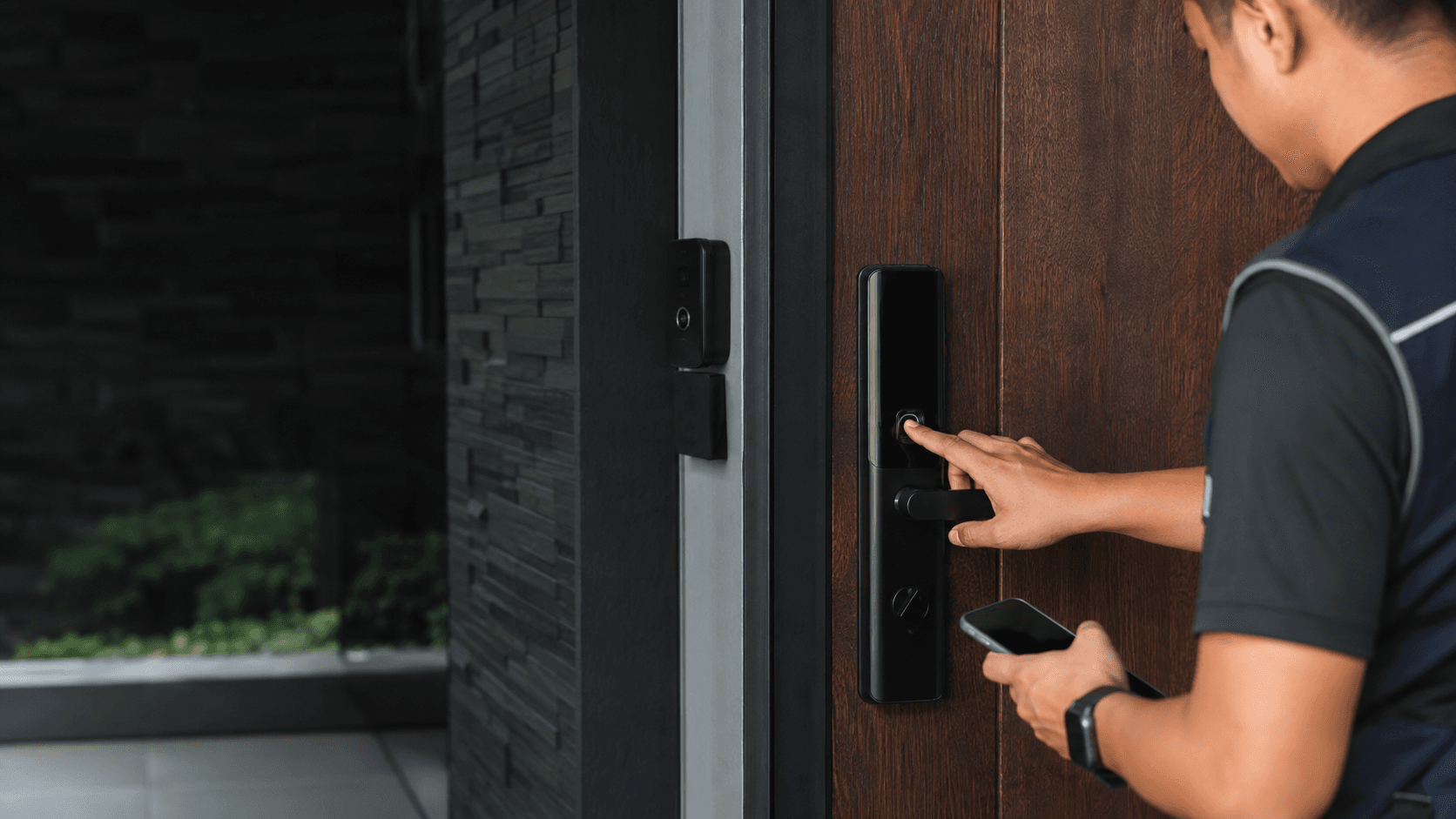
The exact-match query thumb print door lock describes a lock that opens on a verified fingerprint instead of a key. In Malaysia, the buying decision rarely turns on the sensor alone. It turns on whether the door can carry the lock, who needs to enter, and what happens when a finger is not read or the power runs out.
Eyonic Sdn Bhd is a security system supplier in Sarawak that plans, supplies and installs monitoring and ELV systems for homes, offices, shops and industrial sites. Its published review of smart lock door access states that smart locks work best when the door condition, user roles and backup method are reviewed before installation, and that for business use the choice between a standalone smart lock and an access-control panel is usually checked first. That review is the clearest available guidance on this product category, and it frames the rest of this page.
Thumb Print Door Lock. What It Does at the Door
A thumb print door lock replaces the keyed cylinder or the handle set with a reader, a locking mechanism and a controller. A finger placed on the reader is matched against prints stored in the lock. A match releases the mechanism; a non-match keeps the door shut.
That is the whole function. Everything else attached to the category — keypads, cards, phone apps, remote unlocking — is a second entry method layered on top of the same mechanism. The published competitor set for this query clusters on exactly those layers: fingerprint access, keypad entry, Wi-Fi smart locks, and access management. None of the eight analysed pages used the exact query in its H1, and none recorded an exact-match count above zero, which is why a plain explanatory page is the practical opening here.
Two things follow from the mechanism. First, the lock is only as useful as the prints enrolled in it, so enrolment and removal are ongoing tasks rather than a one-time setup. Second, a fingerprint is not a key that can be handed over, so adding and removing people is an administrative action performed at the lock or through its management method.
Fingerprint access versus a keyed cylinder
A keyed cylinder grants entry to anyone holding a copy of the key, and copies can be made without the owner knowing. Fingerprint access grants entry to enrolled fingers only, and removing a person means deleting that print. The trade-off is that a keyed cylinder keeps working when electronics fail, while a fingerprint lock depends on its power source and its reader.
That trade-off is the reason backup entry is treated as a design decision rather than an accessory. A lock with no mechanical or secondary path into the building is a single point of failure.
Where a Thumb Print Door Lock Fits in Malaysia
Malaysian buildings present a wide range of door types, and the lock has to match the door rather than the other way round. The category suits doors where a defined group of people needs regular, repeated entry and where issuing keys is inconvenient or hard to control.
Typical fits include an office main entrance used by staff through the working day, a shop back door used by a small team, a server or store room with restricted access, and a home entrance where the household wants to stop carrying keys. Eyonic's completed work in Sarawak shows the same pattern of needs at building level: the Kuching Immigration Office project focused on arrival flow, staff areas, visitor movement and dependable daily operation, and the KTA Sarawak Sdn Bhd project supported staff movement, visitor handling, tidy cabling and clearer daily site control.
Those projects are access and monitoring work rather than thumb print door lock installations, and they are useful here only as evidence of how entry points are assessed in practice: by who moves through them, when, and how reliably they must work each day.
Where the category fits less well
A door that is already difficult to close, that swells in wet weather, or that is opened dozens of times an hour by the public is a poor candidate for a battery-powered reader lock. High-traffic public entrances usually point toward a wired access-control arrangement instead, which is the same distinction Eyonic's smart lock review draws for business use.
External gates and perimeter openings raise a further question, because a fingerprint reader mounted outdoors faces conditions that an internal door does not. No supplied evidence states an IP rating or weather tolerance for any thumb print door lock, so that question has to be settled against the specific model's documentation before an outdoor position is chosen.
Door Condition and User Roles Before Installation
Two checks decide most installations: whether the door can physically carry the lock, and whether the user list is clear enough to configure.
Door condition covers the door leaf thickness and material, the existing cutout or cylinder position, whether the frame closes squarely, and whether the door is a swing or sliding type. A lock designed for a swing door with a standard cylinder cutout will not transfer to a sliding glass door or a metal gate without a different product. This is the check that most often changes the recommendation, and it is the reason a site survey comes before a proposal rather than after.
User roles cover who is enrolled, what each person can open, and when. A household needs a short list and simple rules. An office needs to separate staff from visitors, and often needs to distinguish between people who enter daily and people who enter occasionally. Eyonic's smart lock review notes that for business use the choice between a standalone smart lock and an access-control panel is usually checked, because a growing user list with time rules eventually outgrows a standalone lock.
Questions that settle the user list
How many people need routine entry, and does that number change often? Does anyone need entry only on certain days or hours? Does a departed staff member or former tenant still hold a key today? Does the building manager, cleaner or contractor need access outside normal hours? Each answer either simplifies the configuration or pushes it toward a managed access-control system.
Enrolment quality matters as much as the list. A print enrolled badly will read badly, and a reader that has to be touched repeatedly in daily use will be distrusted by the people using it. Enrolment should be done on site, with the actual users, and tested before handover.
Backup Entry and Daily Operation
Backup entry is the part of the design that decides whether the lock is dependable. Every thumb print door lock needs at least one path into the building that does not depend on the reader working.
Common backup paths are a mechanical key override, a keypad code, a card, or a second powered entry point. The right choice depends on who needs to get in when the primary method fails: a household may accept a mechanical key kept elsewhere, while an office usually needs a documented method that a duty staff member can use without calling a technician.
Daily operation then settles into a small set of routines. Users place a finger and enter. Administrators add and remove prints as people join and leave. Someone checks that the lock still operates and that the backup path is still available. The failure that matters most is not a rejected finger on a busy morning; it is a lock that stops working while nobody remembers where the override key is kept.
What the evidence does not establish
No supplied evidence states the sensor type, enrolled-print capacity, recognition speed or error rate of any thumb print door lock. No supplied evidence states battery life, power backup behaviour or IP rating. No supplied evidence states wireless protocols, app support or voice assistant compatibility. No supplied evidence states warranty terms for this category.
Those details vary by model and must come from the specific product's documentation. Treating them as category-wide facts would be guesswork, and a lock chosen on guessed specifications is a lock chosen on nothing.
Installation and Handover Steps
Eyonic's published installation process for its security work runs through four stages, and the same sequence applies to a door access installation.
- Site survey — the door, frame, existing hardware, power position and daily traffic are inspected on site before anything is specified.
- System proposal — the survey findings are turned into a recommendation, including whether a standalone lock or a managed access-control arrangement suits the user list.
- Installation — the lock is fitted to the surveyed door, and the entry methods and user roles are configured.
- Handover — operation, enrolment and the backup entry method are explained and tested with the people who will use them.
The survey stage carries the most weight. A lock specified from a photograph or a door measurement alone can arrive unable to fit the frame, and the correction costs more than the survey would have. The handover stage carries the second most, because a lock nobody has been shown how to administer will accumulate stale prints and an unverified backup path.
For a multi-door site, the sequence repeats per door but the user roles should be planned once across the whole building, so that a person's access is consistent at every entrance they are entitled to use.
Questions to Settle Before Buying a
The buying decision narrows quickly once four things are known: the door, the users, the backup method, and who will support the installation afterwards.
On the door, the question is whether the existing leaf and frame accept the lock without modification, and whether the door closes reliably today. On the users, it is how many people need entry and how often that list changes. On backup, it is which non-fingerprint method stays available and who can reach it. On support, it is who attends the site if the lock stops working, and how quickly.
Cost is the remaining question, and it cannot be answered from the evidence available here. The only published prices from Eyonic are RM 1,599 packages for Hikvision CCTV, the Hikvision Alarm System and Autogate, which are different products from a door lock. A thumb print door lock price depends on the model, the door, and whether the work is a single lock or part of a wider access and monitoring setup.
Where a building needs several controlled doors, staff and visitor separation, or a record of who entered, the practical answer is often a managed access-control arrangement rather than several standalone locks. Where a single door needs convenient entry for a small, stable group, a standalone lock is the simpler and more proportionate choice.
Eyonic's founder, Eric Yong, has worked in technical installation of digital security solutions for commercial businesses in Sarawak for more than ten years, and the company's project work in Kuching has covered public offices and engineering consultancy sites. For a door access question in Sarawak, sharing the location, the property type and the required system with Eyonic on WhatsApp at +60 11-5111 7959 is the next practical step.