
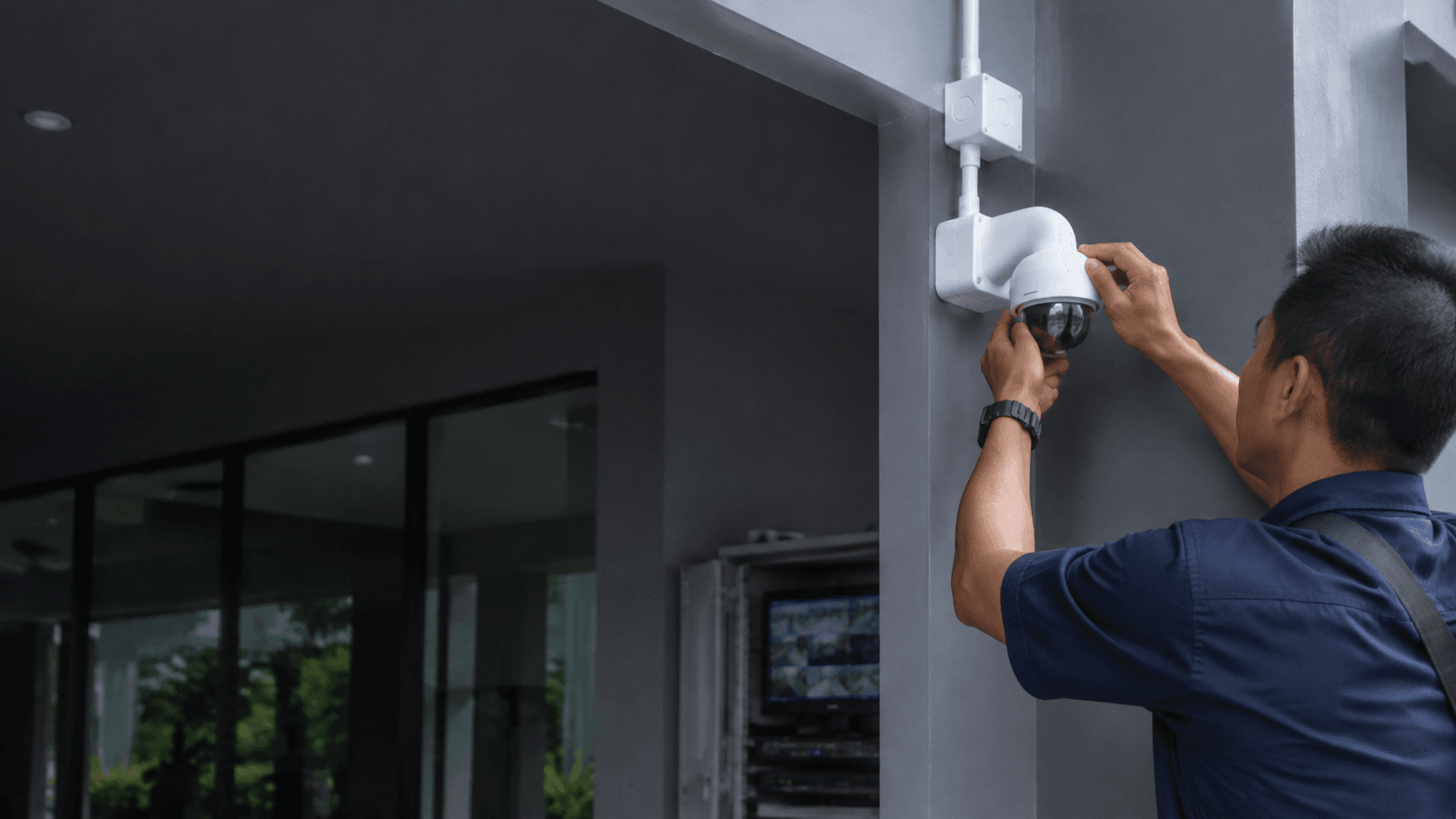
The brand name is well known, but the buying decision rarely turns on the badge alone. What decides whether a Dahua outdoor camera performs on a Malaysian building is where it is mounted, what it must see at night, how it reaches the recorder, and who commissions the finished system. That is a planning problem before it is a product problem.
Dahua Outdoor Camera. what the category covers
The category covers cameras built to sit outside a building and keep recording through rain, heat and darkness. Dahua makes outdoor models in several physical shapes, and the shape matters more than most buyers expect because it decides where the unit can be fixed and what it can be aimed at.
Bullet cameras sit in a long housing and throw a narrow, long view down a driveway, lane or perimeter fence. Turret and dome cameras sit closer to the mounting surface, which makes them harder to grab or redirect by hand and easier to fit under a soffit or above a doorway. Pan, tilt and zoom models cover a wide area from one position and can be steered, which suits a large open compound where a single fixed view would leave gaps.
Every one of those shapes is a housing decision, not a performance promise. Dahua publishes model-level specifications for each series, and those documents are the only place to confirm resolution, lens angle, weather rating and night behaviour for a specific unit. A supplier quoting a model number should be able to point to that documentation before installation begins.
Outdoor placement decisions before supply
Placement is settled on site, not at a desk. The useful questions are what the camera must identify, how far away that subject sits, and what the light looks like at the hour the risk actually occurs.
A gate camera and a car park camera need different things. A gate camera usually needs a tight view of a face or a plate at a known distance. A car park camera usually needs a wide view of movement across an open area, and it will fight glare from headlights and wet ground. Fixing the wrong housing in either position produces footage that records everything and proves nothing.
Cabling and power follow placement. Network cameras need a data path back to the recorder, and the route decides whether the job stays tidy or turns into surface trunking across a finished wall. Deciding the route before the camera is ordered avoids rework later.
What a site survey should settle
A survey walks the property and records the entry points, the blind spots between them, the existing cabling, the power available at each proposed position, and the lighting at each position during the hours that matter. It also records who will use the footage and on what device, because that shapes the recorder and the viewing setup.
Eyonic runs this as a site survey before any proposal is written, so the camera list is built from observed conditions rather than from a standard package.
How a Dahua outdoor camera fits a CCTV installation workflow
A camera is one component in a chain that runs from the lens to the screen in someone's hand. The chain has four stages, and skipping any of them shifts risk onto the property owner.
- Site survey. Walk the property, record entry points, blind spots, cable routes, power availability and lighting conditions at each proposed camera position.
- System proposal. Match camera types, recorder capacity and storage to what the survey found, and set out the scope before work starts.
- Installation. Mount the cameras, run and terminate the cabling, configure the recorder, and set recording rules and retention.
- Handover. Test the system, confirm remote viewing works on the owner's devices, and explain how to review footage and manage users.
Recorder capacity is the stage most often underestimated. Adding cameras later means more channels, more storage and sometimes a different recorder, so the proposal should account for likely expansion rather than only the first phase.
Remote viewing is the stage most often rushed. A system that records correctly but cannot be checked from a phone during a trip away has not delivered what the buyer paid for, so handover should include a live test on the owner's own device.
Lighting and weather conditions that shape camera choice
Malaysian outdoor conditions are hard on cameras in two specific ways: heavy rain for part of the year, and lighting that swings between harsh midday sun and very dark nights.
Rain drives the housing and cable entry decision. Water entering a connector or a poorly sealed housing is a common cause of a camera failing months after a clean installation, and the fix is at the mounting stage rather than the product stage.
Lighting drives the image decision. A position that looks bright during a daytime survey can be almost black at 2am, and a position facing a streetlight can be washed out by glare. Eyonic's own guidance on ColorVu-style cameras is to check the actual lighting conditions at the position before confirming placement, because a camera chosen for low-light colour performance is wasted if the position is genuinely dark or genuinely overexposed.
Practical checks at each position include whether a light source exists nearby, whether that light stays on all night, whether headlights or reflections will point at the lens, and whether the subject will be lit from behind. Those observations decide the housing and the lens angle far more reliably than a specification sheet read indoors.
Project evidence from a Kuching public office installation
Eyonic completed a project for the Kuching Immigration Office, a public office where the requirement was practical support for arrival flow, staff areas, visitor movement and dependable daily operation. The approximate budget for that type of work was RM 12,000 to RM 28,000.
That project shows what a public-facing site demands. Arrival flow means the camera positions must cover people entering and queueing, not just the perimeter. Staff areas and visitor movement mean the coverage has to separate two different kinds of traffic. Dependable daily operation means the system has to keep working through office hours without someone resetting it.
A second Eyonic project, for KTA Sarawak Sdn Bhd, covered an engineering consultancy office in Kuching that needed support for staff movement, visitor handling, tidy cabling and clearer daily site control. The approximate budget for that type of work was RM 8,000 to RM 18,000. Tidy cabling appears in that brief because an office installation is judged on how it looks as well as what it records.
Both projects point to the same planning order: decide what the site needs to see, then choose the hardware that delivers it.
What to prepare before requesting a site survey
A survey moves faster and produces a better proposal when the property owner arrives with three things settled.
The first is the property itself: the address, the type of premises, and whether it is a home, an office, a shop or an industrial site. The second is the coverage priority, meaning which areas matter most if the budget cannot stretch to everything at once. The third is how the footage will be used day to day, including who needs to view it and from where.
Existing infrastructure is worth noting too. If there is already a recorder, cabling or an alarm system on site, the survey should account for it rather than design around it blindly. Eyonic's wider service range covers alarm systems, autogate, keyphone intercom and Starlink installation, so a site with several of those systems can be planned as one job rather than several disconnected visits.
Budget expectations help as well. Eyonic's published packages start at RM 1,599 for a Hikvision CCTV package, an alarm system or an autogate package, and larger commercial work such as the Kuching Immigration Office project sat in the RM 12,000 to RM 28,000 range. Those figures give a rough sense of scale, though a Dahua outdoor camera installation is quoted from the survey rather than from a package price.
One limit is worth stating plainly. Dahua model numbers, resolutions, lens options, weather ratings and night-vision performance vary by series, and no single figure applies across the range. Those details should be confirmed against Dahua's own documentation for the specific model proposed, along with availability and warranty terms from the supplying party, before any commitment is made.
Share the location, property type and required system with Eyonic on WhatsApp at +60 11-5111 7959 to arrange the next practical step.