
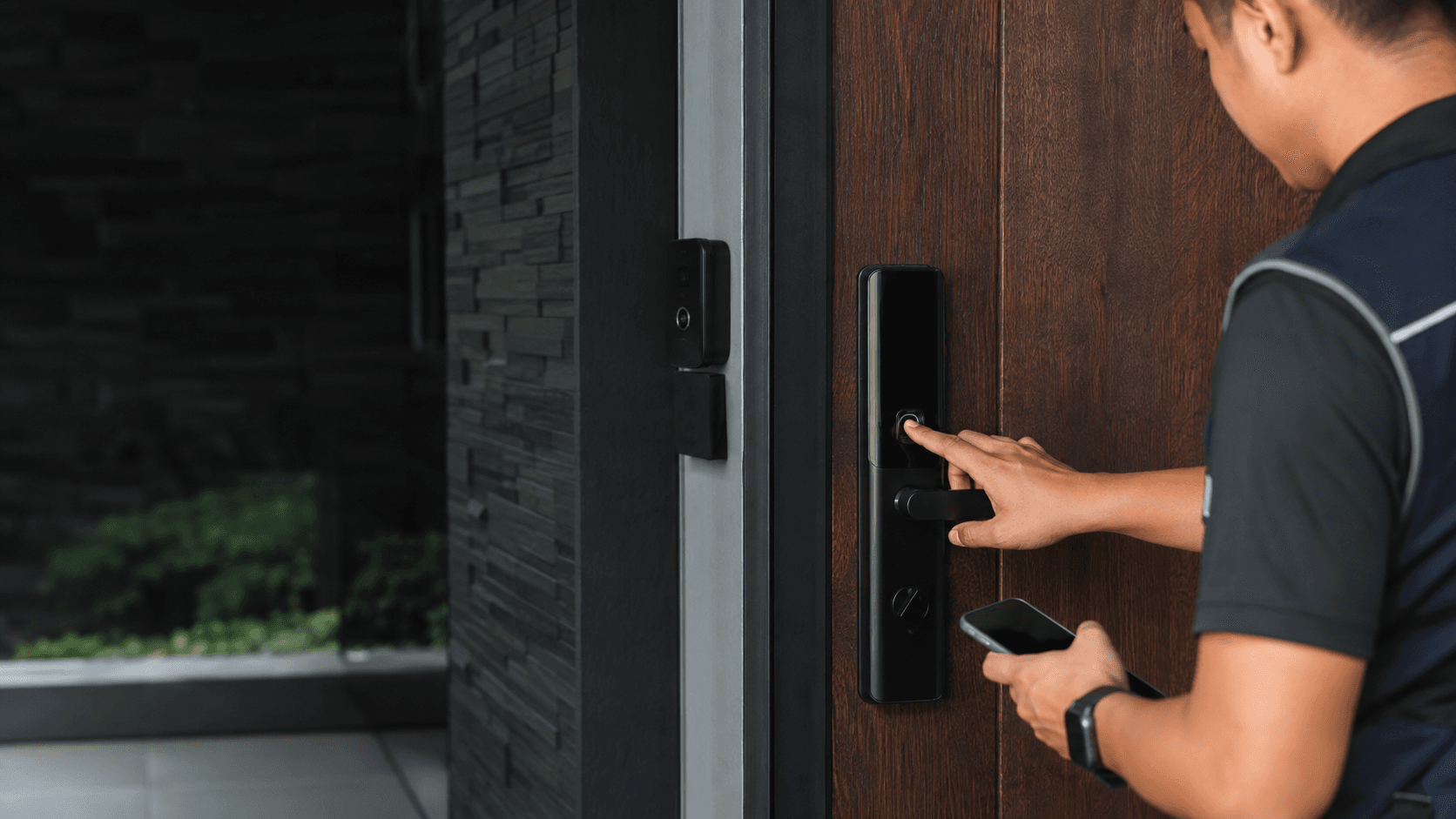
The exact-match query biometric door locks for business describes a category, not a single product. That matters in Malaysia, where a shophouse entrance, an office suite door and a warehouse side gate present very different problems. Eyonic's own product review states that smart locks work best when door condition, user roles and backup method are reviewed before installation, and that for business use the company usually checks whether a standalone smart lock or an access-control panel is more appropriate.
That single sentence carries most of the buying logic. A fingerprint reader is only one part of the decision. The rest is about who needs to enter, how often, what happens when the reader fails, and whether the door itself can accept the hardware.
Biometric Door Locks For Business: What Malaysian Premises Need To Check
Malaysian business premises vary more than most buyers expect. A single-lot office in Kuching, a corner shop in a commercial row, and an industrial unit on the outskirts each raise different questions about door type, traffic and after-hours access.
The practical checks fall into four groups: the access methods the lock supports, the door it will be fitted to, the traffic pattern through that door, and the fallback when the primary method fails. Eyonic's review of smart lock door access lists door condition, user roles and backup method as the three items reviewed before installation, which maps closely to those groups.
Public-facing operations add another layer. Eyonic's project for the Kuching Immigration Office focused on arrival flow, staff areas, visitor movement and dependable daily operation. That combination — public arrival, staff-only zones, and a requirement that the system work every day — is the same combination many Malaysian businesses face at a smaller scale.
Access methods and user roles on a business door
A biometric lock typically combines a fingerprint reader with at least one other entry method. Competitor pages in this category consistently describe combinations such as fingerprint, PIN code, RFID card, mobile app and a physical key. The exact mix varies by model, and no verified specification for a specific business lock is available here, so the useful question is which methods the premises actually needs rather than which list is longest.
User roles matter more than method count. A business door usually serves at least three groups: permanent staff, occasional staff or contractors, and visitors. Each group needs a different level of access and a different way of being removed from the system.
Fingerprint access suits permanent staff because it cannot be lent or copied. PIN codes suit temporary access because a code can be issued and revoked without hardware. A physical key or mechanical override suits the case where the electronics fail and someone still needs to open the door.
The removal problem is the one most often overlooked. When a staff member leaves, a fingerprint enrolment has to be deleted, a code changed, and a card cancelled. A lock that makes this difficult creates a security gap that has nothing to do with the reader's accuracy.
Door condition, traffic flow and backup entry
Door condition decides whether a lock can be fitted at all. Frame depth, door thickness, existing hardware, and whether the door is timber, glass or metal all affect what will mount cleanly. Eyonic's review places door condition first in the pre-installation review, ahead of user roles and backup method.
Traffic flow decides whether the lock will survive daily use. A door used by a handful of staff twice a day behaves very differently from a customer entrance opened continuously during trading hours. High-frequency doors put more wear on the mechanism and make a slow read more noticeable.
Backup entry is the constraint that turns a convenience decision into an operational one. If the reader fails, the battery drains, or a staff member's fingerprint will not read on a wet or dusty hand, the business still needs a way in. Options include a mechanical key override, a PIN code, a second reader, or a separate entrance that remains keyed.
Eyonic's review states that smart locks are good for controlled convenience when user permissions and backup entry are planned properly. The word "controlled" is doing real work there. A lock without a planned fallback is a single point of failure on a door that staff need every working day.
Standalone lock or access-control panel
The choice between a standalone smart lock and an access-control panel is the main fork in this decision, and Eyonic's review names it directly as the check the company runs for business use.
A standalone lock is self-contained. It reads the credential, decides, and releases the door. It suits a single door with a modest number of users, where the business wants a straightforward upgrade from a keyed lock without running new cabling or managing a separate system.
An access-control panel suits a different shape of problem. Multiple doors, a need to manage users centrally, a requirement to review who entered and when, or integration with other building systems all point toward a panel rather than a standalone unit. The trade-off is more planning, more installation work, and a system that needs someone to administer it.
The deciding questions are usually these: how many doors need control, how many people need access, whether entry records are needed, and whether anyone on site will actually manage the user list. A business that cannot answer the last question is often better served by a simpler standalone lock than by a panel nobody administers.
Installation and handover steps
Eyonic's published CCTV installation process runs through site survey, system proposal, installation and handover. The same sequence applies to door access work, because the survey is what establishes door condition and the handover is what confirms the user list is correct.
- Site survey — the door, frame, existing hardware, traffic pattern and power or cabling options are checked on site.
- System proposal — the survey findings are turned into a recommendation, including whether a standalone lock or an access-control panel fits the door.
- Installation — the lock or panel is fitted and configured.
- Handover — users are enrolled, backup entry is confirmed, and the people who will manage the system are shown how it works.
The survey step is where most of the risk sits. A lock chosen from a product listing without checking the door can fail at the mounting stage, and a user list designed without knowing the staff and visitor flow can be wrong from day one.
Handover is where the system becomes usable. Enrolling fingerprints, setting codes, confirming the mechanical override works, and showing the responsible person how to add or remove a user are all part of making the installation complete rather than merely finished.
Practical next step with Eyonic
Eyonic Sdn Bhd plans, supplies and installs security and ELV systems for homes, offices, shops and industrial sites, with work concentrated in Sarawak. The company's project record includes the Kuching Immigration Office and KTA Sarawak Sdn Bhd, both of which involved staff movement, visitor handling and daily operational reliability rather than hardware alone.
For a door access enquiry, the useful information to bring is the location, the property type, the number of doors involved, and the required system. That is enough for a survey to be scoped and for the standalone-versus-panel question to be answered against the actual door.
Share your location, property type and required system with Eyonic on WhatsApp at +60 11-5111 7959 for the next practical step.