
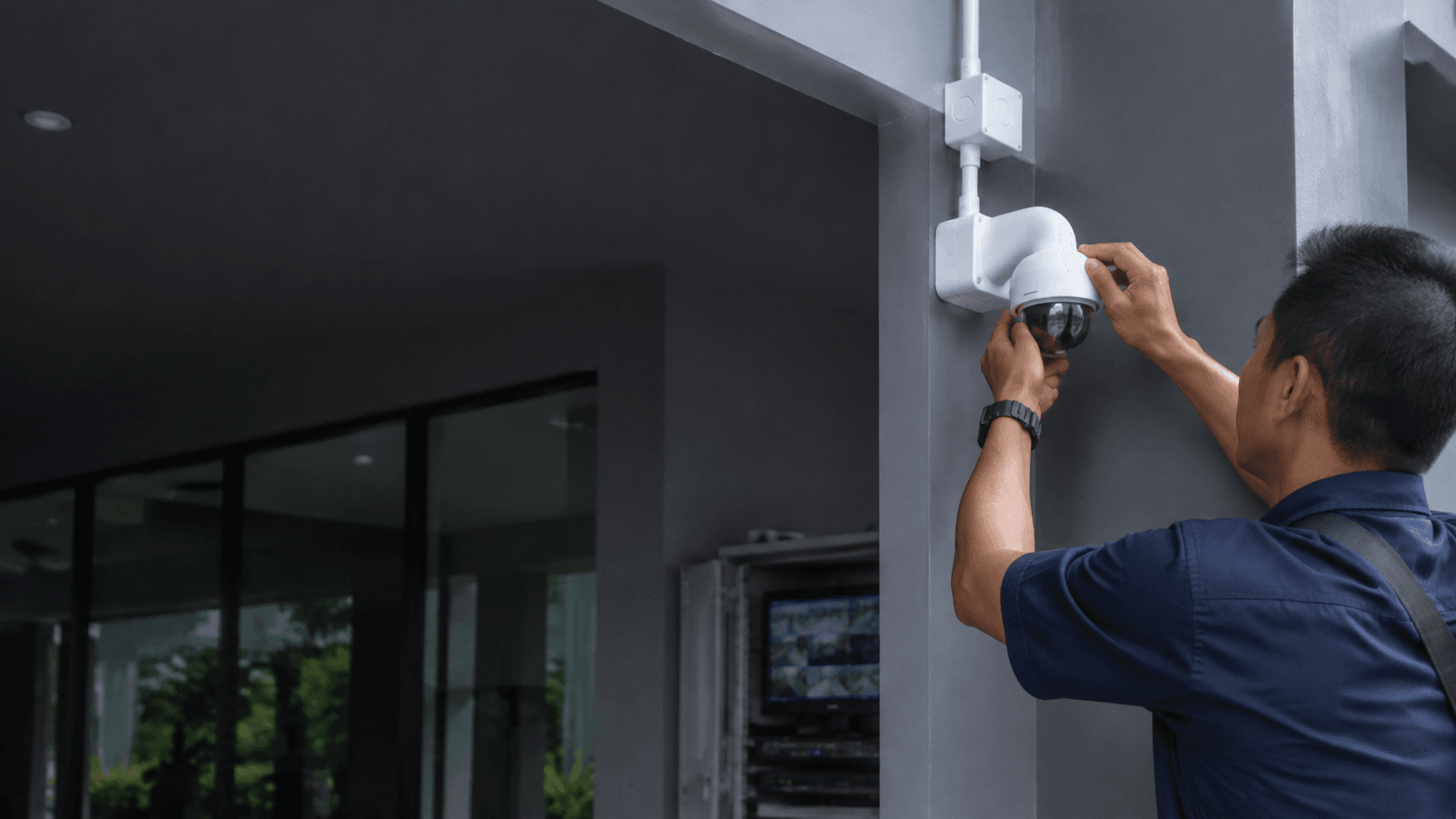
The scope question matters more than the product question. A camera that watches a gate, a back lane, or a car porch is doing a different job from one mounted above a reception desk, and the planning that surrounds it changes accordingly. Eyonic Sdn Bhd, a security system supplier based in Sarawak, handles that planning, supply, and installation work for residential and commercial premises.
Outside Security Systems. What the Scope Usually Covers
An outdoor setup is a small system, not a single device. It normally brings together cameras positioned to watch approaches and perimeters, a recorder that stores what those cameras capture, and a viewing method so footage can be checked without standing at the recorder.
Eyonic describes its CCTV work as planning, supplying, and installing monitoring systems with camera placement, recording, and remote viewing for homes, offices, shops, and industrial sites. Those four elements — placement, recording, remote viewing, and the site types served — define the working scope of an outdoor installation.
Two related services often sit alongside outdoor cameras on the same property. Alarm systems cover intrusion detection at entry points, and autogate packages handle vehicle access at the driveway. Both are listed by Eyonic as separate installation services, which matters because a gate camera and a gate motor solve different problems even when they sit metres apart.
Why Outdoor Coverage Differs From Indoor Coverage
Indoor cameras work in a controlled box. Ceilings are a known height, walls are close, and lighting is broadly consistent through the working day. Outdoors, none of that holds. A camera aimed down a driveway may face direct morning sun and deep shadow in the same frame, and the distance from camera to subject is set by the property rather than the room.
That difference drives three practical consequences.
First, placement carries more weight outdoors because repositioning later usually means new cable runs and new mounting points. Second, lighting becomes a design input rather than an afterthought, since a camera that performs well at midday may behave differently after dark. Third, the recorder and viewing setup must handle cameras that are physically spread out rather than clustered in one corridor.
Eyonic's own guidance on Hikvision ColorVu-style cameras reflects this: the recommendation is to check actual lighting conditions before confirming placement. That is a site-specific check, not a specification lookup, because the same camera can sit in very different light on two neighbouring properties.
What outdoor coverage does not automatically include
An outdoor camera position does not by itself provide monitoring, a subscription service, or a guaranteed response. Eyonic's published material covers planning, supply, installation, and handover of the equipment and viewing setup. Anything beyond that — such as a monitoring arrangement — would need to be confirmed separately rather than assumed from the camera installation.
Outside Security Systems Planning Around Lighting and Placement
Placement decisions are easier to make in a fixed order, because each choice constrains the next. The sequence below follows the four-step process Eyonic uses for CCTV installation work in Sarawak.
- Site survey. The property is walked and the points that need watching are identified — entries, vehicle approaches, side lanes, and any area where movement is hard to see from inside.
- System proposal. The survey findings are turned into a proposed setup covering camera positions, recording, and viewing, so the scope is agreed before any drilling starts.
- Installation. Cameras, cabling, and the recorder are fitted according to the agreed positions.
- Handover. The system is explained and the viewing setup is passed to the people who will use it day to day.
The survey step is where most of the value sits. A camera mounted where the installer can reach it easily is not always the camera mounted where the coverage is needed, and the survey is the point at which that trade-off gets discussed rather than discovered afterwards.
Lighting belongs in the same conversation. A position that looks clean on a plan may sit under a bright security light that washes out the frame, or in a corner that receives almost no light at all. Checking the actual conditions at the actual position, before the bracket goes up, is the approach Eyonic recommends for ColorVu-style cameras.
Remote viewing and NVR setup
Remote viewing is what turns recorded footage into something useful when nobody is on site. It depends on the recorder being configured correctly and on the viewing device being set up during handover rather than left to the property owner to work out later. Eyonic lists NVR setup and remote viewing as distinct parts of its CCTV service, which reflects that these are configuration tasks rather than plug-in steps.
How a Sarawak Installation Is Surveyed and Handed Over
Local conditions shape the work. Sarawak properties range from single-storey homes with open car porches to multi-level commercial premises, and the survey has to account for how each one is actually used rather than how it looks on a floor plan.
Eyonic's completed work includes the Kuching Immigration Office, where the focus was arrival flow, staff areas, visitor movement, and dependable daily operation. That is a useful illustration of how outdoor and perimeter coverage connects to a wider operational need: the cameras are not there to produce footage for its own sake, but to support how a busy public building runs every day.
A second project, for KTA Sarawak Sdn Bhd, covered a practical office setup in Kuching supporting staff movement, visitor handling, tidy cabling, and clearer daily site control. Tidy cabling appears in that description for a reason — on an outdoor installation, cable routing is visible work, and how it is run affects both the appearance of the property and how easily the system can be maintained later.
Handover is the step that determines whether any of this gets used. A system that is installed but not explained tends to be checked once and then ignored. Handover is where the viewing setup, the recording behaviour, and the day-to-day expectations get walked through with the people who will actually operate it.
Costs Packages and What Changes the Budget
Eyonic publishes three packages at RM 1,599 each, and they cover different jobs rather than different tiers of the same job.
- Hikvision CCTV Package — RM 1,599. Camera supply and setup, basic recording configuration, and mobile viewing handover.
- Hikvision Alarm System — RM 1,599. Control panel and sensors, siren and zone setup, and user testing and handover.
- Autogate Package — RM 1,599. Motor recommendation, remote-control setup, and safety testing and handover.
Larger projects sit well above package level. Eyonic's published project budgets include RM 12,000 to RM 28,000 for work of the type carried out at the Kuching Immigration Office, and RM 8,000 to RM 18,000 for work of the type carried out at KTA Sarawak Sdn Bhd. Those ranges describe project scale, not a price list, and they reflect the difference between a straightforward residential installation and a multi-area commercial one.
What moves a budget upward is usually scope rather than equipment grade. More camera positions mean more cabling, more mounting, and more configuration. Longer cable runs across a large compound add labour. Multiple buildings on one site add complexity to both the recording setup and the viewing arrangement. A property where the survey identifies several distinct areas to cover will land closer to the project ranges than to a single package.
Where the published evidence stops
Eyonic's published material does not state camera resolutions, lens sizes, night-vision distances, storage capacities, or weatherproofing ratings for outdoor installations. It also does not state monitoring subscription terms, warranty length, or response times, and it does not give coverage area limits, cable run lengths, or channel counts. Those details are best confirmed against the specific proposal produced after a survey, because they depend on the property rather than on a standard configuration.
Questions Buyers Ask Before Committing
How many cameras does an outdoor setup need? The count follows the number of distinct areas that need watching, not the size of the property. A survey identifies those areas first, and the camera count falls out of that list.
Can an outdoor system be added to later? Adding positions after the fact is possible but usually involves new cabling and mounting work, which is why the survey is the right moment to think through coverage rather than the installation day.
Does outdoor coverage replace an alarm system? No. Cameras record and support viewing; an alarm system detects intrusion at entry points and triggers a siren. Eyonic supplies and installs both as separate services, and many properties use them together.
What happens at handover? The system is explained and the viewing setup is passed over, so the people using it know how to check footage and what the recording is doing. Handover is a named step in Eyonic's installation process, not an informal walkthrough.
Why does lighting get checked on site? Because the same camera position can perform very differently depending on what light reaches it. Eyonic recommends checking actual lighting conditions before confirming placement for ColorVu-style cameras, which is a site check rather than a specification decision.
For a property in Sarawak, the practical next step is a survey rather than a package selection. Sharing the location, property type, and the system being considered with Eyonic on WhatsApp at +60 11-5111 7959 gives the survey something concrete to work from.