
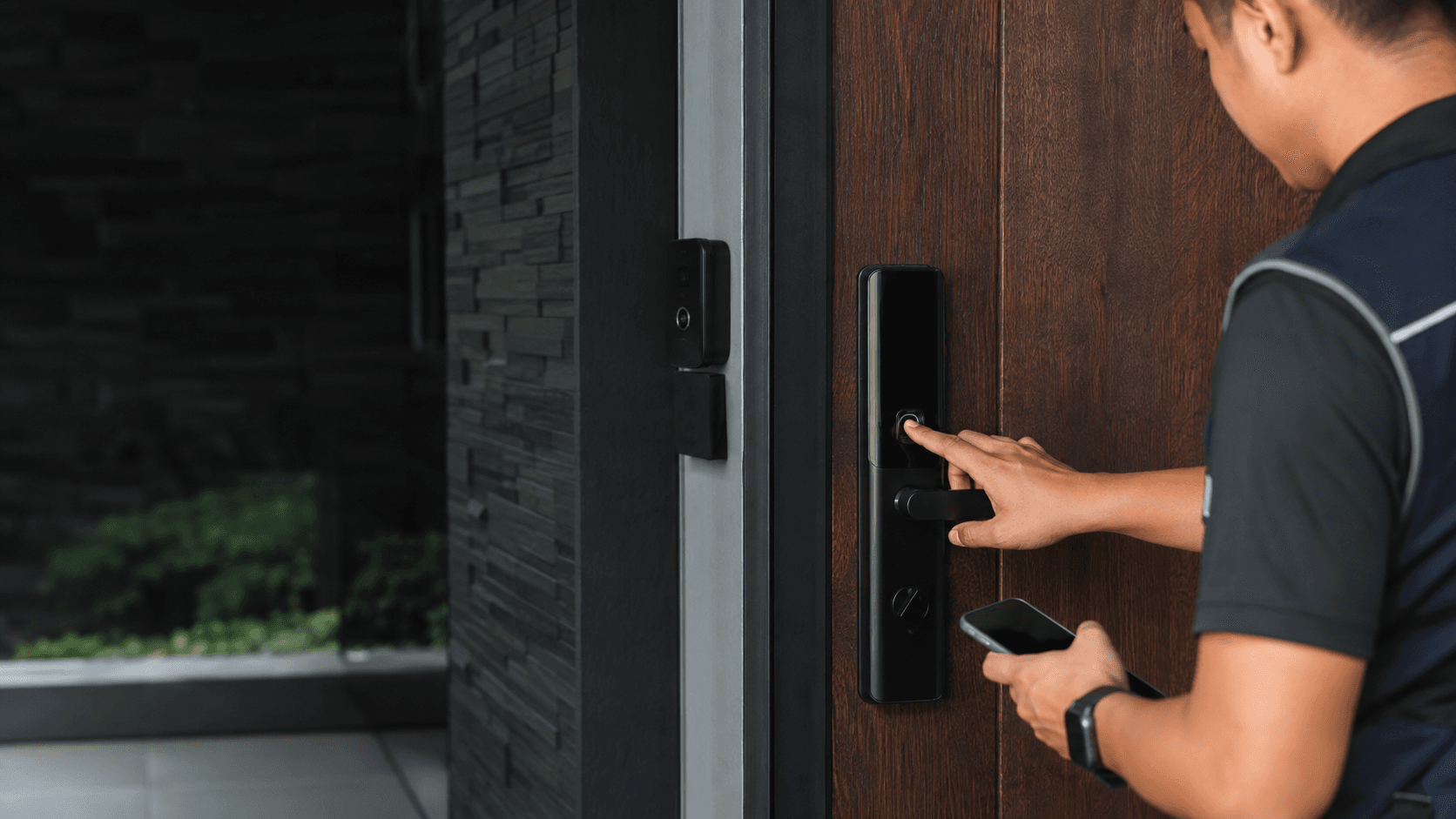
The exact-match query "hugolog lock" points to a specific product family rather than a generic category, and the useful questions sit around access methods, model differences, and what a Malaysian door needs before anything is ordered. The sections below cover what the lock does at the door, how the models differ, and what to verify before committing.
What a Hugolog Lock does at the door
A Hugolog Lock replaces or augments an existing deadbolt so the door can be opened without a turning key. The core access methods documented across the product line are a numeric PIN entered on the keypad, app-based control over Bluetooth, and a physical override key for backup.
PIN entry is the everyday method. The JU01 product page states the lock stores up to 20 PIN codes and includes an anti-peek PIN feature, which lets a user enter extra digits around the real code so an observer cannot read the sequence from finger position. The how-it-works page describes assigning access PINs to up to 20 different users and setting temporary access PINs for guests, which is the mechanism that makes the lock practical for a household with regular visitors or short-stay occupants.
Auto-lock is the second mechanism worth understanding. Rather than relying on a person to secure the door, the lock can be set to re-engage the deadbolt after a delay. That matters most on entrance doors that are opened and closed repeatedly during the day, because the failure mode of a manual deadbolt is simply that someone forgets.
App control adds a remote layer, but it depends on a Bluetooth hub. The support documentation separates the lock from the hub and treats the hub as the bridge that allows app control beyond direct Bluetooth range. Without the hub, app functions are limited to what a nearby phone can reach. That distinction is the single most common source of confusion when a buyer expects remote unlocking from another state or country.
Hugolog Lock models and access options
The model names that appear in Hugolog's own product and support pages are HU01, HU02, HU03, HU04, and JU01. The HU01 and JU01 are presented as digital deadbolts, while the HU03 is presented as a smart lock. The support page lists separate installation guides and programming instructions for HU01, HU02, HU03, and HU04, and installation videos split between keyless entry models (HU01, HU02) and smart lock models (HU03, HU04).
That split is the clearest structural signal available. Keyless entry models centre on the keypad and the physical key. Smart lock models centre on app interaction and the connected experience. The JU01 page describes a motorised deadbolt that replaces an existing deadbolt, completely keyless entry with a digital keypad, storage for up to 20 PIN codes, an anti-peek PIN, and a stated battery life of up to one year.
Beyond those published points, model-by-model differences in dimensions, materials, wireless protocol, and operating temperature are not documented in the material available here, so no comparison table is offered. A buyer comparing HU01 against HU03 should work from the official installation guide and specification sheet for each model rather than from a summary.
Backup keys and override access
The support documentation includes a dedicated override and backup key section covering which key blank to use for additional override keys, what to do if an override key is lost, and why an override key may fail to unlock. The practical reading is that the physical key is a genuine fallback rather than a decorative feature, and that a spare should be cut and stored away from the property before the lock is relied on daily.
App, hub, and connectivity limits
Adding a lock to the Hugolog app and adding a Bluetooth hub are documented as separate setup tasks. The support material also addresses a lock reporting Bluetooth offline and how close the hub must be plugged in relative to the lock. For a Malaysian property with thick walls or a lock mounted on a metal gate, hub placement is a real constraint rather than a formality, and it should be settled during installation rather than after.
How a Hugolog Lock fits a Malaysian property
Malaysian entrance doors vary widely. A landed property in Sarawak may have a timber entrance door with an existing deadbolt, a metal gate with a separate lock, or a grill door that sits in front of the main door. A condominium unit typically has a single fire-rated entrance door with a deadbolt already fitted by the developer.
The first compatibility question is whether the existing deadbolt can be replaced. The support documentation asks directly whether an existing deadbolt can be kept when installing a Hugolog smart lock or keyless entry, and whether the backset of a deadbolt can be changed. Backset is the distance from the door edge to the centre of the deadbolt bore, and it is the measurement that most often decides whether a retrofit is straightforward or requires additional drilling.
The second question is the door itself. The support material covers whether drilling is required, what tools are needed, and whether the lock is waterproof and in what weather conditions it can function. For an external gate or a door exposed to direct rain, that answer determines whether the lock belongs on that door at all. For a covered entrance or an internal door, exposure is far less of a concern.
The third question is who needs access and how often it changes. A family home with a fixed set of occupants needs far less administration than a shop unit with rotating staff, a rental unit with short-stay guests, or an office with contractors arriving on different days. The lock's user-role and PIN management features are what make it workable in the second case, and the absence of a clear access plan is what makes it frustrating.
For business premises, the choice is not automatically a smart lock. A standalone smart lock suits a single controlled entrance with a small, stable user group. Where multiple doors, staff attendance records, or integration with an existing access-control panel are required, a panel-based system is usually the more appropriate route. That distinction is worth settling before any hardware is selected.
What to check before choosing a Hugolog Lock
The checks below are the ones that determine whether the installation is simple or becomes a return visit. They apply equally to a home entrance and a small commercial door.
- Measure the existing deadbolt and confirm the door thickness, backset, and bore diameter against the installation guide for the specific model.
- Decide who needs access, what role each person holds, and whether any of those permissions need to expire automatically.
- Confirm the backup entry method and cut a spare override key before the lock becomes the only way in.
- Establish whether app control is needed at all, and if so, where the Bluetooth hub will be powered and how far it sits from the lock.
- Check the door's exposure to rain and direct sun if the lock is going on an external gate or an uncovered entrance.
- Agree the handover. who holds the master code, who administers PINs, and who is contacted when the lock reports a fault.
Two of these deserve emphasis. The backup key check is the one most often skipped, and it is the one that matters when a battery runs flat or an app fails. The hub placement check is the one most often assumed, and it is the one that produces the "Bluetooth offline" complaint documented in the support material.
Door condition and deadbolt compatibility
A deadbolt that is stiff, misaligned, or worn will not become reliable because a motor is now driving it. If the existing bolt needs a shoulder to the door to engage, a motorised deadbolt will struggle or report a fault. Checking the mechanical condition of the door and frame before purchase is cheaper than discovering the problem after installation.
User roles permissions and audit
The how-it-works material describes reviewing the history of who opens the door, which is the feature that turns a lock into a light access record. For a shop or office, that history is the practical reason to choose a connected model over a purely mechanical keypad. For a home, it is a convenience rather than a requirement.
Installation handover and local support
Hugolog publishes installation guides and programming instructions per model, along with installation videos split between keyless entry and smart lock ranges. That documentation supports a competent DIY installation on a standard door where the existing bore already matches. It does not resolve a door that needs new drilling, a metal gate that needs fabrication, or a lock that must be integrated with an existing alarm or access system.
For those cases, the practical route is a site survey before purchase. Eyonic's installation process for security systems follows site survey, system proposal, installation, and handover, and the same sequence applies to door access work: the door is measured, the access requirement is mapped, the hardware is selected, and the handover covers user setup and testing. Eyonic has completed work for the Kuching Immigration Office, focused on arrival flow, staff areas, visitor movement, and dependable daily operation, and for KTA Sarawak Sdn Bhd, covering staff movement, visitor handling, and tidy cabling.
Handover is where most of the value sits. A lock that is installed but whose master code, user list, auto-lock delay, and hub placement are not documented will generate support calls. A handover that records those settings and confirms the backup key works gives the property a lock that can be managed without the installer present.
Where a property needs door access alongside cameras, an alarm, or an intercom, planning them together avoids duplicated cabling and separate apps. Eyonic supplies and installs CCTV, alarm, autogate, keyphone intercom, and Starlink systems in Sarawak, with published packages starting at RM 1,599 for the Hikvision CCTV package, the Hikvision alarm system, and the autogate package. Door access is reviewed on the same basis: whether a standalone smart lock or a panel-based access-control system fits the site.
For a property in Sarawak, sharing the location, property type, and required system with Eyonic on WhatsApp at +60 11-5111 7959 is the next practical step, and it allows the door and access requirement to be assessed before any hardware is specified.
What remains unverified
Several details that buyers commonly ask about are not documented in the material available here and should be confirmed directly with the supplier or from official Hugolog documentation before purchase. These include technical specifications for each model, pricing in Malaysia, warranty terms, local distributor and support arrangements, and whether a specific model meets Malaysian door, fire, or building requirements. Treating those as open questions is more useful than assuming an answer.