
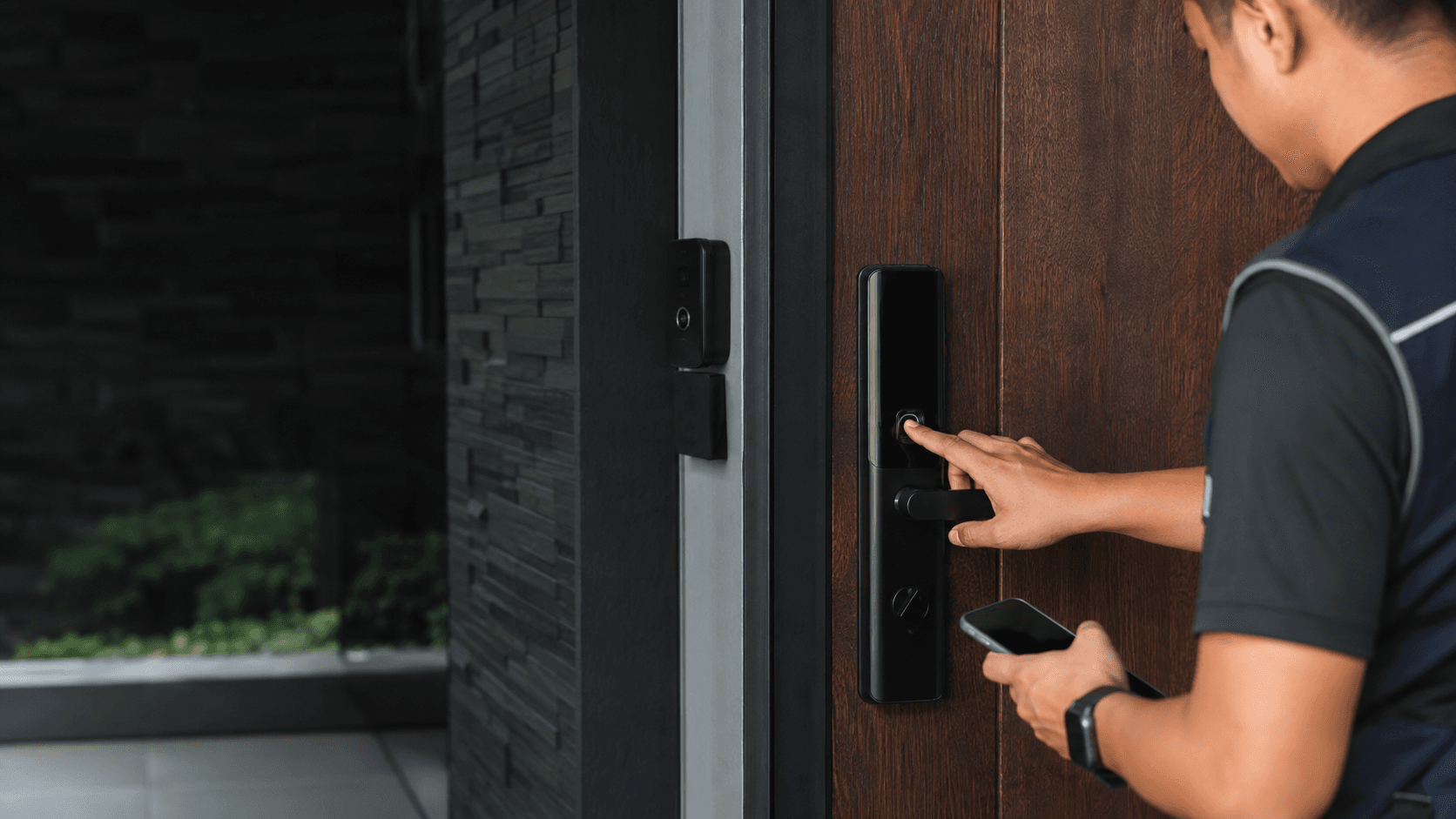
That single change moves the decision point from "who holds a key" to "who holds a code." Everything else — the door, the frame, the users, the backup plan — stays exactly where it was. A keypad deadbolt does not fix a door that already swings loose, and it does not decide who is allowed in at 2am. Those are still human decisions, made before anything is mounted.
Kwikset Keyless Door Lock. what keyless entry changes at the door
Keyless entry removes the physical key from daily use. Access happens through a code entered on a keypad or touchscreen, and the lock still throws a deadbolt or latches a lever exactly as a mechanical lock does. The bolt is not the innovation; the credential is.
Three practical consequences follow. First, a lost key stops being an emergency, because there is no key to lose. Second, a shared code becomes a shared secret, which means it has to be changed when a tenant, cleaner, or staff member leaves. Third, the lock now depends on power, so a dead battery becomes a lockout risk rather than an inconvenience.
Kwikset's own product pages describe electronic locks as operated by a keypad or touchscreen, with entry by personalised access code and locking by a button press. That is the whole mechanism in one line. The rest is fit.
Keypad, touchscreen, and lever formats in the Kwikset range
Kwikset groups its electronic range into deadbolts, levers, and smart locks. The deadbolt form is the one most people picture: a keypad or touchscreen on the outside face, a thumb-turn or motor inside, and a bolt into the frame. The lever form suits interior doors — an office, a store room, a wine cellar — where a deadbolt would be the wrong hardware. Smart lock variants add wireless communication so the lock can talk to other devices.
Two named technologies recur across Kwikset's pages. SmartCode is the electronic keypad deadbolt family. SmartKey Security is the re-keying system that lets a cylinder be re-keyed without removing the lock from the door. Both appear repeatedly in the competitor set, and both are worth understanding before choosing a format, because they answer different questions: SmartCode answers "how do I get in without a key," SmartKey Security answers "how do I change who can get in with a key."
SecureScreen is also named on Kwikset pages in connection with touchscreen security. The claim attached to it concerns fingerprint and code detection on touchscreen models. That claim belongs to Kwikset's documentation, not to this page, and should be read there before it is relied on.
Format choice follows the door, not the catalogue. A metal gate frame, a hollow-core interior door, and a solid timber entrance door each present different mounting realities, and none of them are resolved by picking the prettier keypad.
Door condition, user roles, and backup entry before installation
Eyonic's own smart lock review states the position plainly: smart locks work best when door condition, user roles, and backup method are reviewed before installation. For business use, the same review asks whether a standalone smart lock or an access-control panel is the more appropriate answer. That is the correct order of operations, and it applies to a Kwikset Keyless Door Lock as much as to any other brand.
The checks below are the ones that decide whether the installation is straightforward or becomes a return visit.
- Door and frame condition. Check that the door closes squarely, that the existing bolt lines up with the strike, and that the frame is not swollen, warped, or packed with filler. An electronic lock on a misaligned door will bind, and binding wears motors.
- User roles and permissions. Decide who needs a permanent code, who needs a temporary one, and who should be removed on a schedule. A household needs one answer; a shop with rotating staff needs another.
- Backup entry method. Confirm how the door opens when the battery is flat or the code is forgotten. This is the single most common gap in residential installs, and it is a planning decision, not a product feature.
- Power or battery plan. Establish who checks the battery, how often, and what warning the lock gives before it fails. A lock that reports low battery is only useful if someone reads the report.
- Standalone lock or access-control panel. For a business with multiple doors, staff shifts, and an audit requirement, a standalone lock may be the wrong tool. A panel-based system handles permissions centrally; a standalone lock handles them one door at a time.
- Door type and thickness. Confirm the door can accept the hardware before ordering. Metal gate frames, glass doors, and unusually thin or thick doors all need checking against the manufacturer's requirements.
The trade-off is real. A standalone lock is cheaper, faster to install, and needs no network. A panel-based system costs more and takes longer, but it answers questions a standalone lock cannot: who entered, when, and through which door. For a single home entrance, the standalone lock usually wins. For a staffed office with a rear entrance and a store room, the panel usually wins.
How a Kwikset Keyless Door Lock fits with CCTV, alarm, and intercom work
A door lock is one layer. It controls entry; it does not record it, announce it, or let anyone speak to the person at the door. Those jobs belong to other systems, and the useful question is how they hand off to each other.
CCTV covers the approach and the doorway. A camera above an entrance shows who arrived and what they did, which is the record a lock cannot produce on its own. Placement matters more than specification here — Eyonic's own guidance on ColorVu-style cameras is to check actual lighting conditions before confirming placement, and the same logic applies at a door where a porch light, a corridor light, or a glass reflection can change what a camera actually sees.
An alarm system covers the perimeter and the interior. A door lock and an alarm panel are separate systems unless they are deliberately integrated, and integration is a decision made at design stage, not after both are installed.
A keyphone intercom covers the conversation. For an office or a gated property, the intercom is what lets a visitor be identified and admitted without walking to the door. A keypad lock and an intercom solve adjacent problems: the intercom decides whether to open, the lock decides who can open without asking.
Eyonic's project work shows the pattern in practice. The Kuching Immigration Office project focused on arrival flow, staff areas, visitor movement, and dependable daily operation. The KTA Sarawak Sdn Bhd project covered staff movement, visitor handling, tidy cabling, and clearer daily site control. Both are access-and-visibility problems, and both are solved by systems working together rather than by any single device.
What to confirm before ordering in Malaysia
Malaysian buyers face a specific set of unknowns that a manufacturer's global page does not resolve. The honest position is that several of these cannot be answered from a product page at all.
Local stock and pricing for Kwikset keyless door lock products are not published in a form this page can verify, so no figure is quoted here. Warranty terms vary by distributor and by channel, and a warranty that applies in one market may not transfer to another. Compatibility with specific hubs, apps, or platforms is model-specific and should be confirmed against the exact model number before purchase, not against the brand name.
Installation requirements for Malaysian door types are the most common source of surprises. Metal gate frames, solid timber doors, and hollow interior doors each need different preparation, and a lock specified for a North American residential door may not suit a local gate. This is a measurement question, answered at the door, not at the keyboard.
One further point deserves stating plainly: whether a given supplier stocks or installs Kwikset-branded locks specifically is a question for that supplier. Brand availability and installation capability are separate facts, and assuming one from the other is how orders go wrong.
Practical next step with Eyonic
Eyonic Sdn Bhd is a security system supplier in Sarawak working across CCTV, alarm, autogate, keyphone intercom, and smart lock door access, with planning, supply, and installation handled as one process. The company's stated installation sequence runs site survey, system proposal, installation, and handover — which means the door gets looked at before anything is specified.
For a door access decision, that sequence matters. A survey establishes the door condition, the frame, the user roles, and the backup requirement. A proposal then states whether a standalone lock or a panel-based approach fits. Installation and handover close the loop, including the part most often skipped: making sure the people who use the door every day know how to use it, and know what to do when the battery runs down.
Eric Yong founded Eyonic Security Systems and has worked in the industry for more than ten years, with experience in technical installation of digital security solutions for commercial businesses in Sarawak. That background is relevant to the access-control question specifically, because the standalone-versus-panel decision is usually made on operational grounds rather than product grounds.
Eyonic's published packages — a Hikvision CCTV package, a Hikvision alarm system, and an autogate package, each at RM 1,599 — cover adjacent systems rather than door locks, and are listed here as context for how the company structures its work, not as a lock price.
Share your location, property type and required system with Eyonic on WhatsApp at +60 11-5111 7959 for the next practical step.