
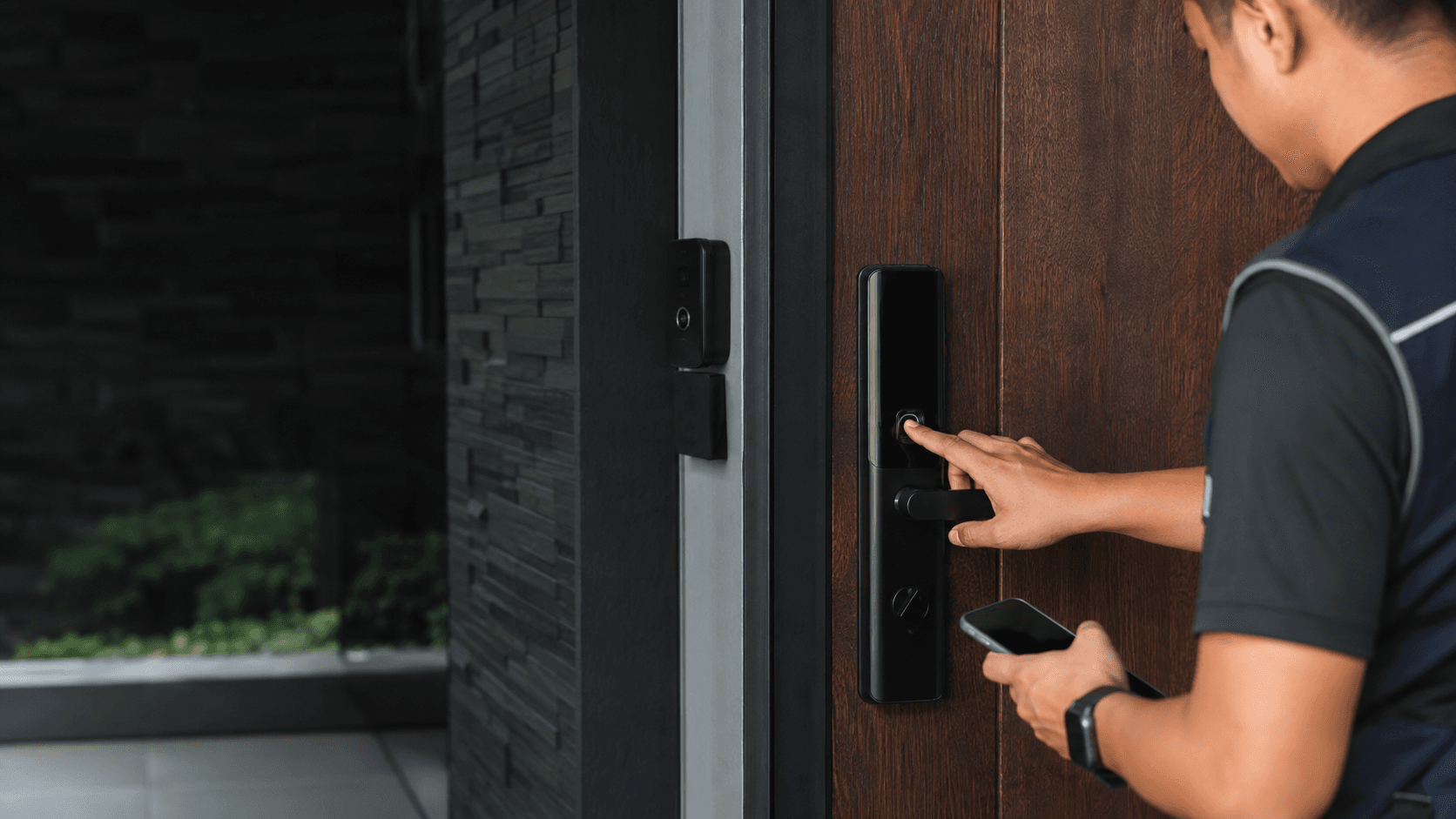
The brand's own store lists several product lines, including the M6, A1 and Y1 series, with models sold as deadbolts, handle sets and front-door lock sets. Third-party reviews describe a Bluetooth-first lock with an optional Wi-Fi gateway, which matters because the gateway is what turns app control into remote control rather than short-range control.
What follows covers what the product family includes, how access methods work in practice, how power and backup entry behave, what door and user-role checks come first, and how installation and support work in Malaysia.
What a Smonet Lock covers in a door access setup
A Smonet Lock is a battery-powered electronic lock that replaces or supplements a mechanical door lock. Access is granted through a fingerprint reader, a keypad code, a phone app over Bluetooth, an IC card or fob on some models, and a physical key as a fallback. The lock body, keypad and reader sit on the exterior, while the interior side holds the battery compartment and manual controls.
The practical difference between a Smonet Lock and a conventional deadbolt is who can be let in and how that access is withdrawn. A mechanical lock gives one key that must be copied or replaced. An electronic lock lets individual codes or fingerprints be added and removed without changing hardware, which is why the product family is often considered for rental units, home offices and small commercial doors.
Eyonic's own review guidance states that smart locks work best when the door condition, user roles and backup method are reviewed before installation, and that for business use the choice between a standalone smart lock and an access-control panel should be checked first. That framing applies directly to a Smonet Lock: the lock is the hardware, but the access decision is about who needs entry and how that entry is audited.
Smonet Lock models and access methods seen in the market
Product listings show the range split by form factor rather than by technology. Deadbolt models replace the existing deadbolt. Handle-set and lockset models replace the whole handle assembly. Front-door lock sets bundle the exterior and interior hardware together. The naming follows the series and a suffix that indicates the finish and configuration, so two models in the same series can differ only in colour or handle style.
Access methods repeat across the range. A fingerprint reader handles the fastest everyday entry. A touchscreen or physical keypad handles codes for family, guests or service people. The app handles user profiles, code creation and deletion, and event history. Some models add voice unlock through a compatible assistant, and some support a wearable unlock. A physical key remains as the mechanical fallback.
Two behaviours are worth knowing because they affect daily use. Anti-peep entry allows random digits before or after the correct code, which reduces the risk of an observed code. A wrong-entry limit shuts the keypad down temporarily after repeated failed attempts, which is a deliberate trade-off: it slows an attacker but can also lock out a legitimate user who mistypes repeatedly.
App control and the gateway question
App control over Bluetooth works only within short range of the door. Remote control, remote status checks and remote unlock require a separate gateway that connects the lock to the network. That gateway is sold separately on at least one documented model, so a buyer comparing listings should confirm whether the gateway is included before assuming remote access is part of the purchase.
This is the single most common expectation gap in the category. A lock advertised with app control may still require a person to be near the door unless the gateway is added. For a Malaysian home where the door is a short walk away, Bluetooth-only control is usually sufficient. For a shop or office where the owner wants to grant entry while off site, the gateway is the part that makes that possible.
Power, battery and backup entry on a Smonet Lock
The lock runs on batteries, and the app reports battery level with a low-battery reminder. The exact battery type and rated life are not confirmed in the available evidence, so a buyer should treat battery figures from any single listing as model-specific rather than family-wide.
Backup entry is the part that decides whether a dead battery becomes a lockout. Documented models provide a physical key as the mechanical fallback, and at least one review describes a micro-USB power option for temporary power. The practical rule is that the mechanical key should be stored somewhere outside the door, because a key kept inside the house is useless when the lock is flat.
Auto-lock is configurable on documented models, with a timer range that allows the door to relock itself after a set interval. That is convenient on a main door and inconvenient on a door that is constantly in use, such as a shop entrance during trading hours. The setting is a policy decision, not a fixed feature.
Door condition and user roles before choosing a Smonet Lock
Door condition comes first. A smart lock needs a door that closes squarely, a frame that holds the strike plate in alignment, and enough thickness and backset for the lock body. A door that already sticks or needs lifting to latch will fight an electronic deadbolt, because the motor or the user has to overcome the same misalignment every time. Fixing the door is cheaper than replacing the lock twice.
User roles come second. A household needs a small number of permanent credentials and a way to issue temporary ones. A business needs to know who entered, when, and whether that record can be produced later. A standalone smart lock handles the first case well. The second case may need an access-control panel instead, which is the check Eyonic applies before recommending hardware for business use.
Three questions sort most cases quickly. How many people need regular entry? Does anyone need entry while nobody is on site? Does the door need a record of movement? A home with a family answers no to the last two and fits a standalone lock. A shop with staff shifts and deliveries answers yes and may need more than a lock.
Where a Smonet Lock fits and where it does not
It fits a main door on a home, a rental unit where codes can be reset between tenants, a small office with a handful of staff, and a door where the owner wants to stop managing physical keys. It fits less well where the door is misaligned, where the environment is exposed to heavy rain or salt air without a covered entrance, and where the requirement is a full audit trail across multiple doors.
For multi-door sites, the sensible approach is to treat the smart lock as one component of a wider access plan rather than the whole system. Eyonic's work for the Kuching Immigration Office focused on arrival flow, staff areas, visitor movement and dependable daily operation, which is the same planning question at building scale: who moves where, and what has to keep working every day.
Local installation and support for a
Installation is a door-fitting job before it is an electronics job. The existing lock is removed, the bore and backset are checked against the new hardware, the strike plate is aligned, and the lock is mounted and tested through several open-and-close cycles. Programming follows. admin code, user codes, fingerprints, auto-lock interval and the backup key test.
Eyonic's installation process for security systems follows a defined sequence that applies to door access work as well.
- Site survey to check the door, frame, alignment and existing hardware.
- System proposal covering the lock model, access methods and user roles.
- Installation and mounting, followed by programming and testing.
- Handover covering code management, battery checks and backup entry.
Support matters more than the initial fitting, because access needs change. Staff leave, tenants change, and a code that was issued for a contractor should be removed when the work finishes. A lock that cannot be reprogrammed easily becomes a lock that keeps old credentials active.
For readers in Sarawak, Eyonic Sdn Bhd plans, supplies and installs security and ELV systems for homes, offices, shops and industrial sites, and the founder, Eric Yong, has more than ten years in technical installation of digital security solutions for commercial businesses in Sarawak. Smart lock door access is listed among the products the company reviews and supplies.
Pricing for a Smonet Lock in Malaysia is not confirmed in the available evidence, so no figure is quoted here. Eyonic's published packages are for different products: Hikvision CCTV, alarm and autogate packages are each listed at RM 1,599. A door access quotation depends on the door, the model and whether a gateway or additional doors are involved.
Share your location, property type and required system with Eyonic on WhatsApp at +60 11-5111 7959 for the next practical step.