
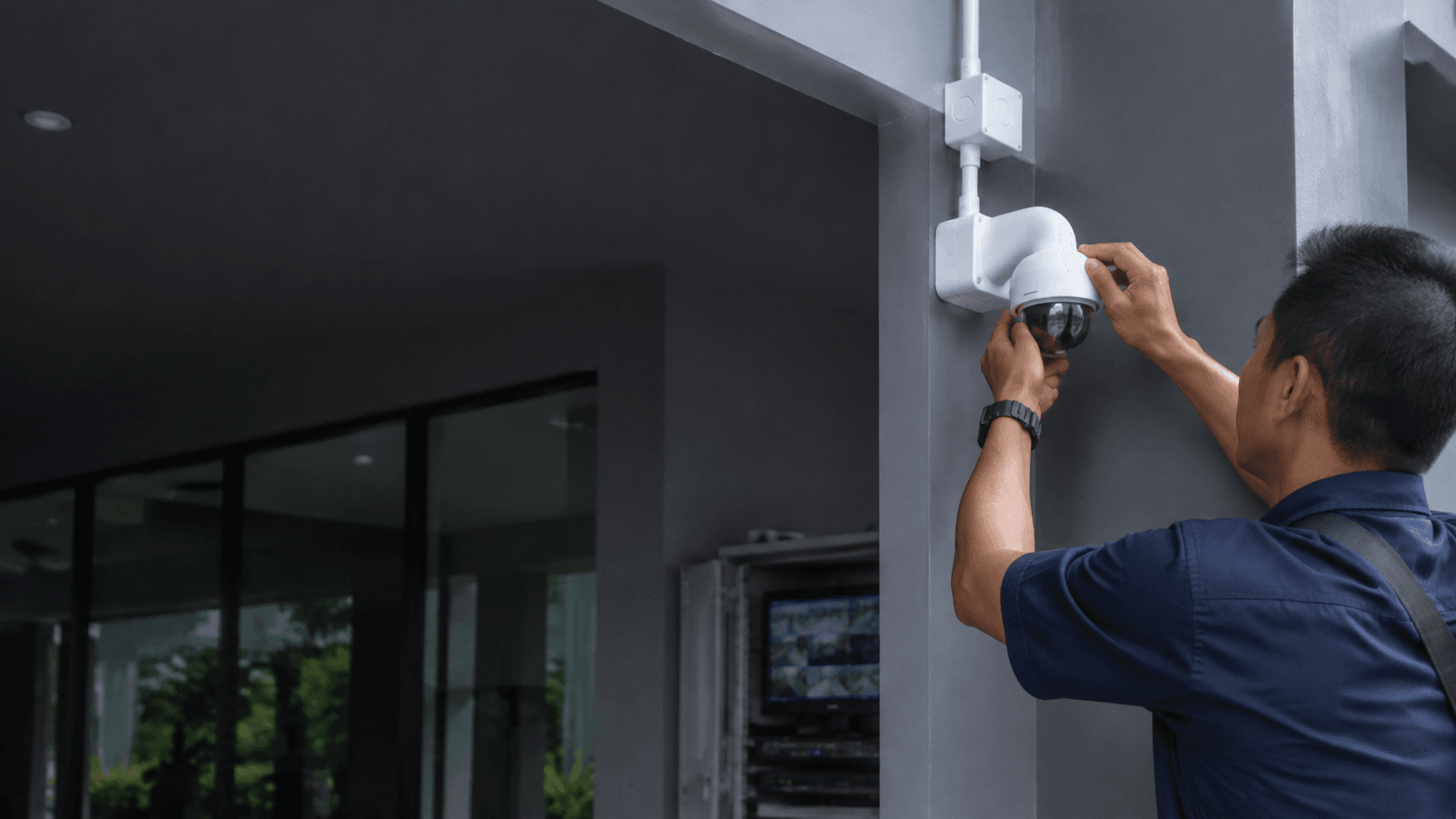
The brand sits in the same broad category as other app-managed IP camera systems, and the search results around it are dominated by app store listings, a Malaysian brand page and RTSP setup references. That tells a buyer something useful: most of the available material explains the app, not whether a specific property will get reliable footage. The gap worth closing is the physical side of the job.
What SriHome CCTV covers
SriHome CCTV refers to a family of wireless IP cameras and an accompanying mobile app used for live viewing, playback and alerts. The cameras connect over a local network and are managed through the app rather than a traditional standalone monitor.
That architecture shapes what the system is good at. A wireless IP camera is quick to position, needs a power source rather than a full video cable run, and can be added to incrementally. The trade-off is that every camera depends on network stability and on the app remaining supported. Where a wired recorder gives a fixed, self-contained record, an app-managed camera system leans on Wi-Fi coverage, the router and the phone.
For a small home, a shop counter or a single office entrance, that trade-off is often acceptable. For a site with many cameras, long cable distances or a requirement for continuous multi-channel recording, a recorder-based system is usually the more dependable structure. The decision is less about brand preference and more about how many cameras, how far apart, and how long footage must be kept.
Where the evidence stops
Public listings describe the app and the camera category, but they do not supply verified model specifications, resolution, lens options, night-vision performance, subscription terms or warranty details for Malaysia. Any figure quoted for those items should be treated as unverified until it comes from the manufacturer or an authorised local seller. Buyers comparing models should ask for the specification sheet directly rather than relying on marketplace descriptions.
How the SriHome app fits daily use
The app is the control surface. Live view, playback, motion detection alerts and remote viewing all run through it, which means the app experience is effectively the product experience for most users.
Daily use usually comes down to four things: how quickly a live view loads, whether alerts arrive without excessive false triggers, whether playback is easy to scrub to a specific time, and whether multiple cameras can be viewed together. App store reviews across this category frequently mention bugs, playback issues and multi-view limitations, so it is reasonable to test those four behaviours during handover rather than assume them.
Remote viewing depends on the camera and phone both reaching the internet. On a weak upload connection, live view will stutter regardless of camera quality. Motion detection alerts depend on sensitivity settings and on what moves in frame — foliage, passing traffic and shifting shadows are common causes of alert fatigue. Tuning sensitivity down and masking irrelevant zones usually matters more than upgrading hardware.
Questions buyers ask before committing
Does the system work without internet? Local recording and local viewing can continue on many IP camera setups, but remote viewing stops when the internet or the router fails. Confirm the local behaviour before purchase.
Is cloud storage required? Cloud storage is commonly offered as an option alongside local recording on a memory card. Whether it is mandatory, and what it costs, varies by model and region, so it should be confirmed in writing.
Can footage be exported? Playback and export are app functions. Test an export during handover so the process is familiar before it is needed.
Camera placement and lighting checks
Placement decides whether footage is usable. A camera aimed at a bright doorway from a dark interior will silhouette faces; a camera pointed at a reflective surface will flare at night. These problems are not fixed by resolution.
Eyonic recommends checking actual lighting conditions before confirming placement for ColorVu-style cameras, and the same discipline applies to any camera chosen for night performance. The check is simple. stand at the intended position at the time of day that matters most, and look at what the camera will see. If the scene is backlit at 7pm, that is the scene the camera records.
Practical placement rules that hold across brands:
- Survey the site and identify the entry points, staff areas and visitor routes that actually need coverage.
- Position each camera to cover a defined zone, avoiding overlap that wastes a channel and avoiding angles that point into strong light.
- Confirm lighting at the intended position during both day and night before fixing the bracket.
- Configure recording, storage duration and remote viewing, then test playback and alerts.
- Hand over with the app set up on the user's phone and the export and playback steps demonstrated.
Height matters too. Cameras mounted very high capture the tops of heads rather than faces, which is a common reason footage is technically present but practically useless for identifying anyone. A position that captures a face at the door is worth more than a wide view of a car park.
Recording, storage and remote viewing
Recording strategy should be decided before installation, because it determines storage size and network load. Continuous recording captures everything and fills storage quickly. Motion-triggered recording saves space but misses the moments before motion starts unless pre-record buffering is enabled.
For most homes and small offices, motion-triggered recording with a short pre-record buffer covers the practical need. For a reception counter or a cash handling area, continuous recording during operating hours is often the better choice. Retention is the other half of the decision: if footage must be kept for a set period, storage capacity has to be sized for that period, not chosen by default.
Remote viewing adds a network requirement on top of storage. Multiple simultaneous viewers, high-resolution streams and weak upload bandwidth compete with each other. Where remote viewing is important, checking the actual upload speed at the site is more useful than comparing camera specifications.
Working with an installer in Malaysia
Installation quality decides whether a camera system is dependable six months later. Cabling routes, power availability, weather exposure and network coverage are all site-specific, and none of them appear in an app store listing.
Eyonic's CCTV installation process includes site survey, system proposal, installation and handover, which is the sequence that surfaces placement and lighting problems before hardware is fixed to a wall. The company is based in Sarawak and has completed work for a public office in Kuching focused on arrival flow, staff areas, visitor movement and dependable daily operation, and for an engineering consultancy office in Kuching covering staff movement, visitor handling and tidy cabling.
For buyers in Malaysia, the practical questions to put to any installer are straightforward. Which camera positions were tested for lighting at night? What happens to recording if the internet drops? How long is footage retained, and what storage size delivers that? Who is contacted if the app stops working? An installer who can answer those four questions has thought about the site rather than the box.
Budget expectations vary with camera count, cabling and whether a recorder is involved. Eyonic's published package pricing starts at RM 1,599 for a Hikvision CCTV package covering camera supply and setup, basic recording configuration and mobile viewing handover, with comparable RM 1,599 packages for alarm and autogate work. Larger office projects sit in a different range: the Kuching Immigration Office project carried an approximate budget of RM 12,000 to RM 28,000, and the KTA Sarawak Sdn Bhd office project an approximate budget of RM 8,000 to RM 18,000. Those figures describe scope, not a quote for any other property.
Share your location, property type and required system with Eyonic on WhatsApp at +60 11-5111 7959 for the next practical step.