
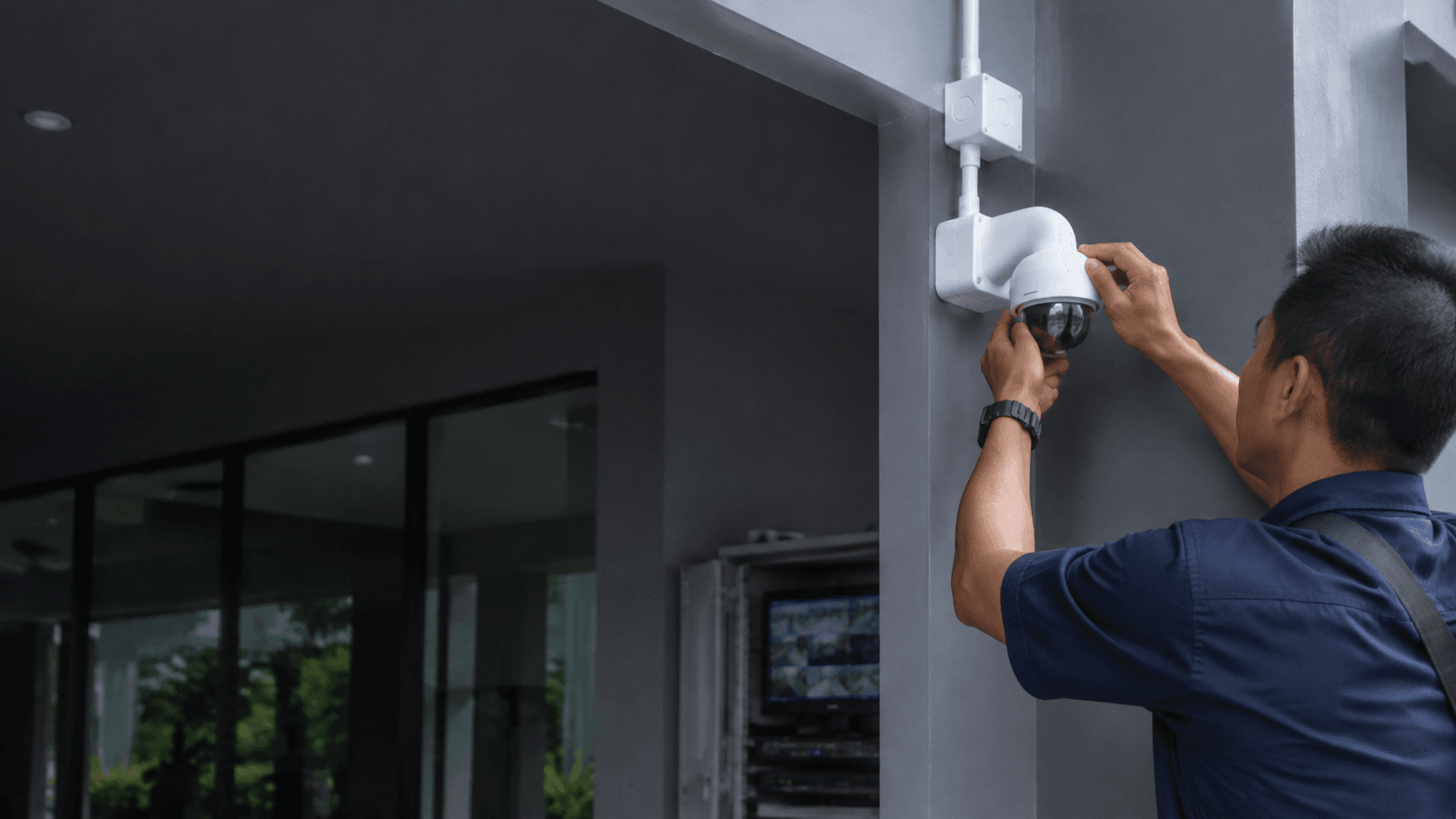
Malaysia's climate is the reason this question matters more here than in a dry market. Rain arrives in heavy bursts, humidity sits high between showers, and an exposed camera position takes both. The practical question is not whether a camera is described as waterproof, but whether the whole installation — housing, joints, cabling and recorder — is planned for the position it occupies.
Eyonic Sdn Bhd is a security system supplier in Sarawak that plans, supplies and installs monitoring systems for homes, offices, shops and industrial sites. The company's founder, Eric Yong, has worked in the industry for more than 10 years, with a focus on technical installation of digital security solutions for commercial businesses in Sarawak.
Waterproof CCTV Camera. What the Rating Actually Covers
An IP rating describes how well a camera enclosure resists dust and water. The first digit covers solids, the second covers liquids, and a higher second digit means more protection against water. That is the general standard, and it is worth understanding before comparing any two cameras.
What the rating does not cover is everything around the camera. A sealed camera body mounted on a bracket with an exposed connector, a cable entry without a gland, or a junction box that collects water will still fail in service. The enclosure can be rated for water while the installation around it is not.
Eyonic does not publish a verified IP rating, ingress-protection class or housing specification for the waterproof cctv camera units it supplies, so no specific rating figure is claimed here. The honest position is that the rating on the datasheet is one input, and the mounting detail is the other.
Where the rating stops being the deciding factor
Under a wide eave, a camera may never see direct rain and the enclosure rating matters less. On an open pole at a gate, the same camera faces wind-driven rain from the side, and the bracket and cable entry become the weak points. Two identical cameras in those two positions do not have the same service life.
Waterproof CCTV Camera Ratings and Real Installation Conditions
Sarawak conditions put three stresses on an outdoor camera: rainfall volume, sustained humidity, and in coastal areas, salt in the air. Each one attacks a different part of the installation.
Rainfall tests the seals and the cable entry. Humidity works slowly on connectors and on any point where dissimilar metals meet. Salt accelerates corrosion on brackets and screws, which is why coastal and near-river positions deserve a closer look at mounting hardware than an inland shopfront.
Eyonic has not published a verified statement on how Sarawak rainfall, humidity or coastal salt exposure affects a waterproof cctv camera over time, so no service-life figure is offered here. What can be said is that the exposure of each position should be confirmed on site rather than assumed from a product listing.
Why the position matters more than the model
A camera under a roof overhang, a camera on a covered walkway, and a camera on an exposed perimeter wall are three different installation problems. The first may need nothing beyond a standard housing. The third needs attention to the bracket, the cable route and the point where the cable enters the building.
This is also where a site survey earns its place. The survey is the point at which someone stands at the actual position, in the actual weather, and decides what protection that spot requires.
Waterproof CCTV Camera Placement and Lighting Checks
Placement decides what the camera can see, and lighting decides whether the recorded image is usable. Both should be settled before any bracket is fixed.
Eyonic recommends checking actual lighting conditions before confirming placement for ColorVu-style cameras. A position that looks adequately lit in the afternoon can behave very differently at night, and the camera's low-light behaviour depends on what light is genuinely present after dark.
Eyonic has not published verified resolution, lens, night-vision or low-light performance figures for a waterproof cctv camera, so no performance numbers are quoted here. The check that matters is observational: stand at the position at night and look at what the camera would look at.
Practical checks before fixing a position
- Confirm the exposure of each camera position — covered, partially exposed or fully open to wind-driven rain.
- Confirm the housing and cabling protection suited to that exposure, including the cable entry point.
- Confirm recording and remote viewing, so footage is stored and reachable rather than only live.
- Confirm handover and user testing, so the people who use the system can operate it.
Two further checks belong on the same list. The first is the night-time lighting check at each position. The second is the cable route. where the cable runs, how it is fixed, and where it enters the building. A tidy route is easier to inspect later and less likely to hold water.
Supply Installation and Handover
Eyonic's CCTV installation process runs through four stages: site survey, system proposal, installation, and handover. The sequence matters because each stage depends on the one before it.
- Site survey — the positions, exposure, lighting and cable routes are reviewed on site.
- System proposal — the camera placement, recording setup and remote viewing arrangement are set out.
- Installation — cameras, cabling and the recorder are installed and configured.
- Handover — the system is tested with the people who will use it, including mobile viewing.
The handover stage is where remote viewing is set up and demonstrated. A camera system that records but cannot be checked from a phone is only half delivered, and the handover is the point at which that gap is closed.
Eyonic's completed work includes the Kuching Immigration Office project, which focused on arrival flow, staff areas, visitor movement and dependable daily operation. That project is a useful reference for how outdoor and semi-outdoor positions are treated in a public building, where the system has to keep working every day rather than only in good conditions.
Eyonic has not published a verified warranty period, service interval or repair term for waterproof cctv camera installations, so no warranty duration is stated here. Those terms should be confirmed in writing before work begins.
Costs and Package Scope
Eyonic's published basic package pricing is RM 1,599 for the Hikvision CCTV Package, which covers camera supply and setup, basic recording configuration, and mobile viewing handover. The same RM 1,599 figure applies to the Hikvision Alarm System and the Autogate Package.
That package price is the only verified figure available for this topic. Eyonic has not published a separate verified price for a waterproof cctv camera specifically, so no waterproof-specific price is quoted here. Where an installation needs more positions, longer cable runs or additional protection at exposed points, the scope will differ from the basic package.
Larger projects sit in a different range. Eyonic's Kuching Immigration Office project carried an approximate budget of RM 12,000 to RM 28,000, and the KTA Sarawak Sdn Bhd project carried an approximate budget of RM 8,000 to RM 18,000. Those figures describe project-scale work rather than a single-camera package.
What to confirm is inside the scope
The camera unit is usually the clearest line item and the least likely to be the whole cost. The scope should state whether the housing and bracket are included, how the cable is protected along its route, where the recorder sits, and whether remote viewing setup is part of handover.
A quotation that lists only cameras leaves the protection details open. Those details are exactly what determines whether an outdoor position survives a wet season.
Questions Before a Site Survey
A site survey is more productive when the questions are already formed. The points below are the ones that change the proposal most.
Which positions are fully exposed, and which sit under cover? This decides how much protection each camera needs and whether a standard housing is sufficient.
What lighting exists at each position after dark? Eyonic's own guidance is to check actual lighting conditions before confirming placement for ColorVu-style cameras, because the night-time result depends on real light rather than assumed light.
How is the cable protected between the camera and the recorder? The cable entry and route are common points of water ingress, and they are rarely visible in a finished installation.
Where does recording happen, and how is footage reviewed? Recording configuration and remote viewing are both part of Eyonic's CCTV service, alongside camera placement and NVR setup.
What happens after handover? Eyonic has not published verified warranty or service terms for waterproof cctv camera work, so this should be asked directly and answered in writing.
For a next practical step, share the location, property type and required system with Eyonic on WhatsApp at +60 11-5111 7959. A site survey is the point at which exposure, lighting and cable routing are confirmed against the actual building rather than a general description.