
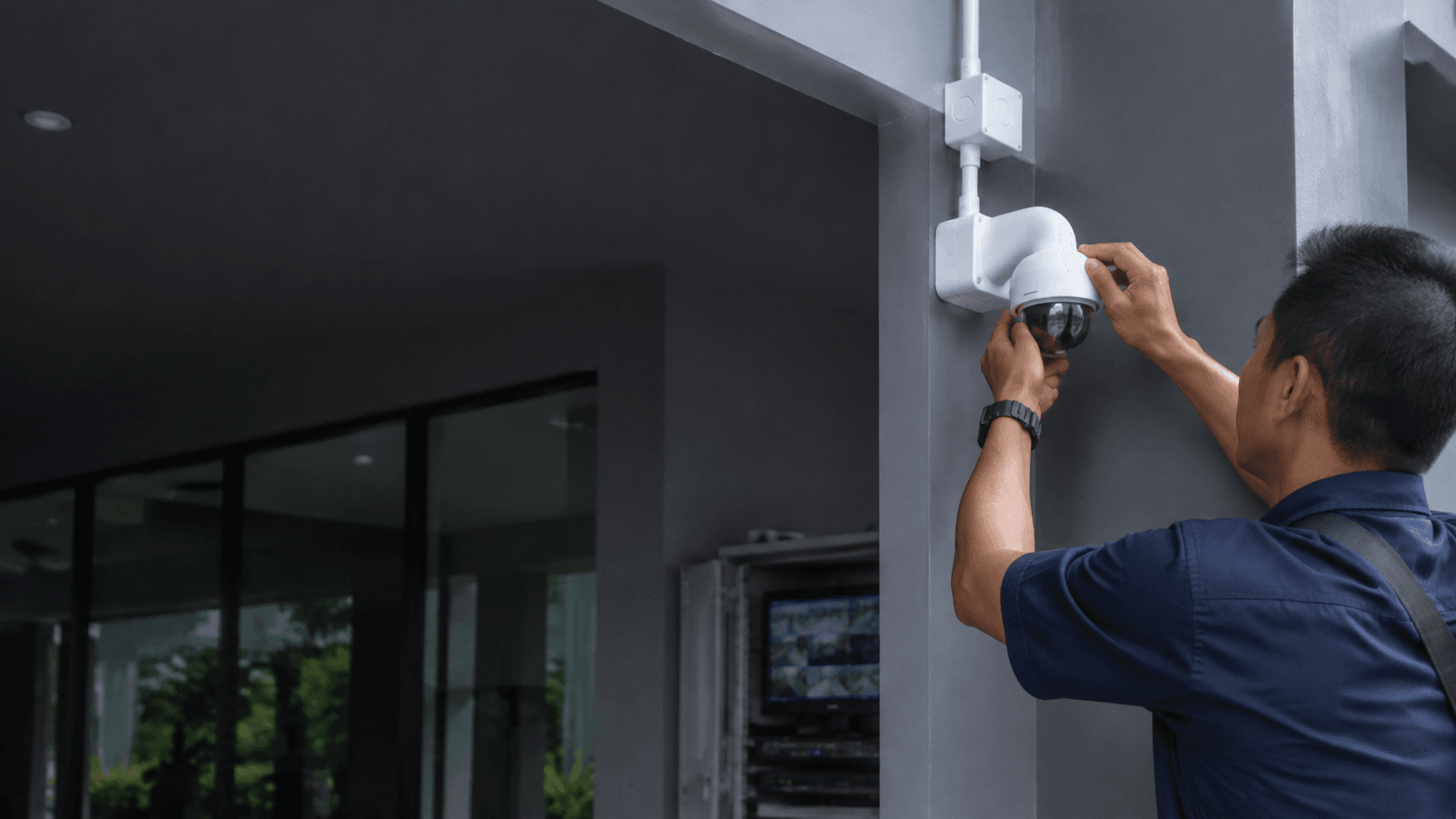
The exact-match query small cctv camera for home with mobile connectivity describes a specific combination: a camera small enough to sit discreetly in a home, plus a setup that lets the footage reach a phone. Eyonic Sdn Bhd, a security system supplier in Sarawak, Malaysia, works with Hikvision cameras and handles camera placement, NVR setup and remote viewing as part of its CCTV service.
Compact size changes what a camera can do and where it can go. It does not change the fundamentals: the camera still needs power or a battery, a network path to the recorder or the internet, and a viewing method that works on the phone in hand. The sections below cover what the setup involves, why compact cameras suit Malaysian homes, what to check before fixing a position, how mobile viewing and handover work, the installation sequence, and what the packages cost.
Small CCTV Camera for Home with Mobile Connectivity: What the Setup Involves
A working setup has four parts that must all function together. The camera captures the scene. The recorder or local storage holds the footage. The network carries the video. The phone app displays it and, depending on configuration, sends alerts.
Eyonic's CCTV service covers planning, supply and installation of monitoring systems with camera placement, recording and remote viewing for homes, offices, shops and industrial sites. That means the camera, the recorder and the phone viewing are treated as one system rather than three separate purchases.
Compact cameras are often chosen for indoor positions where a full-size unit would be intrusive, or for tight spots such as a corridor, a stair landing or a small shop counter. The trade-off is that a smaller housing can limit how much room there is for larger lenses and sensors, so the position and the lighting matter more, not less.
What the camera itself does not solve
A compact camera does not fix a weak network path. If the camera sits far from the router or the recorder, or behind thick walls, the video may stutter or drop regardless of how good the camera is. Placement and network planning are part of the same decision.
A compact camera also does not decide what gets recorded and for how long. Recording configuration, storage capacity and retention are separate choices that Eyonic handles during setup.
Why Compact Cameras Suit Malaysian Homes
Malaysian homes commonly mix terraced houses, apartments and shop-lots, and each layout creates different constraints. A terraced house may need coverage of a car porch and a front gate. An apartment may need an indoor view of the entry area. A shop-lot may need a counter view plus a back-door view.
Compact cameras fit these situations because they can be mounted in places where a larger unit would be awkward: above a door frame, in a corner near the ceiling, or on a wall where a bulky housing would stand out. For homes where appearance matters, a smaller camera is easier to place without drawing attention.
Eyonic's project work shows the same principle at a larger scale. For the Kuching Immigration Office, the focus was arrival flow, staff areas, visitor movement and dependable daily operation. The lesson for a home is that camera positions should follow how people actually move through the space, not just where a camera happens to fit.
Where compact cameras make less sense
Long outdoor perimeters, wide driveways and large open areas usually need cameras with more reach and better low-light performance than a small indoor unit provides. In those cases, a compact camera can still be useful as a secondary view, but it should not be the only camera covering the area.
Small CCTV Camera for Home with Mobile Connectivity Placement and Lighting Checks
Placement decides what the camera can see, and lighting decides how well it sees it. Both should be confirmed on site before any bracket is fixed.
Eyonic recommends checking actual lighting conditions before confirming placement for ColorVu-style cameras. A position that looks adequate in daylight can behave very differently at night, especially if a nearby light source creates glare or if the area is genuinely dark.
Useful checks before installation:
- Confirm what the camera must cover, such as an entry door, a gate, a corridor or a counter.
- Check the light at the times that matter, including after dark, rather than only during a daytime visit.
- Check the network path from the camera position to the router or recorder.
- Check whether the position is reachable for maintenance without disturbing the household.
- Check whether the camera angle captures faces or only the tops of heads, since a high angle can reduce how useful the footage is.
For a small CCTV camera for home with mobile connectivity, the phone view is only as good as the position. A camera pointed at a blank wall will stream perfectly and show nothing useful.
Lighting edge cases
Glass is a common problem. A camera aimed through a window can pick up reflections from indoor lights at night, which can wash out the view. A camera aimed at a reflective surface such as a polished floor or a mirror can produce the same effect.
Strong backlight is another edge case. If a bright doorway or a streetlight sits directly behind the subject, the subject can appear as a silhouette. Repositioning the camera or adjusting the angle usually resolves this better than changing settings.
Mobile Viewing Recording and Handover
Mobile viewing is the part most people care about, and it depends on three things working together: the camera, the recorder, and the network that connects them to the phone.
Eyonic's Hikvision CCTV Package at RM 1,599 includes camera supply and setup, basic recording configuration, and mobile viewing handover. The handover step matters because it is where the phone viewing is confirmed to work, rather than assumed to work.
Recording configuration determines what is stored and where. A home may want continuous recording, motion-triggered recording, or a mix. The choice affects how far back the footage goes and how much storage is needed.
Remote viewing is listed as part of Eyonic's CCTV service, alongside camera placement and NVR setup. That grouping reflects how the system is actually built: the recorder is configured, the network is prepared, and the viewing method is set up and tested before the job is considered complete.
What handover should confirm
A proper handover confirms that the phone can open the live view, that recorded footage can be played back, and that the person responsible for the system knows how to use it. It also confirms who to contact if something stops working.
Handover is also the point to confirm the recording settings match expectations. If the system was configured for motion-triggered recording but the household expected continuous recording, that difference is easier to resolve during handover than weeks later.
Installation Sequence from Survey to Handover
Eyonic's CCTV installation process follows a defined sequence. The same sequence applies whether the job is a single compact camera or a multi-camera system.
- Site survey. The property is reviewed to understand the layout, the areas that need coverage, the lighting conditions, and the available network and power paths.
- System proposal. A proposal sets out the recommended cameras, the recorder, the placement plan and the recording approach, so the scope is clear before work begins.
- Installation. Cameras are mounted, cabling is run, the recorder is set up, and the system is configured for recording and remote viewing.
- Handover. Mobile viewing is set up and tested, recording is confirmed, and the system is explained so the household can use it.
The survey stage is where most problems are avoided. A camera position that looks fine on a floor plan can turn out to be blocked by a beam, too far from power, or badly lit at night. Confirming these details on site is cheaper than correcting them after installation.
The proposal stage is where scope is agreed. Adding a camera later is possible, but it is usually simpler and tidier to plan the full set of positions at the start, even if only some are installed immediately.
Costs Packages and Next Practical Step
Eyonic lists three packages at RM 1,599 each. The Hikvision CCTV Package covers camera supply and setup, basic recording configuration, and mobile viewing handover. The Hikvision Alarm System covers a control panel and sensors, siren and zone setup, and user testing and handover. The Autogate Package covers motor recommendation, remote-control setup, and safety testing and handover.
For a home that wants a small CCTV camera for home with mobile connectivity, the Hikvision CCTV Package is the relevant starting point because it includes the camera setup, the recording configuration and the mobile viewing handover in one scope.
Larger projects sit in a different budget range. Eyonic's Kuching Immigration Office project had an approximate budget of RM 12,000 to RM 28,000, and the KTA Sarawak Sdn Bhd project had an approximate budget of RM 8,000 to RM 18,000. Those figures reflect multi-area commercial and public-office work, not a single home camera, and they are useful mainly as a sense of how scope drives cost.
Several details are not covered by the available information and should be confirmed directly: the specific camera model and its technical specifications, the mobile app and its features, warranty terms, and any subscription or cloud storage costs. These vary by model and configuration, so they are best confirmed against the actual proposed system rather than assumed.
Eric Yong, founder of Eyonic Security Systems, has been in the industry for more than ten years and is experienced in technical installation of digital security solutions for commercial businesses in Sarawak.
To move forward, share the location, property type and required system with Eyonic on WhatsApp at +60 11-5111 7959.