
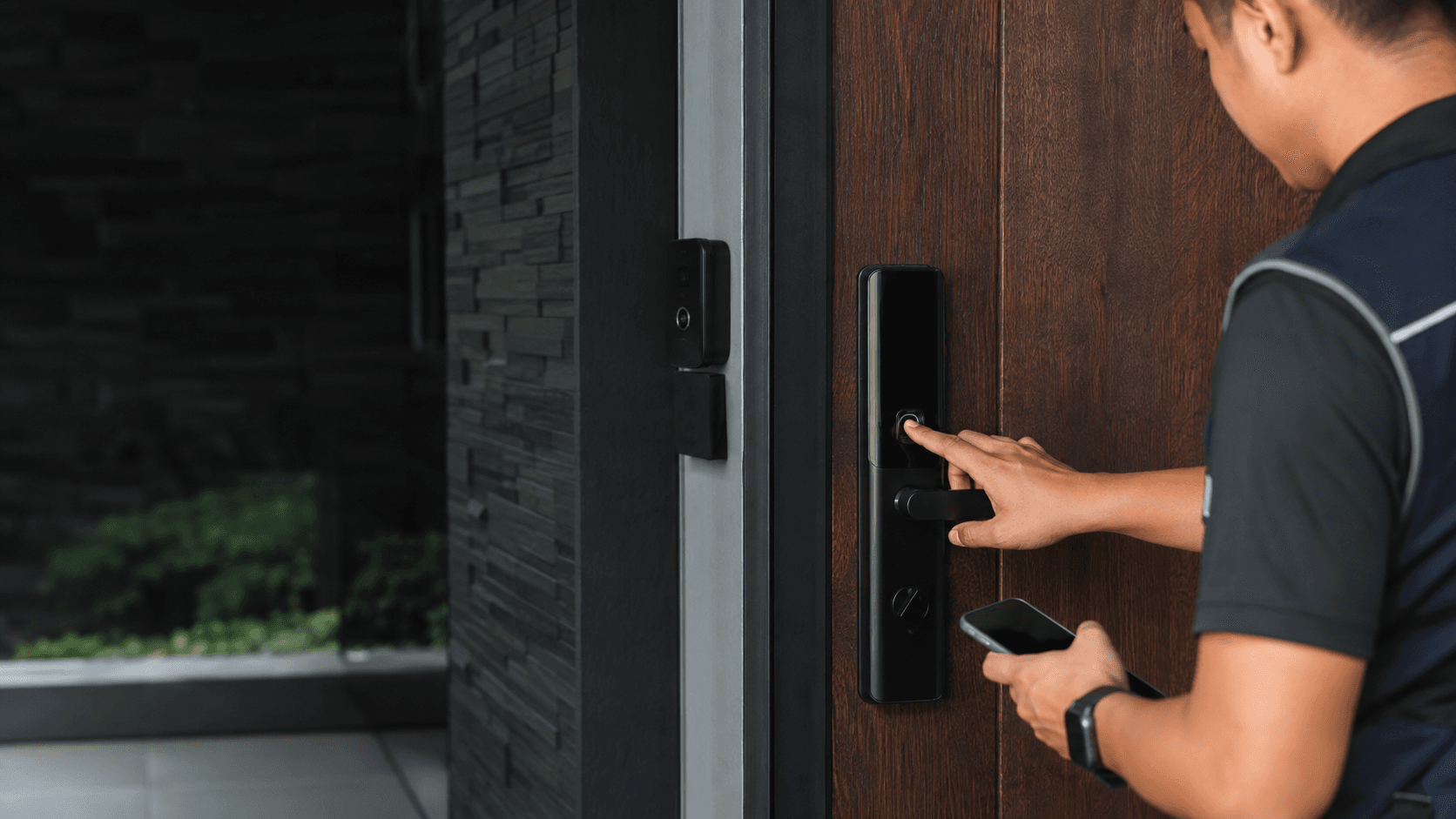
The term describes a lock family rather than one product. Kwikset builds electronic deadbolts and electronic levers that share the same idea: a code typed on a keypad replaces a key for everyday entry. The lock still contains a mechanical cylinder, so a key remains part of the design even when the keypad does the daily work.
For a buyer in Malaysia, the practical question is not which model looks best in a catalogue. It is whether the door already on the property can carry the lock, who needs a code, and what happens on the day the keypad stops responding.
Kwikset Touchpad Keyless Entry. What the Term Covers
Kwikset groups these products under electronic locks, and the range splits into deadbolts and levers. A deadbolt replaces the existing deadbolt on an entry door. A lever replaces the handle set, which suits interior doors such as an office, a store room, or a wine cellar.
Both types are operated by an electronic keypad or touchscreen. A personalised access code opens the door, and a button or a single touch locks it again. That is the whole mechanism. a code is entered, the electronics release the bolt or the latch, and the door opens without a key being handled.
Kwikset also names SmartCode across its keyless entry deadbolts and levers, and SmartKey appears as a re-keying feature on some models. SecureScreen appears on touchscreen models as a way to reduce the chance that fingerprints reveal which digits were pressed. Those names describe features inside the family, not separate categories of lock.
One limit matters before anything else. The supplied evidence does not include verified model numbers, code capacity, battery life, finish options, or warranty terms for a specific Kwikset Touchpad Keyless Entry unit. Any figure quoted from a retailer listing should be checked against that model's own documentation rather than assumed to apply across the range.
Touchpad and Touchscreen Keypads on the Same Lock Family
Kwikset uses both words, and they describe two ways of entering the same code. A touchpad has physical buttons. A touchscreen has a flat surface that responds to touch. The lock's job does not change between them.
The difference shows up in daily use. Physical buttons give a definite press and are easy to operate with a gloved hand or in poor light once the positions are known. A touchscreen presents a cleaner surface and, on models that carry SecureScreen, is designed so that the digits pressed are harder to read from smudges left behind.
Neither type removes the need for a code that other people cannot guess. A short or repeated code undermines the lock regardless of which keypad sits on the door.
Kwikset also lists smart locks that work with a smart phone and with smart home products, alongside keyless entry without smart technology. That split matters for planning. A lock that only stores codes on the device behaves differently from one that connects to a phone or a hub, and the supplied evidence does not include a verified compatibility list for smart-home platforms. Compatibility should be confirmed for the exact model before purchase.
Door Condition, User Roles and Backup Entry Before Installation
Eyonic's own review of smart lock door access states that smart locks work best when the door condition, user roles, and backup method are reviewed before installation. Those three checks apply directly to a Kwikset Touchpad Keyless Entry decision.
Door condition comes first because an electronic lock is still a lock. The door has to close squarely, the existing cut-out has to suit the replacement, and the frame has to hold the bolt or latch in line. A door that already needs force to close will not become easier to secure because the keypad is new.
User roles decide how the lock is set up. A home with one or two regular users needs a different arrangement from a shop with staff who change over time, or an office where visitors need occasional entry. Codes that are shared widely stop being a record of who entered.
Backup entry is the check most often skipped. Every electronic lock depends on power and on electronics that can fail. A mechanical key cylinder, a second entry door, or a managed override keeps the property usable on the day the keypad does not respond. The backup method should be decided before installation, not after the first lockout.
Eyonic's pre-installation checks follow a fixed order:
- Inspect the door condition, including how it closes and whether the existing cut-out suits the replacement lock.
- Confirm the user roles, meaning who needs a code and how often that list changes.
- Agree the backup entry method so the property stays accessible if the keypad fails.
- Decide whether a standalone lock or an access-control panel fits the site.
- Confirm the exact model and its documentation before ordering.
The same review process shapes Eyonic's wider installation work. The company's CCTV installation process runs through site survey, system proposal, installation, and handover, and the same sequence applies to door access: the site is looked at before a product is named.
Kwikset Touchpad Keyless Entry Compared With a Standalone Lock or Access-Control Panel
A standalone lock is the simpler option. It holds its own codes, needs no central system, and suits a single door where a small number of people need access. A Kwikset Touchpad Keyless Entry deadbolt or lever fits that shape of requirement.
An access-control panel suits a different shape. When several doors have to be managed together, when entry records matter, or when codes must be issued and withdrawn across a building, a panel gives one place to manage all of it. A standalone lock on each door would mean managing each door separately.
Eyonic's review of smart lock door access notes that for business use the company usually checks whether a standalone smart lock or an access-control panel is more appropriate. That check is about scale and administration, not about which product is better in general.
Cost and complexity move in opposite directions. A standalone lock is quicker to install and easier to live with on one door. A panel adds planning, cabling, and configuration, and only earns that effort when the number of doors or the need for records justifies it.
There is a middle case worth naming. A small office with one main entrance and a handful of staff may be well served by a standalone lock, while the same office with a staff entrance, a store room, and a server room is usually better served by a panel. The deciding factor is how many doors have to be managed as one system.
What Eyonic Checks Before Recommending a Lock
Eyonic Sdn Bhd is a security system supplier in Sarawak that plans, supplies, and installs monitoring and ELV systems for homes, offices, shops, and industrial sites. Door access sits alongside that work rather than apart from it.
The company's product review of smart lock door access sets out the checks plainly: door condition, user roles, and backup method are reviewed before installation, and for business use the choice between a standalone lock and an access-control panel is confirmed first. Those checks are the reason a recommendation follows a site visit rather than a product list.
Completed work shows the same pattern at a larger scale. Eyonic completed a project for the Kuching Immigration Office focused on arrival flow, staff areas, visitor movement, and dependable daily operation. A public office with that mix of movement needs access decisions made around how people actually arrive and move, not around a single door.
Eyonic also completed work for KTA Sarawak Sdn Bhd, an engineering consultancy site that needed a practical office setup in Kuching to support staff movement, visitor handling, tidy cabling, and clearer daily site control. Both projects point to the same starting question: what has to happen at the door, and who has to pass through it.
Where a lock is part of a wider system, the surrounding work matters as much as the lock. Eyonic's published packages list a Hikvision CCTV package, a Hikvision alarm system, and an autogate package at RM 1,599 each, covering supply, setup, and handover. Door access is planned alongside those systems when a site needs them together.
Kwikset Touchpad Keyless Entry Questions Buyers Ask Before Ordering
Can a Kwikset Touchpad Keyless Entry lock be fitted to an existing door? That depends on the door, not on the lock family. The existing cut-out, how the door closes, and how the frame holds the bolt all have to be checked. The supplied evidence does not include verified door thickness, bore, or backset specifications, so those measurements have to be taken from the actual door and matched against the chosen model's documentation.
What happens if the keypad fails? The lock still has a mechanical cylinder, so a key provides one route back in. A second entry door or a managed override provides another. The backup method should be agreed before installation so that a failed keypad is an inconvenience rather than a lockout.
Is a touchpad or a touchscreen better? A touchpad gives physical buttons that are easy to press in poor light. A touchscreen gives a flat surface, and on models carrying SecureScreen it is designed to make pressed digits harder to read from smudges. Both accept a code, and both depend on that code being kept private.
Does it need a phone or a hub? Not necessarily. Kwikset lists keyless entry without smart technology alongside smart locks that work with a smart phone and smart home products. The supplied evidence does not include a verified compatibility list, so the exact model's requirements should be confirmed before ordering.
How many codes are needed? That follows from the user roles. A home with two regular users needs far fewer than a shop with changing staff. The number of codes a specific model supports is not covered by the supplied evidence and should be confirmed against that model's documentation.
Is it available in Malaysia, and at what price? The supplied evidence does not include verified Malaysian pricing, stock availability, or local distributor information for Kwikset Touchpad Keyless Entry. Those details should be confirmed with the supplier handling the order rather than assumed from an overseas listing.
When a site needs door access planned alongside other security systems, Eyonic can be reached on WhatsApp at +60 11-5111 7959 with the location, property type, and required system.