
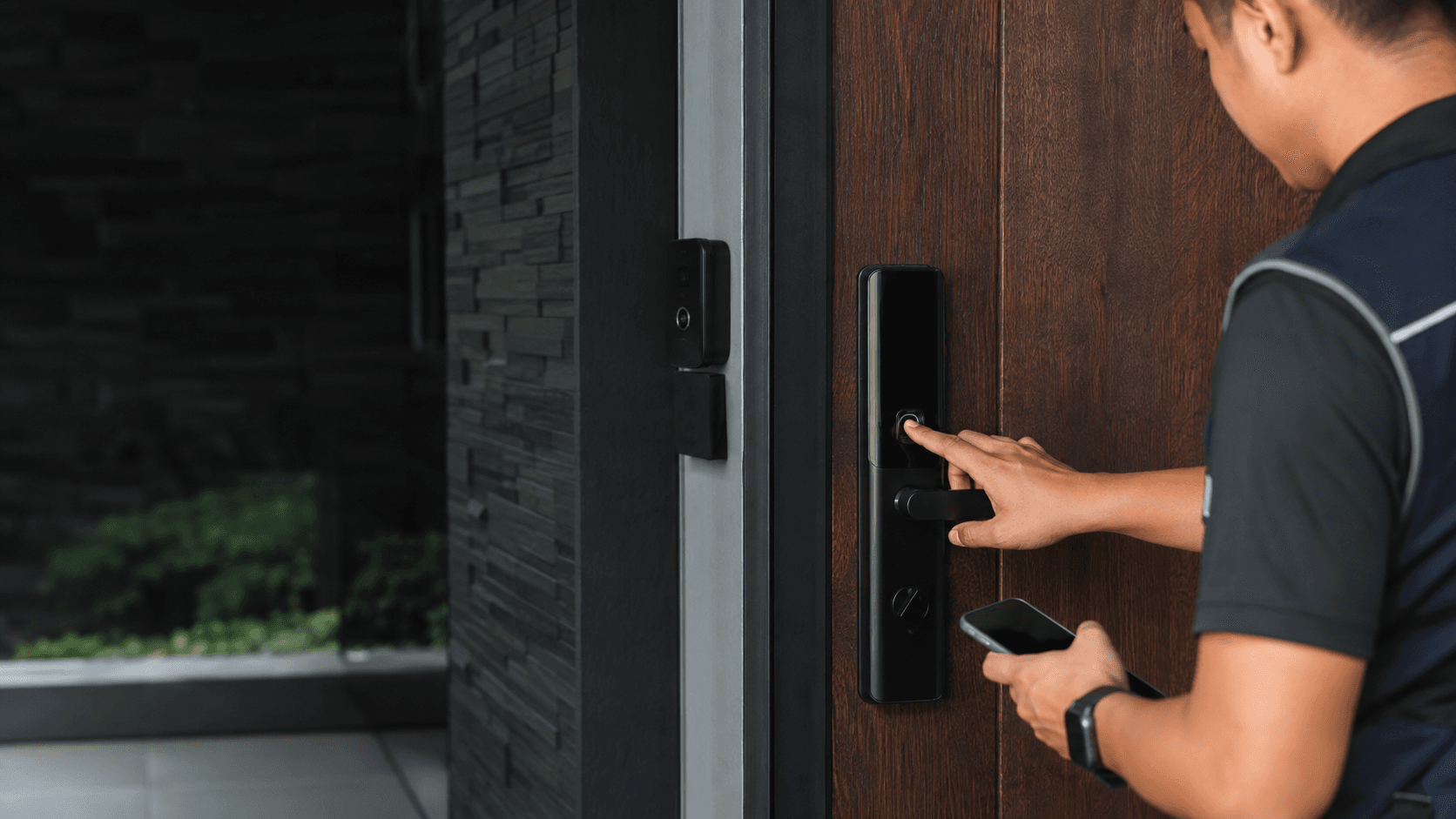
The exact-match query biometric door lock for office describes a lock that reads a physical trait instead of a key. In an office, that trait is usually a fingerprint. The lock either stands alone on the door or connects to a wider access-control panel. Eyonic's own product review notes that smart locks work best when the door condition, user roles and backup method are reviewed before installation, and that for business use the choice between a standalone smart lock and an access-control panel should be checked first.
Biometric Door Lock For Office. What Matters Before Choosing
Three things decide whether a biometric lock suits an office door: the door itself, who needs to enter, and what happens when the lock fails. Get those wrong and the lock becomes a daily problem rather than a convenience.
- Check the door condition and thickness, because a lock that does not fit the existing cut-out cannot be installed without extra work.
- List every user role — permanent staff, part-time staff, cleaners, contractors and visitors — and decide which roles need their own credential.
- Confirm the backup entry method, such as a mechanical key, a code, or a second power source, so a dead battery does not lock a team out.
- Decide between a standalone smart lock and a networked access-control panel, based on how many doors and how much record-keeping the office needs.
- Plan the power source and wiring route before drilling, especially on glass or metal doors where cabling is harder to hide.
- Test the lock with real users on a normal working day before the old key system is retired.
Eyonic's published installation process follows a similar order: site survey, system proposal, installation, then handover. That sequence matters more on an office door than a home door, because an office cannot easily close for a day while a lock is re-fitted.
Choosing the Right Biometric Door Lock For Office
The right unit depends on door type, user count and whether entry records are needed. A single-door office with a handful of staff has different requirements from a multi-door floor with shift changes.
Standalone lock or access-control panel
A standalone biometric lock stores fingerprints on the lock itself. It needs no network and no software, which keeps the installation simple. An access-control panel centralises users across doors and can log who entered and when. Eyonic's product review states that for business use, the company usually checks whether a standalone smart lock or an access-control panel is more appropriate — the answer depends on the site, not on the lock alone.
Door type and fit
Wooden office doors are the simplest case. Glass doors, metal doors and fire-rated doors each add constraints, because the lock body, mortise and cabling must suit the existing frame. A site survey is the point where those constraints are confirmed rather than assumed.
User roles and permissions
Offices rarely have one uniform group of users. Permanent staff may need full access, while cleaners and contractors may need time-limited entry. A lock that supports separate user roles and temporary credentials handles staff turnover without re-keying the whole building.
What Is a Biometric Door Lock for Office?
A biometric door lock for office is a door lock that verifies a person by a physical characteristic — most commonly a fingerprint — before releasing the door. It replaces or supplements a mechanical key, and it may also accept a PIN code or a card as a second method.
The practical difference from a keyed lock is that nothing needs to be carried or handed over. The practical difference from a keypad lock is that a code can be shared or observed, while a fingerprint cannot be passed to another person. That distinction is the main reason offices adopt biometric entry for staff doors rather than for every door in the building.
Practical Considerations for
Reliability, power and support decide whether the lock still works in month twelve. These are the points that cause most office complaints after installation.
Power and battery life
Battery-powered locks avoid cabling but introduce a maintenance task. Wired locks avoid battery changes but need a power route to the door. Either way, the office needs a defined backup method so a flat battery or a power cut does not block entry.
Fingerprint quality and daily use
Recognition depends on the sensor and on how the finger is presented. Worn fingerprints, wet hands and very dry skin all affect reads. A lock that also accepts a code or card gives users a fallback on the days a fingerprint does not register.
Installation conditions
Eyonic's review of Hikvision ColorVu cameras makes a point that applies to any site-based installation: check the actual conditions on site before confirming placement. The same discipline applies to a lock — the door, frame and traffic pattern should be inspected before the model is fixed.
Support and handover
A lock that nobody can administer becomes a liability. Handover should cover adding and removing users, changing the backup code, and what to do when the lock reports a fault. Eyonic's CCTV work follows a survey, proposal, installation and handover sequence, and the same structure suits access hardware.
Residential and Business Biometric Locks in Sarawak
Eyonic Sdn Bhd is a security system supplier based in Sarawak, Malaysia. The company plans, supplies and installs monitoring and ELV systems for homes, offices, shops and industrial sites, and its product range includes Hikvision cameras and smart locks.
For office work specifically, Eyonic has completed projects for a public office and an engineering consultancy. The Kuching Immigration Office project focused on arrival flow, staff areas, visitor movement and dependable daily operation. The KTA Sarawak Sdn Bhd project supported staff movement, visitor handling, tidy cabling and clearer daily site control. Both are office environments where entry and movement matter, and both show the kind of site where a biometric door lock for office use would sit alongside cameras and access hardware rather than replace them.
Eyonic's founder, Eric Yong, has worked in the industry for more than 10 years and is experienced in technical installation of digital security solutions for commercial businesses in Sarawak. That experience is relevant because office lock installation is a fitting problem as much as a product problem.
Making an Informed Choice About
The decision comes down to matching the lock to the door, the users and the backup plan. A lock that fits all three is a good lock for that office, regardless of what the specification sheet claims.
Where the office already has cameras or an alarm, it is worth checking whether the lock should integrate with them or stand alone. Eyonic's published packages for CCTV, alarm and autogate are each priced at RM 1,599, which gives a sense of the entry-level budget for security hardware in this market. Larger office projects sit well above that: Eyonic's Kuching Immigration Office project had an approximate budget of RM 12,000 to RM 28,000, and the KTA Sarawak Sdn Bhd project had an approximate budget of RM 8,000 to RM 18,000. Those figures cover wider office security work, not a single lock, but they show the range that office-scale installations reach.
For a single office door, the practical next step is a site survey. The survey confirms the door type, the user list and the backup method, and it is the point where a standalone lock and a panel-based system can be compared against the actual site. Share the location, property type and required system with Eyonic on WhatsApp at +60 11-5111 7959 for the next practical step.