
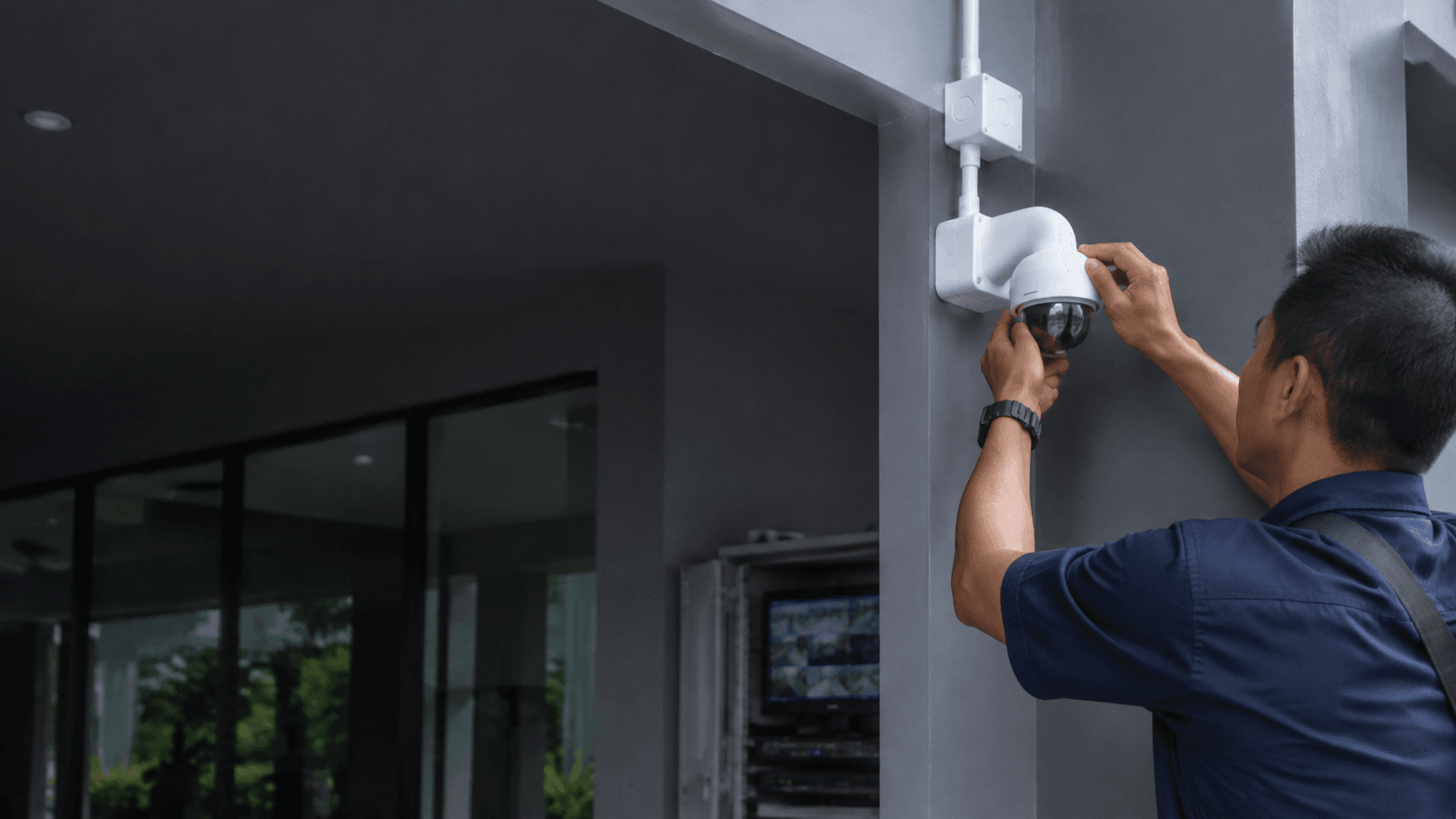
The term covers more ground than a single product. It describes a camera that joins a Wi-Fi network and passes footage to a recorder, a memory card or a cloud service, which is why two buyers asking for the same thing can end up with very different systems.
Wifi Cctv Camera. What the Term Covers
A wifi cctv camera is a network camera that uses Wi-Fi for its data path. Power still has to reach the camera in most cases, so "wireless" usually refers to the video link rather than the absence of all cabling. That distinction matters when a site is chosen on the assumption that nothing needs to be run at all.
Eyonic's CCTV scope covers planning, supply and installation of monitoring systems with camera placement, recording and remote viewing. Those four elements are the practical definition of a working setup: where the cameras point, how footage is stored, and how it is watched from elsewhere.
Wireless cameras commonly appear in two shapes. A standalone camera records to a memory card or a cloud plan and suits a small coverage area. A camera linked to a wireless recorder joins a multi-camera system where footage is stored centrally. The second shape behaves more like a conventional CCTV installation, with the recorder doing the heavy lifting.
When a Wifi Cctv Camera Fits the Site
Wireless suits sites where running cable is difficult, disruptive or expensive. Finished interiors, rented premises, older buildings with solid walls, and locations where a cable route would cross a public area all push the decision toward a wireless link. Sites that need many cameras across a large footprint often lean the other way, because a wired backbone is more predictable once it is in place.
Coverage area is the first question. A small shop, an office entrance, a single gate or a home with one or two points of interest can be served by a wireless camera without a full recorder build. A site with staff areas, visitor movement and multiple entry points needs a plan rather than a single device.
Eyonic's work for the Kuching Immigration Office focused on arrival flow, staff areas, visitor movement and dependable daily operation. That is the pattern for a public-facing site: the cameras follow how people actually move through the building, not just where a wall is convenient.
Lighting is the second question. Eyonic recommends checking actual lighting conditions before confirming placement for ColorVu-style cameras, because a position that looks adequate in daylight can behave differently after dark. A wireless link does not change how a camera sees, so the same lighting check applies.
Where wireless struggles
Dense walls, metal structures and crowded radio environments can weaken a Wi-Fi link. A camera that drops its connection stops contributing footage even though the hardware is fine. This is a placement and network question, not a camera-brand question, and it is one reason a site survey comes before a purchase.
What to Compare Before Committing
Compare the recording path first. Footage stored on a memory card inside the camera is lost with the camera. Footage stored on a recorder can survive the loss of one unit. Footage stored in a cloud plan depends on a subscription continuing. Each option has a different failure mode, and the choice should follow what the site needs to prove after an incident.
Compare the power arrangement second. A camera that needs a nearby power point limits where it can go. A camera running on battery or solar removes that limit but introduces a maintenance cycle. Neither is automatically better; the site decides.
Compare the viewing arrangement third. Remote viewing is part of Eyonic's CCTV scope, and it is the feature most people actually use day to day. A system that records correctly but is awkward to check on a phone tends to be checked less often.
Compare the handover fourth. A working system includes configured recording, tested alerts and a user who knows how to review footage. Supply alone leaves that work with the buyer.
How Installation and Handover Work
Eyonic's CCTV installation process runs through four stages.
- Site survey — the property is reviewed for camera placement, lighting, network conditions and cable or power routes.
- System proposal — the recommended setup is put forward based on what the survey found.
- Installation — cameras, recording and network links are installed and configured.
- Handover — the system is tested and the user is shown how to operate it, including remote viewing.
The survey stage is where most of the risk is removed. A wireless camera placed without checking signal strength, lighting and the recording path can be installed correctly and still fail the job it was bought for.
Handover is where the system becomes usable. Recording configuration, mobile viewing and basic review are the parts a user touches, so they are the parts worth testing before the installer leaves.
Practical Limits and Evidence Gaps
Several things cannot be stated with confidence here. No verified technical specifications are available for any wifi cctv camera model, covering resolution, lens, storage, wireless band, power source or weather rating. No verified pricing exists for a wireless camera package; the published Eyonic packages are RM 1,599 for a Hikvision CCTV package, RM 1,599 for a Hikvision alarm system and RM 1,599 for an autogate package, and none of those is a wireless camera package.
No verified Malaysian regulatory, warranty or network requirements for wireless cameras are available, and no verified performance data exists on wireless reliability, range or interference in Malaysian premises. There is also no verified claim about which brands or models Eyonic supplies for wireless cameras specifically.
Those gaps are worth naming because wireless performance is the exact area where marketing language tends to outrun evidence. A buyer comparing wireless options should treat range and reliability claims without a site-specific check as unproven.
Budget context does exist for comparable work. Eyonic's Kuching Immigration Office project carried an approximate budget of RM 12,000 to RM 28,000, and the KTA Sarawak Sdn Bhd office project carried an approximate budget of RM 8,000 to RM 18,000. Both were multi-point commercial installations rather than single-camera jobs, so they frame scale rather than a wireless camera price.
Getting a Practical Next Step
The useful starting information is location, property type and the system required. Those three details let a supplier judge whether a wifi cctv camera suits the site or whether a wired approach will serve better, and they shorten the gap between an enquiry and a survey.
Eric Yong founded Eyonic Security Systems and has worked in the industry for more than ten years, with experience in technical installation of digital security solutions for commercial businesses in Sarawak. That background is relevant at the survey stage, where placement and lighting decisions are made.
Share your location, property type and required system with Eyonic on WhatsApp at +60 11-5111 7959 for the next practical step.