
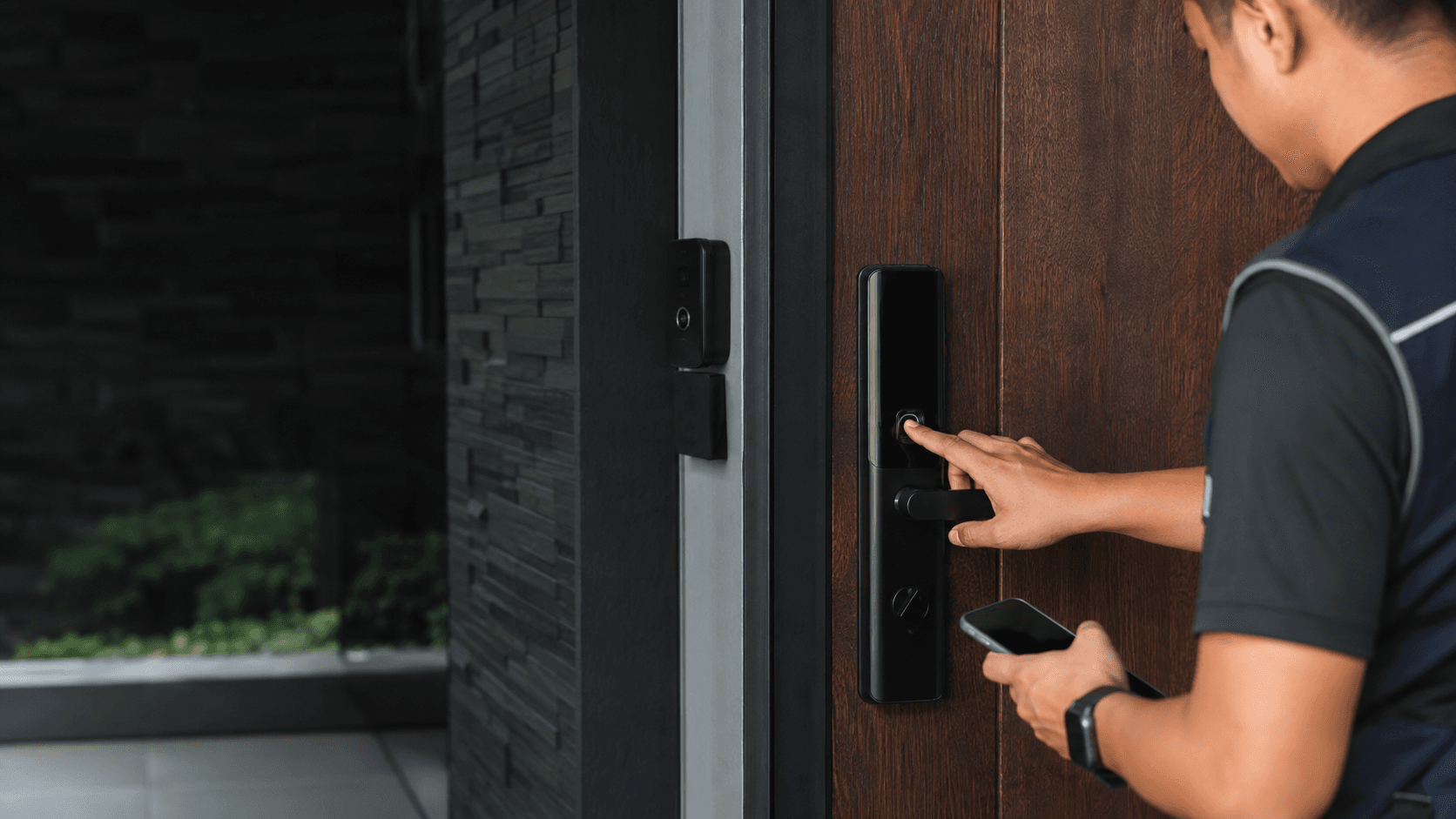
Eyonic Sdn Bhd reviews smart lock door access as a product category and notes that smart locks work best when door condition, user roles, and backup method are reviewed before installation. That review sits alongside the company's wider security work in Sarawak, where installation projects follow a site survey, system proposal, installation, and handover sequence.
The sections below cover the access methods available, the door checks that decide whether a lock fits, what happens when power or batteries fail, how shared access is managed, and what handover should include. The aim is to judge whether a specific lock is a practical fit for a specific entrance before any purchase.
Best Keyless Entry Front Door Locks for Malaysian Entrances
There is no single best keyless entry front door lock for every Malaysian entrance, because the deciding factors are local: the door leaf and frame already installed, how many people need daily access, whether the entrance is residential or commercial, and how the building handles power interruptions.
Eyonic's own product review guidance frames the decision around three checks before installation: door condition, user roles, and backup method. For business use, the same review notes that Eyonic usually checks whether a standalone smart lock or an access-control panel is more appropriate. That distinction matters because a single residential entrance and a staffed office entrance place different demands on the same hardware category.
Malaysian entrances also vary more than a product listing suggests. A condominium unit door, a landed property's main gate-adjacent entrance, a shop lot's front shutter-adjacent door, and an office reception door each present different frame depths, closing behaviour, and traffic volumes. A lock that performs well on one may need adapters, additional drilling, or a different mounting approach on another.
Keyless Entry Front Door Locks and the Access Methods They Use
Access method is the first practical filter, because it determines who can enter, how quickly, and what happens when a credential is lost or shared.
Keypad entry uses a numeric code. It suits households where several people need access and codes can be changed when someone moves out. The trade-off is that codes can be observed or shared casually, so code hygiene matters more than the hardware itself.
Fingerprint access removes the shared-secret problem. It suits entrances where a small, stable group of people needs fast entry without carrying anything. The trade-off is enrolment. every user must be registered at the lock, and a person whose fingerprint will not read reliably needs a secondary method.
Smart lock access through a phone app adds remote control, temporary credentials, and entry records. It suits landlords, short-stay operators, and offices where access needs to change without reissuing anything physical. The trade-off is dependency on the app, the phone, and the lock's own power source.
An access control panel takes the same access methods and centralises them. It suits commercial entrances with multiple doors, staff turnover, and a need for one place to add or remove users. The trade-off is cost and complexity: a panel-based system needs more planning, more cabling, and more deliberate handover than a standalone lock.
Most entrances combine two methods rather than relying on one. A keypad plus fingerprint lock, or a smart lock with a mechanical key override, gives a fallback when the primary method fails.
Door Condition, Frame, and Existing Hardware Checks
Door condition is the check that most often decides whether a chosen lock can be installed at all, and it is the first item Eyonic's smart lock review places before installation.
The relevant questions are physical. Does the door leaf have enough thickness and solid material at the lock position to take the lock body and its fixing points? Is the frame sound enough to hold a strike plate under repeated closing? Does the door close cleanly today, or does it need lifting, planing, or hinge adjustment first? A lock fitted to a door that already binds will keep binding, and the lock will take the blame.
Existing hardware matters too. A door with a mortise lock already cut into it follows a different installation path from a door with a cylindrical deadbolt, and a door with a narrow stile or a glass panel may not accept a standard body at all. Metal doors, fire-rated doors, and doors in rented premises each add their own constraints, and none of those constraints can be judged from a product page.
This is where a site survey earns its place. Eyonic's installation process begins with a site survey and a system proposal before any work, which is the point at which door condition, frame condition, and existing hardware are confirmed against the intended lock rather than assumed.
Power, Battery, and Backup Entry Planning
Backup entry is the second item in Eyonic's pre-installation checks, and it is the one most often skipped.
Battery-powered locks depend on their cells. When those cells run down, the lock either warns in advance or stops responding, and the difference between those two outcomes is usually whether anyone acted on the warning. A planned replacement routine, rather than a reaction to a lockout, is the practical control.
Mains-powered and panel-based systems depend on building power. A power interruption at a commercial entrance can leave a door in whichever state the system defaults to, so the default state needs to be a deliberate decision rather than an accident of installation.
Whatever the power source, the entrance needs at least one entry path that does not depend on it. That may be a mechanical key override, a second door, or a staffed point of contact. The test is simple. if the lock's power source failed tonight, how would the people who need to get in actually get in? If the answer is unclear, the backup plan is not finished.
User Roles, Permissions, and Shared Access
User roles are the third pre-installation check, and they shape the lock choice more than most buyers expect.
A household with four permanent residents needs a different permission structure from an office with rotating staff, a cleaner who attends twice a week, and visitors who arrive unannounced. The first needs simple, fast daily entry. The second needs the ability to add and remove access without touching the hardware, and a record of who entered when.
Shared access raises the question of revocation. A code that has been shared with a former tenant, a departed staff member, or a contractor cannot be un-shared, only changed. A system that supports individual credentials, rather than one shared code, makes revocation a single action instead of a household-wide reset.
For commercial entrances, this is the point at which a standalone smart lock and an access control panel diverge. A standalone lock handles a small, stable user group well. A panel handles a larger, changing user group with clearer administration. Eyonic's review notes that this comparison is part of how business installations are assessed.
Installation, Handover, and Ongoing Support
Installation quality decides how a lock behaves over years, not weeks, and handover decides whether the people using it can manage it without calling anyone.
Eyonic's documented installation process runs through four stages: site survey, system proposal, installation, and handover. Applied to a door access installation, that sequence means the door is assessed before a lock is specified, the proposal reflects the actual entrance rather than a catalogue, the fitting is done against confirmed conditions, and the handover covers the things users need to operate the lock day to day.
A useful handover covers more than a demonstration. It should leave the owner able to add and remove users, change codes or credentials, recognise a low-battery or fault indication, and use the backup entry method. It should also record what was installed and where, so a future fault can be diagnosed without guesswork.
Ongoing support matters most where the lock is part of a wider system. Eyonic's project work in Sarawak includes the Kuching Immigration Office, where the focus was arrival flow, staff areas, visitor movement, and dependable daily operation, and the KTA Sarawak Sdn Bhd office project, which centred on staff movement, visitor handling, and tidy cabling. Both illustrate the same point. door access is judged by how it performs in daily use, not by the specification sheet.
Before installation, the checks that matter most can be worked through in order:
- Confirm door condition, including leaf thickness, solid material at the lock position, and whether the door closes cleanly today.
- Confirm frame condition and existing hardware, including whether a mortise cut, narrow stile, or glass panel limits the lock body that will fit.
- List every user and their role, separating permanent daily users from occasional and temporary ones.
- Decide how access will be revoked when a user leaves, and whether individual credentials are needed.
- Choose the access method or combination, such as keypad entry, fingerprint access, or app-based smart lock control.
- Decide between a standalone lock and an access control panel based on user count and how often that list changes.
- Agree the backup entry method and test it before the installation is signed off.
- Plan the handover so the owner can manage users, credentials, and fault indications without assistance.
Two constraints apply throughout. First, no lock choice can be confirmed without seeing the door, because the same model can fit one entrance and fail another. Second, a lock is only as useful as its backup plan, because every powered access method has a failure mode and the entrance still needs to work on the day it fails.
For entrances that form part of a wider security setup, door access is usually planned alongside other installed systems rather than in isolation. Eyonic supplies and installs CCTV, alarm, autogate, and keyphone intercom systems in Sarawak, with documented packages at RM 1,599 for the Hikvision CCTV package, the Hikvision alarm system, and the autogate package. Door access decisions sit naturally alongside those systems when an entrance needs both monitoring and controlled entry.
Share your location, property type and required system with Eyonic on WhatsApp at +60 11-5111 7959 for the next practical step.