
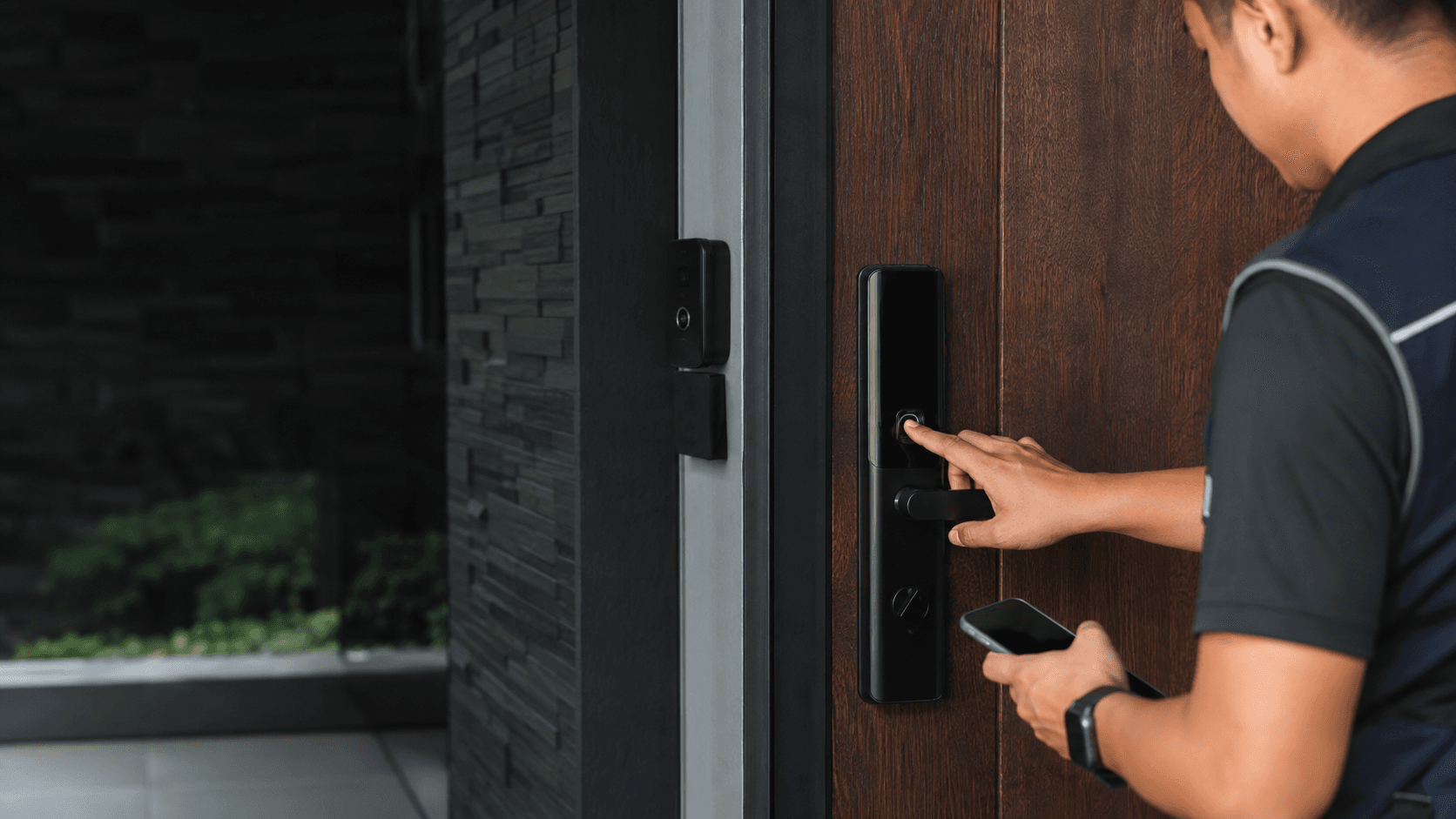
Most lock roundups written for American readers assume a covered porch and a mild winter. Neither applies in Sarawak, where a gate lock faces direct rain, sustained humidity, and heat for years. That difference changes which hardware survives and which fails early.
Eyonic Sdn Bhd plans, supplies, and installs security and ELV systems in Sarawak, including smart lock door access, and reviews door condition, user roles, and backup entry before recommending a model. The same review applies to any digital door lock outdoor job.
Digital Door Lock Outdoor. what the term covers
The phrase describes keyless entry hardware intended for a door or gate that is exposed to weather. It is a use case, not a product category with one fixed specification. Two very different products sit under it.
A smart deadbolt or lever lock replaces the existing lock body on a front door. A smart padlock or gate lock secures a sliding gate, grille, or shed door. Both remove the key, and both depend on a power source, an unlock method, and a housing that tolerates moisture.
Indoor smart locks are built for a sheltered door. An outdoor digital door lock is expected to handle rain hitting the face of the unit, condensation forming inside it, and heat building up in direct sun. Those three stresses drive the specification more than any app feature.
Eyonic's product review notes that smart locks work best when door condition, user roles, and backup method are reviewed before installation, and that for business use the choice between a standalone smart lock and an access-control panel is worth checking first. That guidance applies directly to outdoor placements, where a failed lock is harder to work around.
Weather, gate, and door conditions that decide the choice
Exposure is the first question. A lock under a wide porch roof sees far less water than one mounted on a gate post at the roadside. The second question is how the door moves: a swing door and a sliding gate need different hardware entirely.
Humidity is the quieter problem. Moisture that enters a housing and cannot escape corrodes contacts and drains batteries faster than the rated figure suggests. A lock that performs well in a dry climate may behave differently in a coastal or riverside location.
Heat matters for the same reason. A dark metal gate post in afternoon sun reaches a higher surface temperature than the surrounding air, and the lock body sits against it.
Physical fit decides as much as weather. Door thickness, existing bore holes, gate frame material, and whether the door is hollow or solid all affect what can be mounted without modification. None of these can be confirmed from a product listing alone.
Eyonic's approach to camera placement is to check actual conditions on site before confirming a position rather than relying on a general recommendation. The same logic applies to a lock: the mounting surface and the weather it actually receives are checked before a model is confirmed.
When an outdoor-rated lock is the right answer
An outdoor digital door lock suits a property where keys are repeatedly lost or shared, where a gate needs to be opened by more than one household member, or where a business needs to control who enters a side or rear door. It also suits a rental or short-stay property where codes can be changed between guests.
It is a poor fit where the door is already damaged, where the frame cannot carry the lock body, or where no reliable backup entry method exists. A lock that depends entirely on a battery and a working keypad leaves no way in when either fails.
Digital Door Lock Outdoor options for gates, grilles, and front doors
Three broad placements cover most Malaysian properties, and each carries a different constraint.
A front door lock replaces the existing deadbolt or lever. This is the most common placement and the one with the widest choice of unlock methods, because the door is usually sheltered and the lock body sits inside the door thickness.
A gate or grille lock secures an opening that is fully exposed. Padlock-style units and gate-specific locks are built for this, and the mounting hardware matters as much as the lock itself.
A secondary or rear door lock covers service entrances, store rooms, and staff areas. These are often the least sheltered doors on a property and the ones most likely to be forgotten during planning.
For business premises, the choice between a standalone smart lock and a managed access-control panel is a real fork. A standalone lock is simpler and cheaper to run. A panel gives central control over many doors and users, which matters when staff turnover is frequent or when entry records are needed.
Eyonic's completed work for the Kuching Immigration Office focused on arrival flow, staff areas, visitor movement, and dependable daily operation. That is the same set of concerns a business weighs when deciding how many doors need controlled entry and who should hold access.
Installation sequence Eyonic follows from survey to handover
Eyonic's installation process runs through four stages, and the same sequence applies to lock work.
- Site survey, where the door, gate, frame, exposure, and existing hardware are inspected on site.
- System proposal, where the suitable lock type and access method are set out for the property.
- Installation, where the lock is mounted, wired or powered, and configured.
- Handover, where users are set up, entry methods are tested, and the backup method is confirmed.
The survey stage is where most outdoor problems are caught. A lock that looks suitable online may not fit the gate frame, may sit in a position that collects water, or may need a power route that does not exist. Finding that before ordering is cheaper than finding it after mounting.
Handover is where the backup method gets tested rather than assumed. If the primary unlock method fails, the property still needs a way in, and that path should be confirmed while the installer is on site.
Digital Door Lock Outdoor checks before confirming a model
These checks are worth completing before any model is ordered, because each one can rule out hardware that otherwise looks correct.
- Confirm the door or gate condition, including thickness, frame material, and whether the existing opening can carry the lock.
- Confirm who needs access and what role each user holds, since a household and a staffed office need different permission structures.
- Confirm the backup entry method, so the property is not locked out when a battery or keypad fails.
- Confirm the exposure the lock will actually face, including roof cover, prevailing rain direction, and afternoon sun.
- Confirm the power source and whether it can be maintained without dismantling the door.
Two of these deserve more weight than they usually get. User roles determine whether a simple code lock is enough or whether per-user permissions and entry records are needed. Backup entry determines whether the property can still be opened on the day the electronics stop working.
Eyonic's review guidance notes that smart locks are good for controlled convenience when user permissions and backup entry are planned properly. That is the honest limit of the category: the convenience is real, and it depends on planning rather than on the lock alone.
What cannot be confirmed without a datasheet
Weatherproofing ratings, operating temperature ranges, battery life, and the full list of unlock methods vary by model and should come from the manufacturer's own documentation for the specific unit being considered. A general claim that a lock is weatherproof does not establish how it performs on a gate post in Sarawak.
Compatibility with a particular gate, grille, or door thickness is likewise model-specific. It is confirmed by measuring the opening, not by comparing marketing descriptions.
Support and next step with Eyonic
Eyonic Sdn Bhd is based in Sarawak and works on security and ELV systems for homes, offices, shops, and industrial sites. The company's founder, Eric Yong, has worked in technical installation of digital security solutions for commercial businesses in Sarawak for more than ten years.
Published package pricing covers a Hikvision CCTV package at RM 1,599, a Hikvision alarm system at RM 1,599, and an autogate package at RM 1,599. Lock supply and installation is quoted per property, because the door, gate, and exposure conditions differ from site to site.
For a digital door lock outdoor installation, the practical starting point is the property itself. Share the location, property type, and required system with Eyonic on WhatsApp at +60 11-5111 7959, and the next step is a site survey rather than a model recommendation made at a distance.