
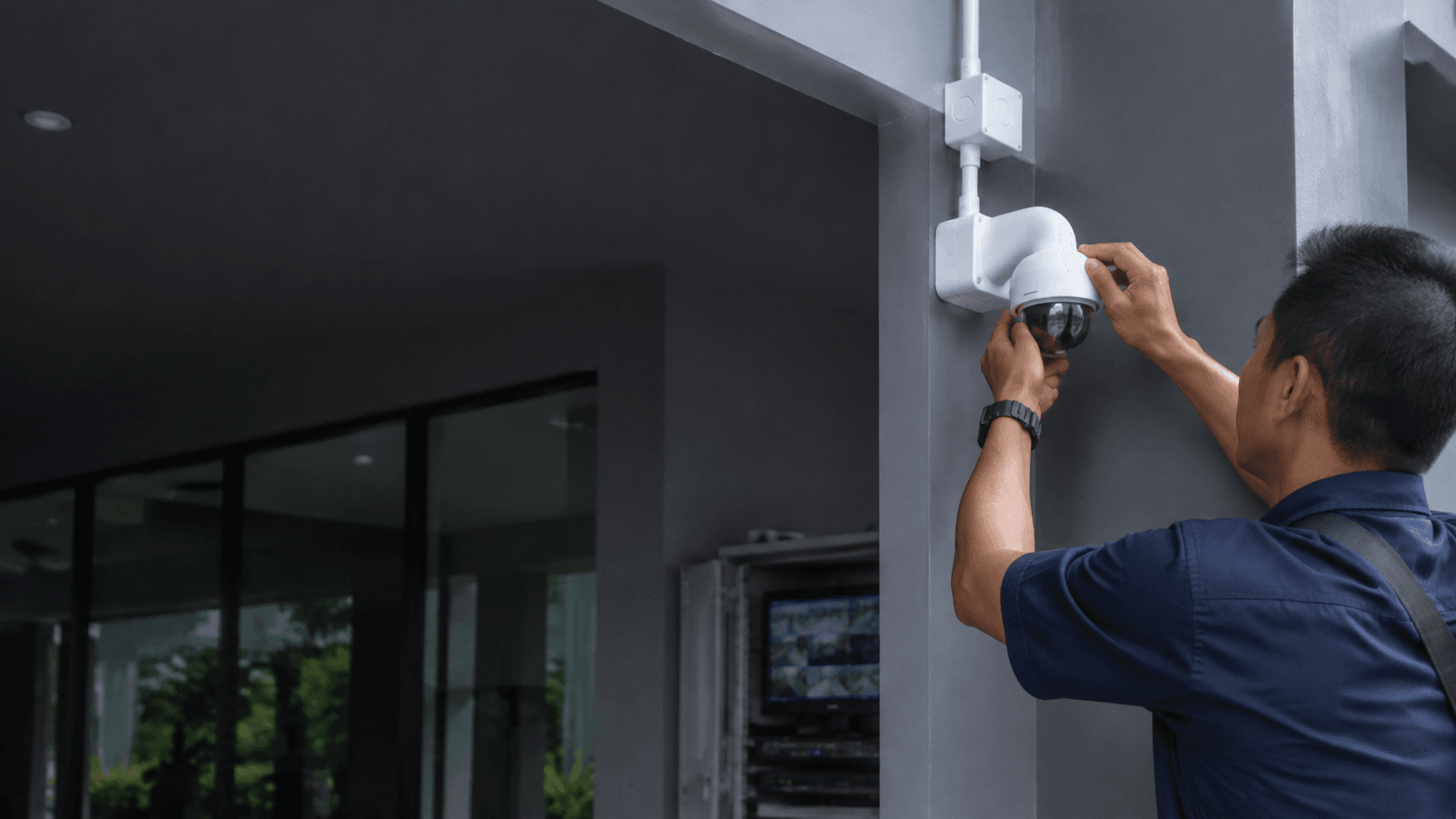
The trade-off is real. a moving camera sees one direction at a time, so coverage depends on how it is placed, how it is controlled and what it is asked to record. This page sets out where Ptz Cctv earns its place on Malaysian sites, what to compare before committing, and how Eyonic plans the work from survey to handover.
ptz cctv: what a moving camera covers on one view
A PTZ camera sits on a motorised mount. Pan moves the lens left and right, tilt moves it up and down, and optical zoom magnifies the scene through the lens rather than by enlarging pixels. That combination lets one camera hold a wide view of a car park or a perimeter line, then narrow onto a gate, a vehicle or a doorway when something needs a closer look.
Optical zoom is the part that matters most for identification. Digital zoom crops and enlarges what the sensor already captured, so it adds size without adding detail. Optical zoom changes the actual field of view, which is why zoom range is one of the first things to compare between models.
Remote control is the second half of the equation. An operator can steer the camera from a phone, a desktop client or an NVR interface, and many systems also support preset positions that the camera returns to on command. Auto tracking, where the camera follows a moving subject, appears on some models, but its behaviour varies by brand and firmware.
Night vision is a separate decision from zoom. Infrared illumination, low-light sensors and integrated lighting all change what a camera can show after dark, and the right choice depends on whether the site needs to detect movement, recognise a person, or read a plate.
Where ptz cctv earns its place. open lots, long perimeters, arrival points
PTZ cameras tend to make sense where the area is large, the points of interest are spread out, and fixed cameras would need to be multiplied to cover the same ground.
- Open car parks and yards. A single camera can sweep the whole lot and then zoom onto a specific bay or vehicle.
- Long perimeter lines. Fences and boundary walls that run for tens of metres are awkward for fixed cameras, which see a narrow slice each.
- Arrival and entry points. Gates, lobbies and reception areas benefit from a camera that can watch the approach and then tighten on a face or a vehicle.
- Sites with changing activity. Where the busy area shifts through the day, a steerable camera adapts without new cabling.
The counter-case matters just as much. A corridor, a small shop floor or a single doorway is usually served better by fixed cameras, because a fixed camera never misses what happens while the PTZ is pointed elsewhere. Many sites end up with both. fixed cameras holding constant views and a PTZ covering the open ground between them.
What to compare before choosing ptz cctv: zoom range, lighting, recording, control
Four things decide whether a PTZ installation performs as expected.
Zoom range. A longer optical zoom reaches further, but it also narrows the field of view at the far end. The question is not how far the camera can see, but whether it can render a usable image at the distance that matters on site.
Lighting. Eyonic recommends checking actual lighting conditions before confirming placement for ColorVu-style cameras, and the same discipline applies to PTZ. A position that looks clear in daylight can behave differently at night, under floodlights, or facing a bright entrance.
Recording and NVR compatibility. A PTZ camera still needs somewhere to record. NVR setup, storage duration and how the recorder handles a moving camera all affect what can be reviewed later. Compatibility should be confirmed before purchase rather than assumed.
Control and remote viewing. Who steers the camera, and from where? Preset positions reduce the burden on an operator, while remote viewing lets a owner or manager check the site without travelling. The control method shapes daily use more than the camera body does.
How Eyonic plans ptz cctv work. site survey, system proposal, installation, handover
Eyonic's CCTV installation process follows four stages, and PTZ work runs through the same sequence.
- Site survey. The site is walked to establish what needs watching, where cameras can be mounted, how power and network reach those points, and what the lighting is actually like.
- System proposal. The survey findings become a proposed system covering camera placement, recording and remote viewing, matched to the property type and the way the site operates.
- Installation. Cameras, cabling and recording equipment are installed and configured, including NVR setup and mobile viewing.
- Handover. The system is tested with the people who will use it, and viewing access is set up so daily operation does not depend on the installer.
Eyonic Sdn Bhd is a security system supplier in Sarawak working across CCTV and ELV systems for homes, offices, shops and industrial sites. Eric Yong, the founder, has been in the industry for more than 10 years and works on technical installation of digital security solutions for commercial businesses in Sarawak.
Kuching Immigration Office. ptz cctv planning for arrival flow and visitor movement
Eyonic completed a project for the Kuching Immigration Office, focused on arrival flow, staff areas, visitor movement and dependable daily operation. The approximate budget for that type of work was RM 12,000 to RM 28,000.
The shape of that brief is instructive for PTZ planning. A public office has a predictable arrival pattern, a steady stream of visitors, and staff areas that need their own coverage. Those are exactly the conditions where a steerable camera can watch an approach and then tighten on a specific point, while fixed cameras hold the constant views that a busy counter or corridor needs.
A second Eyonic project, for KTA Sarawak Sdn Bhd, covered a practical office setup in Kuching supporting staff movement, visitor handling, tidy cabling and clearer daily site control, with an approximate budget of RM 8,000 to RM 18,000. Both projects point to the same planning habit: match the camera type to the movement pattern rather than to the product list.
Practical limits and evidence gaps for ptz cctv claims
Several things commonly claimed about PTZ cameras cannot be verified from the evidence available here, and it is worth knowing which questions to put to a supplier directly.
No supplied evidence states PTZ camera specifications such as zoom multipliers, resolution, sensor size, or IP and IK ratings for any model Eyonic supplies. No supplied evidence states PTZ CCTV pricing, package pricing or installation charges. No supplied evidence states PTZ performance at night, tracking accuracy or detection distance. No supplied evidence states warranty terms, service response times, or certification of installers, and no supplied evidence states Malaysian regulatory or licensing requirements for CCTV installation.
Those gaps are not reasons to avoid the category. They are the specific items to confirm in writing before committing: the exact model and its published specification sheet, the quoted price and what it includes, how the camera behaves in the site's actual night conditions, the warranty and support terms, and any local requirement that applies to the property.
One further limit is inherent rather than evidential. A PTZ camera cannot be in two places at once. If a site needs continuous, uninterrupted coverage of several fixed points, fixed cameras carry that load and the PTZ adds reach on top. Treating a single moving camera as a straight replacement for multiple fixed cameras is only safe when the site's movement pattern, lighting and recording setup have all been checked first.
Eyonic's basic Hikvision CCTV package is listed at RM 1,599, covering camera supply and setup, basic recording configuration and mobile viewing handover. Whether a PTZ camera fits within that package depends on the site, which is why the survey comes first.
Share your location, property type and required system with Eyonic on WhatsApp at +60 11-5111 7959 for the next practical step.