
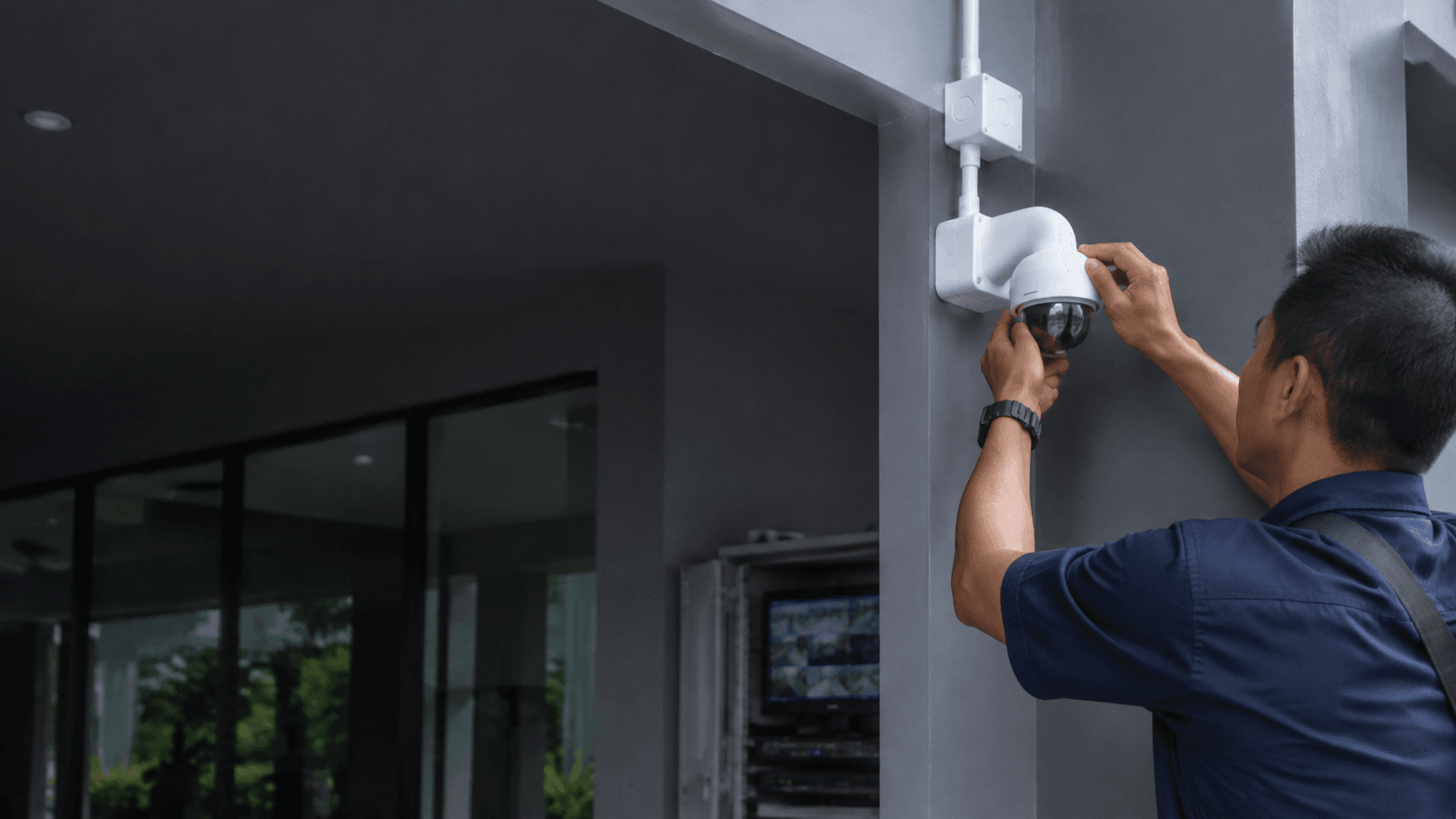
The work is planned, supplied, and installed for homes, offices, shops, and industrial sites, with the site survey deciding where each camera goes before any cable is run. Eyonic Sdn Bhd is a security system supplier in Sarawak, Malaysia, working with Hikvision cameras and ELV systems.
What a cctv camera system covers in a working property
A working cctv camera system is more than a set of cameras. It is a chain of decisions that starts with what needs to be seen and ends with who can view it. Eyonic's scope covers camera placement, recording, and remote viewing, which means the supplier is responsible for where cameras point, where footage is stored, and how it is watched later.
Four parts carry the result.
- Cameras mounted where they can actually see the target area, not just where mounting is easiest.
- Recording handled by a recorder that keeps footage available for review after an incident.
- Remote viewing so the property can be checked from a phone or computer away from the site.
- Cabling and power routed tidily, because messy runs are the most common reason a system looks unfinished.
Homes, offices, shops, and industrial sites each stress the system differently. A shop cares about the counter and the entrance. An office cares about staff movement and visitor handling. An industrial site cares about perimeter and loading areas. The same camera model can serve all three, but the placement plan cannot be copied between them.
How Eyonic plans a cctv camera system before installation
Eyonic's CCTV installation process runs through four stages: site survey, system proposal, installation, and handover. The survey comes first because placement, cabling, and recorder location all depend on what the site actually looks like.
- Site survey. The property is walked through to identify entry points, high-value areas, existing cabling, power availability, and lighting at different times of day.
- System proposal. The survey findings become a proposed layout with camera positions, recorder location, and the package tier that fits the site.
- Installation. Cameras, cabling, and the recorder are installed and configured, including recording settings and remote viewing access.
- Handover. The system is demonstrated, mobile viewing is set up, and the user is shown how to review footage.
The survey stage is where most problems are prevented. A camera that faces a bright window, a doorway that is blocked by a pillar, or a recorder placed in a cupboard with no ventilation are all issues that are cheap to fix on paper and expensive to fix after installation.
Why the survey matters more than the camera model
Two properties with identical camera lists can produce very different footage. The difference is usually placement, angle, and lighting. A camera aimed at a gate from ten metres away sees a different scene from one mounted at the gate itself, even at the same resolution.
Eyonic's project for the Kuching Immigration Office focused on arrival flow, staff areas, visitor movement, and dependable daily operation. That is a public office with continuous foot traffic, so the placement plan had to account for how people actually move through the building rather than just covering rooms. A similar approach applies to a shop counter or an office reception.
Camera placement checks that decide picture quality
Placement is the single biggest factor in whether footage is useful. A camera that covers the wrong angle produces video that cannot identify anyone, no matter how good the hardware is.
Eyonic recommends checking actual lighting conditions before confirming placement for ColorVu-style cameras. ColorVu cameras are designed to produce colour images in low light, but the result depends on what light is genuinely present at night. A street lamp that looks adequate during a daytime survey may leave a doorway in near-darkness after midnight.
What the survey checks at each position
- Lighting at night, not just at survey time. The check should happen when the area is at its darkest, not during a daytime visit.
- Field of view against the target. A camera covering a wide area may miss detail at the point that matters most, such as a face at a door.
- Obstruction over time. Trees, signage, and parked vehicles can block a view that was clear on survey day.
- Cable route and power. The shortest cable run is not always the best one, and exposed cabling is both a security risk and a maintenance problem.
- Recorder location. The recorder needs ventilation, power, and reasonable access for review without being obvious to visitors.
These checks are why a generic kit bought online often disappoints. The kit is fine; the placement is not. A supplier who surveys the site first can position cameras where the lighting and layout actually support the footage.
Package pricing and what each tier includes
Eyonic lists a Hikvision CCTV Package at RM 1,599. The package covers camera supply and setup, basic recording configuration, and mobile viewing handover. That is the entry point for a straightforward property.
Larger or more complex sites move beyond the package tier. Two Eyonic projects show the range: the KTA Sarawak Sdn Bhd office project carried an approximate budget of RM 8,000 to RM 18,000, and the Kuching Immigration Office project carried an approximate budget of RM 12,000 to RM 28,000. Both were office environments in Kuching with different coverage demands.
The gap between RM 1,599 and the project ranges reflects scope, not markup. A package covers a defined set of cameras and a basic recording setup. A project budget covers more camera positions, longer cable runs, more complex routing, and the labour that comes with a larger building.
What moves a site from package to project pricing
- Camera count. More positions mean more hardware, more cable, and more installation time.
- Building layout. A single-storey shop with open ceilings is faster to cable than a multi-level office with solid walls.
- Cable distance. Long runs between cameras and the recorder add material and labour.
- Coverage requirements. A site that needs every entrance, exit, and internal corridor covered needs more positions than one focused on a single entrance.
- Existing infrastructure. Sites with usable conduit or existing cabling cost less to fit than sites starting from nothing.
Eyonic also lists a Hikvision Alarm System at RM 1,599 and an Autogate Package at RM 1,599. These are separate systems, but they are often planned alongside CCTV because they share the same entry points. A gate that opens automatically and a camera that watches the gate are two parts of the same access decision.
Common questions before a is installed
Does the system need internet to record
Recording happens at the recorder on site, so footage is captured whether or not the internet is working. Internet matters for remote viewing, which is how the property is checked from a phone or computer away from the site. If the connection drops, recording continues and remote access resumes when the connection returns.
Can the system be checked from a phone
Yes. Mobile viewing handover is part of the Eyonic package, which means the app is set up and demonstrated before the installer leaves. That handover step matters because a system that records but cannot be checked remotely loses much of its day-to-day value.
How long does installation take
Duration depends on camera count, cable routes, and building layout. A straightforward package on a single-storey property is a shorter job than a multi-level office with long cable runs. The site survey is what produces a realistic timeline, which is why it comes before the proposal rather than after.
What happens if lighting is worse than expected
That is exactly what the lighting check is for. If a position turns out to be darker than the survey suggested, the placement can be adjusted or a different camera position chosen before installation. Catching it at survey stage avoids re-running cable later.
Is the system suitable for a shop or industrial site
Eyonic plans, supplies, and installs monitoring systems for homes, offices, shops, and industrial sites. The hardware range is the same; the placement plan changes. A shop needs counter and entrance coverage, while an industrial site needs perimeter and loading area coverage, and both need the recorder positioned where it can be maintained.
What should be prepared before the survey
Knowing the property type, the areas that matter most, and whether remote viewing is needed gives the survey a clear starting point. Eric Yong, founder of Eyonic Security Systems, has worked in the industry for more than ten years and is experienced in technical installation of digital security solutions for commercial businesses in Sarawak.
Share the location, property type, and required system with Eyonic on WhatsApp at +60 11-5111 7959 for the next practical step.