
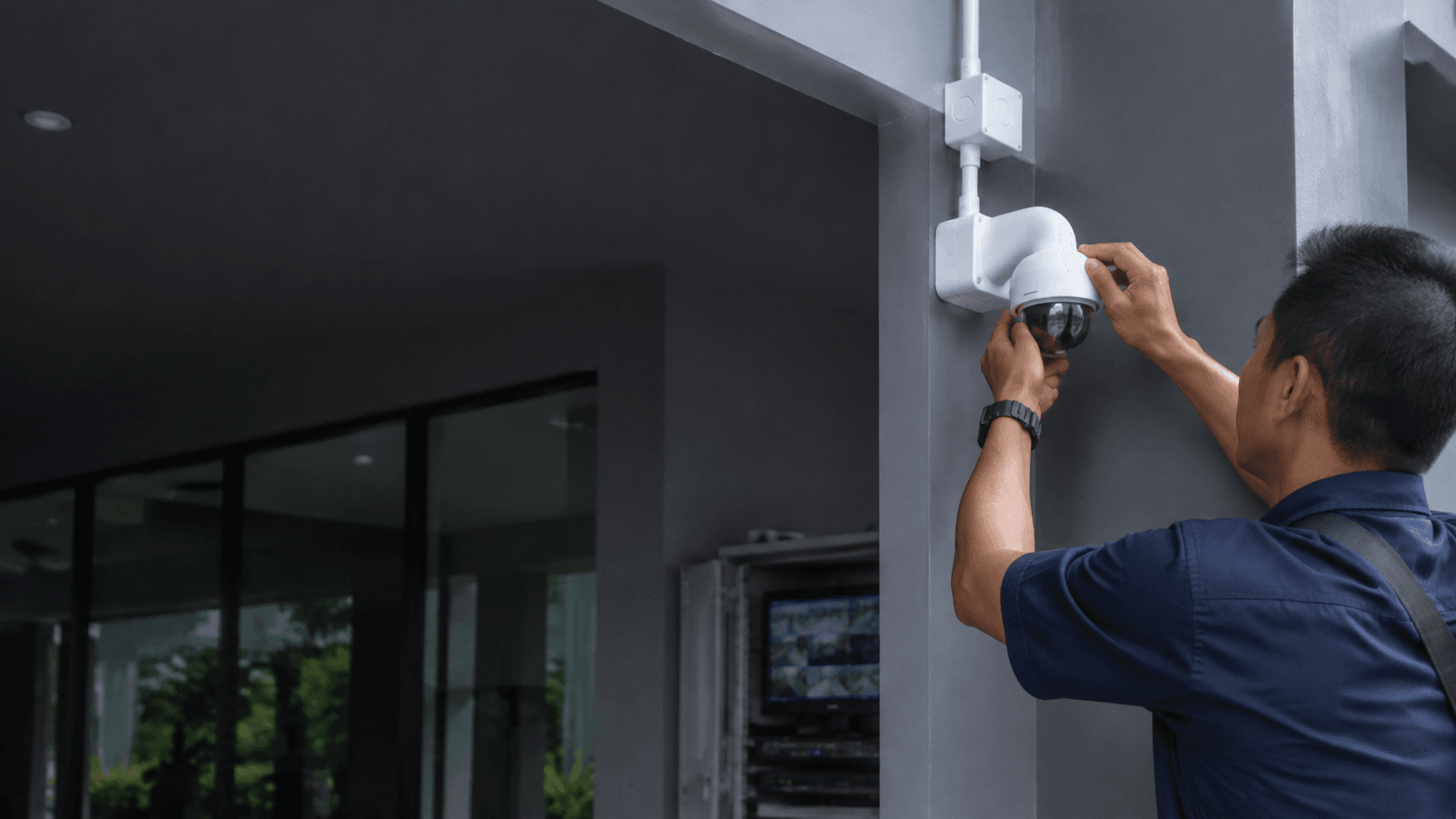
Outdoor CCTV is the part of a surveillance setup that sits outside the building envelope, where rain, heat, dust, and insects attack every joint and lens. The camera is only one component. Cabling, recorder capacity, power, and the way footage is reviewed all decide whether the system stays useful after the first month.
Eyonic Sdn Bhd is a security system supplier in Sarawak, Malaysia, working on CCTV and ELV systems. The company handles planning, supply, and installation, and its founder Eric Yong has worked in the industry for more than 10 years, with experience in technical installation of digital security solutions for commercial businesses in Sarawak.
Outdoor CCTV. What Matters Before Choosing
Most outdoor failures trace back to decisions made before any camera is mounted. Position, light, and cable route matter more than headline resolution.
- Survey the site and note where light falls at night, not just during the day.
- Confirm camera positions against actual lighting conditions before fixing brackets.
- Agree the system proposal, including recorder location and storage.
- Install cabling, cameras, and recorder as one coordinated job.
- Hand over with mobile viewing tested and recording verified.
That sequence reflects how Eyonic describes its own CCTV installation process: site survey, system proposal, installation, and handover. Skipping the survey stage usually means re-running cable later, which costs more than the original installation.
Lighting deserves separate attention. Eyonic advises checking actual lighting conditions before confirming placement for ColorVu-style cameras, because a position that looks bright at midday can be almost black at 2am. A camera rated for low light still needs some ambient source, and a poorly chosen angle can point straight into a streetlamp or a reflective wall.
Choosing the Right Outdoor CCTV
The right choice depends on what the site needs to prove, not on the largest number on a specification sheet. A shop entrance, a factory perimeter, and a home gate have different priorities.
Three practical questions narrow the field quickly. First, does the site need to identify a face or a number plate, or only confirm that someone approached? Second, is there mains power and a cable route to each position, or does the camera need to run on battery or solar? Third, who reviews the footage, and on what device?
Wired systems generally suit fixed positions where cable can be run once and left alone. Wireless and battery cameras suit rented premises, heritage buildings, or positions where chasing cable is impractical. The trade-off is maintenance. batteries need replacing, and wireless links can drop under heavy interference.
Recording location is the other major fork. Local recording on a recorder keeps footage on site and avoids ongoing subscription costs, while cloud recording survives theft of the recorder itself. Many sites run both, with local recording as the primary and cloud as a backup for a small number of key cameras.
What is outdoor cctv?
Outdoor CCTV is a camera system built to operate outside, using weather-resistant housings and sealed connectors, connected to a recorder or cloud service so footage can be stored and reviewed remotely. The defining difference from indoor equipment is environmental tolerance rather than image quality.
Housings are commonly rated IP66 or similar, meaning they resist dust and strong water jets. That rating covers the enclosure, not the cable entry or the connector behind it, which is why installation quality matters as much as the product specification.
Practical Considerations for Outdoor CCTV
Several constraints appear repeatedly on real sites, and planning around them early avoids expensive rework.
Cable distance limits apply to every technology. Long runs over copper can degrade signal, and the fix is usually a different cable type, a mid-span device, or a local switch rather than a higher-specification camera. Power over Ethernet simplifies this by carrying both data and power on one cable, but it requires a compatible recorder or injector.
Night performance depends on more than the sensor. Infrared illumination has a usable range, and beyond it the image falls away. Colour-at-night cameras need ambient light to produce colour, so a site with no street lighting may still return a monochrome image. This is exactly why Eyonic recommends checking actual lighting conditions before confirming placement.
Storage sizing is a common oversight. More cameras, higher resolution, and continuous recording all consume disk space faster. Motion-triggered recording reduces storage needs but can miss the seconds before an event, which are often the most useful.
Maintenance is modest but real. Lenses collect dust and water spots, spiders build webs near infrared emitters, and connectors corrode if they were not sealed properly. A brief periodic clean and a check of recorded footage keeps a system dependable.
For larger or public-facing sites, the design brief changes. Eyonic's project for the Kuching Immigration Office focused on arrival flow, staff areas, visitor movement, and dependable daily operation, which shows how coverage priorities shift when a site handles the public rather than only staff. A similar pattern appears in the KTA Sarawak Sdn Bhd project, where the office setup in Kuching supported staff movement, visitor handling, tidy cabling, and clearer daily site control.
Cost and package context
Eyonic lists a Hikvision CCTV package at RM 1,599, covering camera supply and setup, basic recording configuration, and mobile viewing handover. The same figure applies to its Hikvision alarm system and autogate package, each at RM 1,599.
Larger installations sit well above that. The Kuching Immigration Office project carried an approximate budget of RM 12,000 to RM 28,000, and the KTA Sarawak Sdn Bhd project an approximate budget of RM 8,000 to RM 18,000. Those ranges reflect scope, camera count, and site complexity rather than a per-camera price.
Making an Informed Choice About Outdoor CCTV
A workable decision comes from matching coverage to purpose. Identify the few points that genuinely need identification-quality images, then cover the rest of the perimeter with wider, lower-cost views. This usually costs less than blanketing every wall with high-resolution cameras.
Confirm the recorder location is secure and ventilated, and that it is not the first thing a visitor sees. Check that remote viewing works on the devices actually used day to day, and that someone other than the installer knows how to export a clip if it is ever needed.
Where a site already has cabling, replacing cameras on an existing system can be more economical than a full rebuild, provided the recorder and cable type remain compatible. Where the site is new, running cable before ceilings and walls are closed is far cheaper than retrofitting later.
For sites in Sarawak, a supplier who can attend the premises matters as much as the product brand. Eyonic's services cover site survey, camera placement, NVR setup, and remote viewing, alongside alarm systems, autogate, keyphone intercom, and Starlink internet installation.
Share the location, property type, and required system with Eyonic on WhatsApp at +60 11-5111 7959 for the next practical step.