
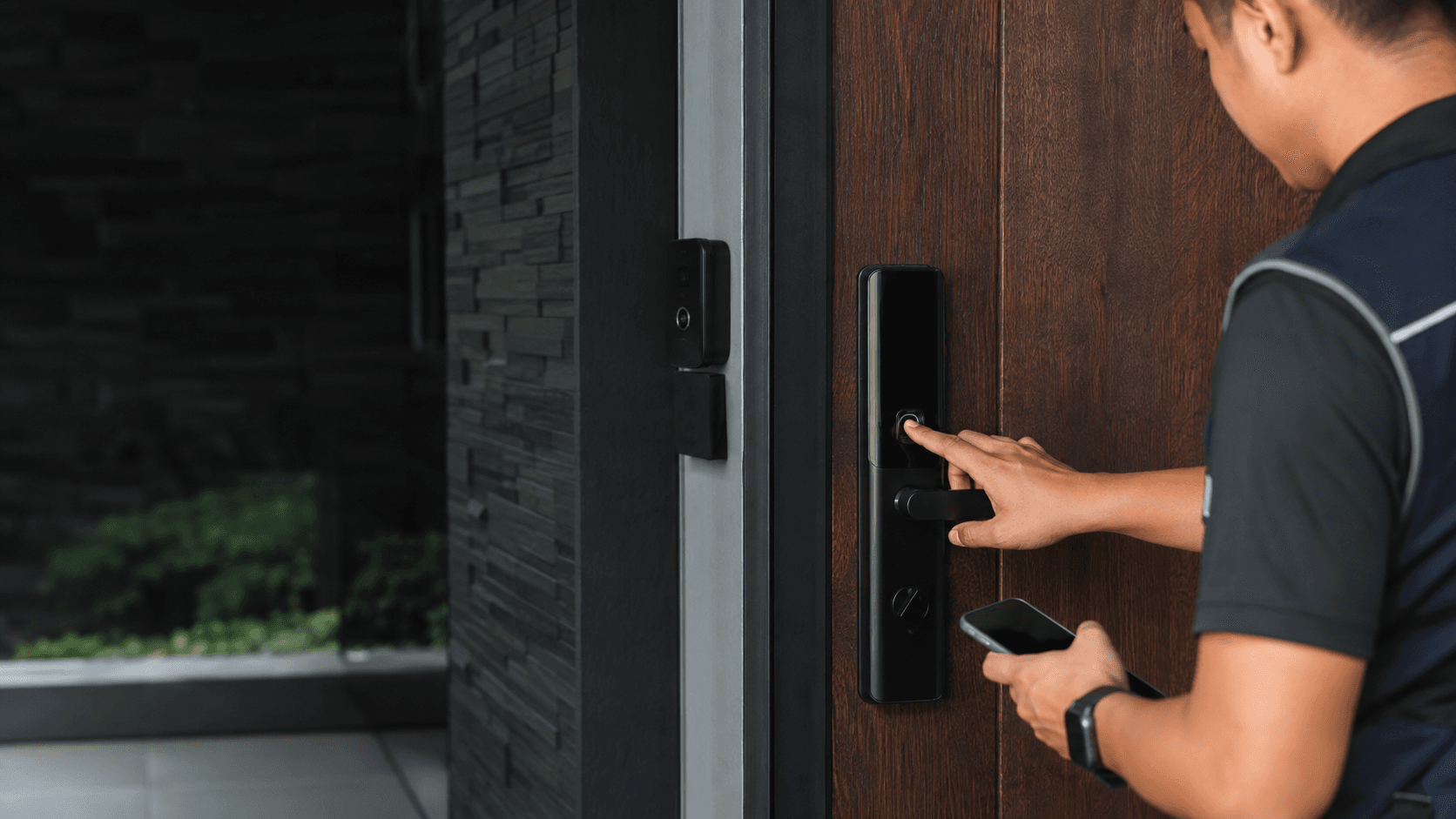
The grille gate is the awkward door in most Malaysian homes. It sits outside the timber or aluminium main door, it is usually narrower, and its bars leave gaps that a standard deadbolt cannot bridge. That geometry is why a digital lock for grill door is a separate product class rather than a variant of an ordinary smart lock.
This guide covers what the hardware actually does, where it fails, and how to judge whether a given model suits a specific gate.
Digital Lock For Grill Door. What Matters Before Choosing
Three things decide whether a model works on a particular gate: the mounting type, the door thickness and gap, and how the lock behaves from the inside.
Grille locks generally fall into two mounting families. Rim locks sit on the surface of the gate and are the common choice for iron grilles and gate doors. Mortise and slim-body locks are cut into the door edge and suit aluminium or narrow-profile doors. A lock designed for a 40 mm timber door will not fit a grille frame, and a slim-body lock built for aluminium may not have enough body depth for a wrought-iron gate.
The second constraint is the gap between the gate and the frame. Rim locks need a strike plate that lines up with the gate's closing position. If the gate has settled or the hinge has dropped, the bolt will not seat, and no amount of app configuration fixes a misaligned strike.
The third is inside access. A grille gate often has an open bar section, which means anyone reaching through can potentially operate an interior handle or button. This is the single most discussed failure mode in owner forums, and it is a physical design problem rather than a software one.
Choosing the Right Digital Lock For Grill Door
Work through the gate itself before comparing features. The sequence below reflects the order in which the constraints actually bind.
- Measure the gate frame depth and the door thickness at the lock position, then confirm the model's stated compatibility range covers both.
- Check the closing gap and strike alignment; a rim lock needs a flat, stable mounting surface and a strike that meets the bolt squarely.
- Decide the entry methods required — keypad, card, fingerprint, or app — and confirm the model supports all of them rather than a subset.
- Confirm a mechanical key override exists, and store that key somewhere other than inside the property.
- Review inside access. if the gate has open bars near the lock, plan a cover, a shield, or a model with no exposed interior release.
- Check the power source and whether emergency power is possible, typically via a micro-USB terminal on the exterior.
- Confirm the lock suits outdoor exposure if the gate is not sheltered, since rain and direct sun shorten electronics life.
Steps one and two eliminate most unsuitable models before price or brand enters the conversation. A lock that cannot physically mount is not a candidate regardless of its feature list.
What is digital lock for grill door?
It is a locking device that replaces the mechanical key cylinder on a metal grille gate with electronic authentication — a PIN, a card, a fingerprint, or a phone app — while retaining a physical key as a fallback. The defining feature is not the electronics but the mounting geometry: grille locks are shaped to fit bar gates and narrow frames rather than solid timber doors.
Published specifications illustrate the range. The Hafele GL5600 lists smart card, password, and fingerprint entry, a random security coding function, auto locking, a double locking function, password exposure protection, an indoor privacy mode, and emergency power via micro USB, with AA alkaline batteries as the power source. The AEGLOC SDL-T10 lists fingerprint, PIN code, card, mechanical key, and Bluetooth app access, with an optional Wi-Fi gateway, and states an operating temperature range down to -10°C.
Those two examples show the category's typical shape: multiple credential types, an auto-lock behaviour, and a battery supply with a wired or USB fallback.
Practical Considerations for Digital Lock For Grill Door
Feature lists are similar across brands. The differences that matter show up in daily use and in failure conditions.
Inside access and the reach-through problem
An open-bar grille lets a hand pass through to the interior side of the lock. If that side has a thumb-turn, a lever, or an unlock button, the gate can be opened from outside without any credential. Owner discussions on this exact issue converge on the same remedies: fit a physical cover over the interior mechanism, choose a lock with no exterior-facing release, or remove the interior handle entirely where the model allows it.
This is worth resolving before purchase rather than after. A lock that is electronically strong but mechanically reachable is not providing the security its specification implies.
Weather exposure
Grille gates are frequently unsheltered. Electronics rated for indoor use will degrade faster outdoors, and fingerprint readers in particular struggle with wet or dusty fingers. Where the gate faces direct rain, a sheltered mounting position or a model with a stated outdoor rating is the practical choice. The AEGLOC SDL-T10's stated -10°C lower operating limit indicates it is specified for outdoor temperature ranges, which is a relevant signal for exposed installations.
Power and lockout risk
Battery-powered grille locks fail in one direction: they stop accepting credentials. The Hafele GL5600's micro-USB emergency power terminal exists precisely for this scenario, and it is a feature worth confirming on any model under consideration. A lock without an emergency power path means a dead battery requires either a mechanical key or a locksmith.
Door condition and alignment
Grille gates move. Hinges sag, frames shift, and a bolt that seated cleanly at installation may not seat a year later. Auto-lock functions amplify this: if the bolt cannot extend, the lock may report a fault or fail to secure. Regular adjustment of the strike plate is part of owning this hardware, not an installation defect.
Standalone lock or access control panel
For a single home gate, a standalone digital lock for grill door is usually sufficient. For a business entrance with multiple staff and a need to review who entered and when, a lock that reports to an access-control panel is the more appropriate structure. The decision hinges on whether entry records and centralised permission changes are required, not on the lock's credential types.
Making an Informed Choice About
The category is mature enough that the deciding factors are physical fit, inside access, and power resilience rather than brand prestige. A model that mounts cleanly, cannot be reached through the bars, and has a working emergency power path will outperform a more feature-rich lock that fails on any of those three.
Where the gate is part of a wider property system — cameras, alarm, intercom — it is worth confirming that the lock's app or gateway does not conflict with existing equipment, and that the installer is treating the gate as one component of a coordinated setup rather than an isolated purchase.
For readers in Sarawak, Eyonic Sdn Bhd plans, supplies, and installs security systems including smart locks, with a documented process covering site survey, system proposal, installation, and handover. The company's project record includes the Kuching Immigration Office, where the work focused on arrival flow, staff areas, visitor movement, and dependable daily operation, and KTA Sarawak Sdn Bhd, an engineering consultancy office setup supporting staff movement, visitor handling, and tidy cabling. Founder Eric Yong has worked in technical installation of digital security solutions for commercial businesses in Sarawak for more than 10 years.
Eyonic's published package pricing for related systems is RM 1,599 for a Hikvision CCTV package, RM 1,599 for a Hikvision alarm system, and RM 1,599 for an autogate package. Larger project budgets on record range from RM 8,000 to RM 18,000 for the KTA Sarawak office and RM 12,000 to RM 28,000 for the Kuching Immigration Office work.
Share your location, property type and required system with Eyonic on WhatsApp at +60 11-5111 7959 for the next practical step.