
The brand sells wireless home security cameras, solar-powered cameras, video doorbells, baby monitors and pet feeder cameras, and its own product pages group the range by model code rather than by use case. That catalogue structure is useful for browsing and weak for deciding. A buyer in Malaysia has to settle three things before a model code matters: where the camera can physically go, how it gets power, and how it reaches the network.
Most published material about the zumimall camera range is product listing copy. The model families that recur across the brand's own collections are solar wireless cameras, battery-powered cameras, 4G LTE cellular cameras, video doorbells and indoor monitors. Each family solves a different installation problem, and the differences are practical rather than cosmetic.
Zumimall Camera models and power options
The range splits by how the unit is powered and how it sends video. Solar models pair a panel with an internal battery, so they suit positions that receive consistent daylight. Battery models rely on rechargeable cells and suit positions where a panel would be shaded or awkward. 4G LTE models carry their own cellular connection and suit sites where Wi-Fi does not reach. Doorbell models mount at an entry point and combine a camera with a call button. Indoor models cover baby monitoring and pet watching.
Model codes that appear repeatedly across the brand's collections include X2/X2K, X3K, X6K, X7K, G1K, GX2BK, GX2K, F5, P8, P10, A60, BK05, BK06 and BK07. The codes indicate family and generation, not a ranking. Two cameras with similar codes can differ in lens count, resolution and power method, so the code alone does not tell a buyer what the unit does.
Published specifications for resolution, battery life, storage limits and pricing for Malaysia are not available from a primary source, so this article does not quote them. Treat any figure seen on a marketplace listing as unverified until it appears on the manufacturer's own page or manual for that exact model.
Solar, battery and 4G LTE differences
These three families exist because buildings are not uniform. A terrace house with a sunny car porch, a shophouse with a deep five-foot way, and a rural store room with no fixed line each need a different answer.
Solar-powered security camera
A solar model needs daylight on the panel, not just daylight in the scene. A panel mounted under a roof overhang, behind a wall, or facing away from the sun's arc will underperform even on a bright day. The camera may still work, but the battery drains faster than the panel replaces charge, and the unit eventually needs manual charging. The practical check is to watch the intended panel position across a full day before committing to it.
Solar suits gates, perimeter walls, car porches and open compound edges. It suits poorly under dense tree cover, inside covered corridors, and on walls that face a neighbouring building closely enough to shade the panel for most of the day.
Battery-powered security camera
A battery model trades the panel for a larger cell and a periodic charging routine. It fits rental properties where drilling and wiring are restricted, and positions where no cable route exists. The trade-off is maintenance. someone has to reach the camera, remove it, charge it and refit it. A camera mounted three metres up a wall is a poor candidate for a battery-only design unless the household is willing to handle that cycle.
4G LTE cellular camera
A 4G LTE model carries its own data connection and needs a SIM plan. It suits sites with no broadband, temporary sites, and outbuildings beyond Wi-Fi range. The constraint is recurring cost and coverage: the SIM plan is a running expense, and signal strength at the mounting point decides whether the camera works at all. Signal should be tested at the exact height and position, not at ground level near the gate.
Zumimall Camera placement and lighting checks
Placement decides more outcomes than model choice. A well-placed mid-range camera outperforms a poorly placed higher-specification one, because the failure mode is usually the scene, not the sensor.
Four checks cover most installations:
- Confirm the field of view covers the approach path, not just the door or gate itself.
- Check the actual lighting at the position across morning, afternoon and night, rather than assuming the scene is bright or dark.
- Confirm the mounting surface can take the bracket and that the camera can be reached for charging or service.
- Test network or cellular signal at the final height and angle before drilling.
Lighting deserves particular attention. Cameras that produce colour images in low light depend on ambient light reaching the sensor, so a position that looks adequately lit to the eye may still be too dark for colour recording. The reliable method is to check the real conditions at the position rather than judging from a distance. Eyonic applies the same principle when confirming placement for low-light cameras, checking actual lighting conditions before the position is fixed.
Angle matters too. A camera pointed along a wall catches the side of anyone walking past; a camera pointed across the approach catches a face. Height is a compromise. higher positions resist tampering and cover more ground, but they flatten facial detail and make the unit harder to service.
Storage app access and multi user sharing
The brand's app documentation describes live viewing, playback of recorded events, alarm notifications, device sharing and management of multiple devices. Local and cloud storage both appear across the range, and the brand markets no-monthly-fee operation, which in practice means local storage carries the recording load unless a cloud plan is added.
Local storage usually means a memory card inside the camera. That keeps recordings on site and avoids a subscription, but it also means the card is the single point of failure: if the camera is removed, the footage goes with it. Cloud storage moves recordings off site and adds a recurring cost. The two are not mutually exclusive, and a mixed setup is common.
Multi-user sharing lets more than one person view the same camera. For a household this is convenient. For a business it raises a question worth settling early: who can view, who can download, and what happens when a staff member leaves. Shared access that is never reviewed tends to outlive the reason it was granted.
Data encryption is claimed across the range. Encryption protects the transmission and storage path, but it does not compensate for a weak account password or a shared login. Account hygiene matters more than the encryption label.
Installation steps for a
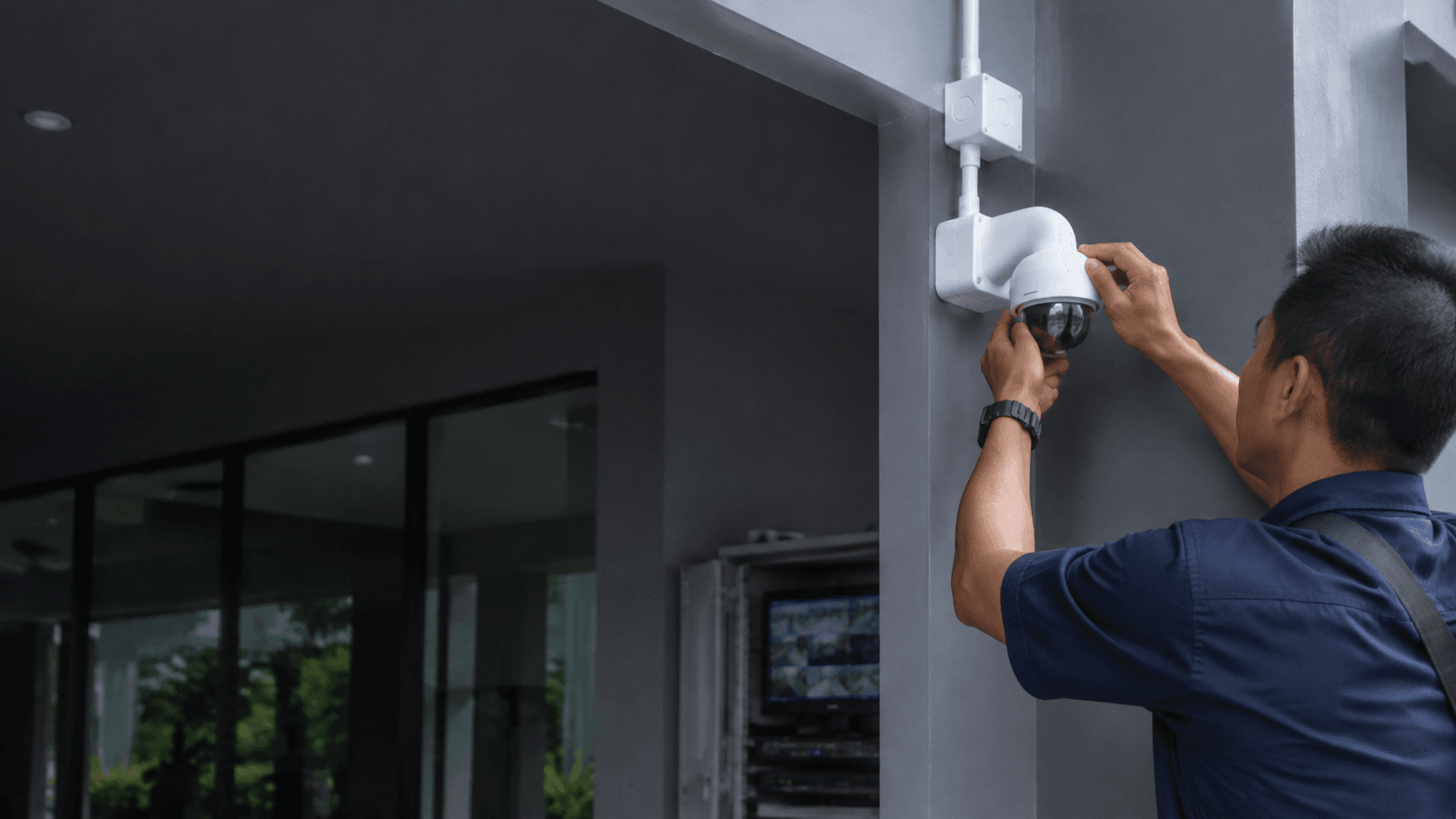
The sequence below follows the same order Eyonic uses on its CCTV work: survey, proposal, installation, handover. The order matters because each stage can invalidate the previous one. A camera positioned before the signal is tested may have to move; a camera mounted before the lighting is checked may record unusable night footage.
- Survey the site and identify what actually needs to be seen, including approach paths, entries and any blind spots.
- Choose the position for each camera and confirm the field of view covers the intended area.
- Check lighting and network or cellular signal at that exact position before any drilling.
- Mount the camera and confirm its power source is adequate for the position, whether solar, battery or fixed supply.
- Connect the camera to the network or insert and activate the SIM, then complete app pairing.
- Configure recording, motion or human detection zones, and alert recipients.
- Test playback, alerts and shared access with the people who will actually use the system, then hand over.
Step six is where most setups are either useful or noisy. Detection zones that cover a public road generate constant alerts, and constant alerts get ignored. Narrowing zones to the property boundary and the entry points keeps notifications meaningful.
Local support and next practical step
Availability, warranty terms and authorised distribution for Zumimall in Malaysia are not confirmed by a primary source, so a buyer should verify those directly with the seller before purchase. The same applies to app subscription pricing and cloud storage tiers.
Where a property already has a wired CCTV system, adding a wireless camera is usually a supplement rather than a replacement. Wireless units handle positions that cabling cannot reach; wired systems handle continuous recording and stable power. Eyonic's own installation work follows a survey-first approach, and its completed projects include the Kuching Immigration Office, where the focus was arrival flow, staff areas, visitor movement and dependable daily operation, and KTA Sarawak Sdn Bhd, where the requirement was staff movement, visitor handling and tidy cabling.
For a property in Sarawak that needs cameras, alarms, intercom or gate control planned together, Eyonic's founder Eric Yong has worked in digital security installation for commercial businesses in the state for more than ten years. Share the location, property type and required system on WhatsApp at +60 11-5111 7959 for the next practical step.