
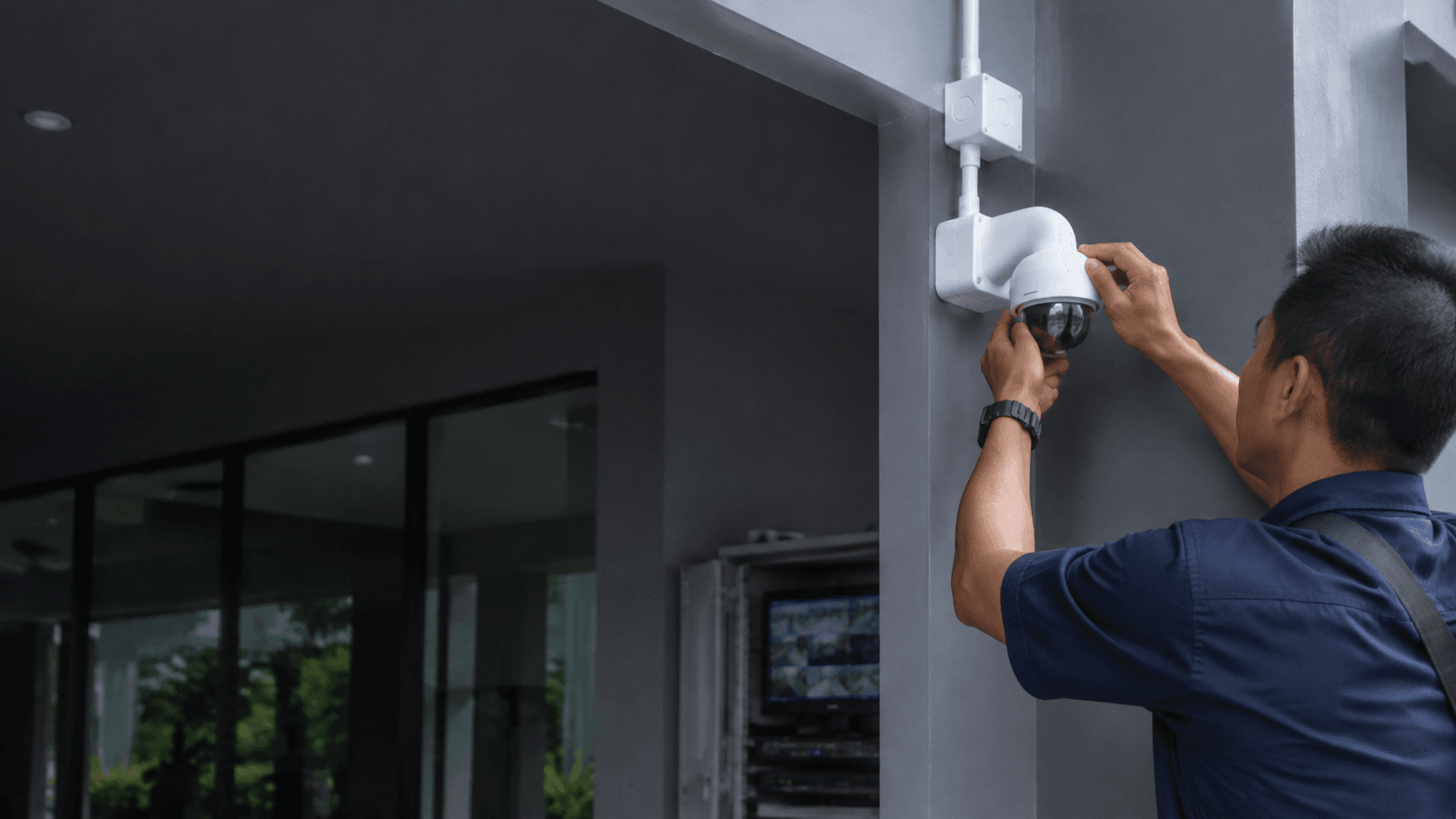
The exact-match query "outdoor security camera system for business" describes a category rather than a single product. A business system differs from a home kit in three practical ways: it usually runs more cameras, it records continuously rather than on motion only, and it is expected to keep working through weather, power events and staff turnover. Eyonic Sdn Bhd, a security system supplier based in Sarawak, Malaysia, handles planning, supply and installation for homes, offices, shops and industrial sites.
What Matters Before Choosing an Outdoor Security Camera System For Business
Most buying mistakes happen before any camera is selected. The useful sequence starts with the site, not the hardware.
- Survey the site and note entrances, counters, storage, parking and perimeter routes.
- Check actual lighting at each position, including after dark, before confirming camera placement.
- Decide how many channels are needed now and how many might be added later.
- Choose camera types per position rather than one model for the whole building.
- Plan the recorder, storage and remote viewing together with the cameras.
- Agree on cabling routes, mounting points and who handles handover and user training.
Eyonic's CCTV installation process follows this shape: site survey, system proposal, installation, and handover. That order matters because a proposal written before the survey tends to over-specify some areas and leave others uncovered.
Lighting checks come before placement decisions
Eyonic recommends checking actual lighting conditions before confirming placement for ColorVu-style cameras. A position that looks bright at midday can be the darkest corner of a compound at night, and a camera chosen for full-colour night imaging will underperform if the real light level was never measured.
Choosing the Right Outdoor Security Camera System For Business
Channel count is the first hard constraint. A small shop office may need four to eight cameras; a multi-area commercial site can need far more. The recorder must have enough channels and storage for the camera count and the retention period the business actually wants.
Camera type should follow the position. Bullet cameras suit long perimeter runs and gate approaches. Dome and turret cameras suit entrances and covered walkways where a lower profile helps. Fixed lenses cover predictable fields; motorised or varifocal lenses help where the useful detail sits far from the mounting point.
Wired and wireless options both exist in this category. Wired connections, including PoE, carry both power and data over one cable and avoid the interference and battery questions that wireless links introduce. Wireless suits retrofit situations where cabling is impractical, at the cost of more attention to signal paths and power.
Coverage areas that usually decide the design
Entrances and exits, customer and public areas, inventory and storage, payment counters, parking and loading areas are the zones that most often shape a commercial layout. A design that covers all of them with fewer, better-placed cameras usually costs less than one that adds cameras to compensate for poor positions.
What Is an Outdoor Security Camera System for Business?
It is a surveillance setup built for commercial premises, where cameras are mounted outside and exposed to weather, and where recording, storage and remote viewing are managed as one system rather than as separate devices. The defining requirement is dependable daily operation, not peak image quality on a single camera.
That requirement shows up in the details. Housing and mounting need to tolerate rain and heat. Recording needs to continue unattended. Staff need to be able to view footage without specialist knowledge. And the system needs to survive changes in who operates it.
A completed example is the Kuching Immigration Office project, where Eyonic provided practical support for a public office focused on arrival flow, staff areas, visitor movement and dependable daily operation. The approximate budget for that type of work was RM 12,000 to RM 28,000. A smaller office engagement, the KTA Sarawak Sdn Bhd project, supported staff movement, visitor handling, tidy cabling and clearer daily site control, with an approximate budget of RM 8,000 to RM 18,000.
Revo America – 4 To 128 Channel Commercial Camera Security Systems
Revo America's commercial category spans 4 to 128 channels, which shows how wide the range is within this single query. At the low end, a 4-channel recorder covers a small premises. At the high end, 128-channel commercial NVR systems with dozens of cameras serve large multi-building sites. The same page also lists 32-channel and 64-channel configurations with 4K cameras and 8TB storage.
Other suppliers in the category follow similar patterns. Lorex organises business systems by channel count and storage, from 8-channel wired NVR kits with 2TB drives up to 32-channel systems with 8TB. Swann lists wired NVR and DVR systems with 4K and 6K camera options. Camius markets a 16-channel 4K PoE NVR with 4TB and 8TB drive options. CCTV Security Pros structures its guidance around 4, 8, 16 and 32-camera PoE systems.
The pattern across all of them is the same: channel count, storage capacity and camera resolution are the three numbers that define a system, and they scale together. A business that picks a channel count first and storage second will usually end up with a workable design.
Where the trade offs sit
Higher resolution increases storage demand and network load. Longer retention increases storage demand again. More channels increase recorder cost and cabling work. These three constraints pull against each other, which is why the survey and the retention decision should come before the camera list.
Practical Considerations for
Budget is easier to reason about with real figures. Eyonic's published packages start at RM 1,599 for a Hikvision CCTV package covering camera supply and setup, basic recording configuration and mobile viewing handover. The same RM 1,599 figure applies to a Hikvision alarm system package and an autogate package. Larger commercial work sits well above that, as the RM 8,000 to RM 28,000 project ranges show.
Installation quality affects how long a system stays useful. Tidy cabling, protected cable routes and correctly aimed cameras reduce maintenance calls. Handover matters too. if staff cannot view footage or export a clip, the system is only partly installed.
Maintenance is the least glamorous consideration and one of the most consequential. Cameras need occasional cleaning, recorder drives have finite service life, and network settings need review when routers or internet services change.
Edge cases worth planning for
Some sites need more than cameras. Access control, alarm systems, intercoms and gate automation often sit alongside surveillance, and planning them together avoids duplicated cabling and separate handovers. Eyonic supplies and installs alarm systems, autogate systems and keyphone intercoms in Sarawak alongside CCTV, which allows a single coordinated installation rather than several contractors working around each other.
Another edge case is the site with no reliable internet. Local recording continues without it, but remote viewing does not. That distinction should be clear before the system is specified, because it changes what the business can expect from the installation.
Making an Informed Choice About
The decision narrows to four questions: how many areas need coverage, how long footage must be kept, what lighting and weather conditions each position faces, and who will operate the system day to day. Answers to those four questions determine channel count, storage, camera type and handover requirements.
Eric Yong, founder of Eyonic Security Systems, has worked in the industry for more than ten years and is experienced in technical installation of digital security solutions for commercial businesses in Sarawak. That experience is most useful during the survey, when placement and lighting decisions are still open.
For businesses in Sarawak, a supplier that handles survey, proposal, installation and handover in one sequence removes the coordination problem between cabling, cameras and recording. Share your location, property type and required system with Eyonic on WhatsApp at +60 11-5111 7959 for the next practical step.