
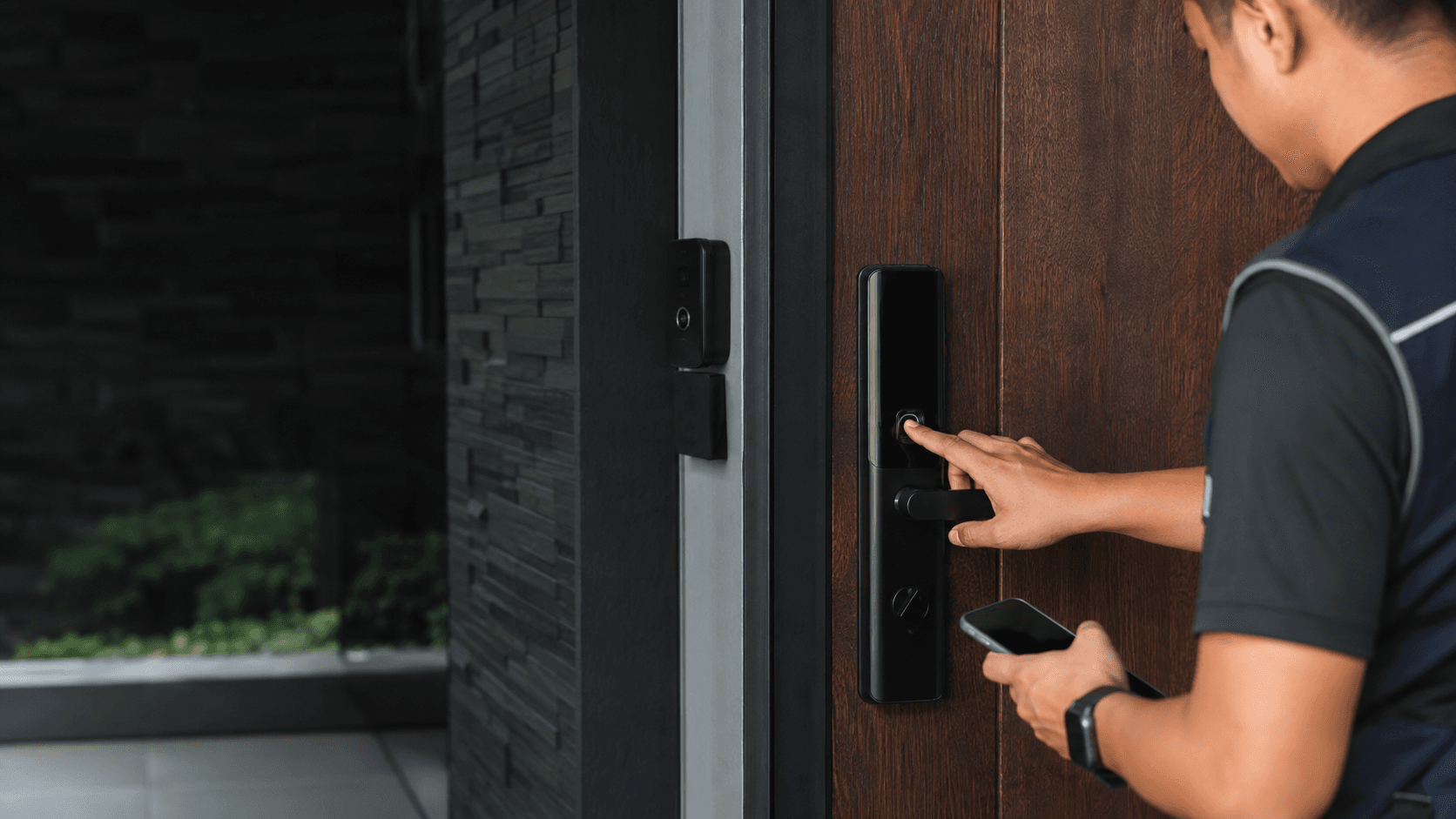
The category covers two different products sold under one search phrase. A full replacement removes the old deadbolt and installs a motorised unit with a keypad, app, or both. A retrofit adapter keeps the existing deadbolt and mounts a connected turning mechanism on the inside face of the door. Both are marketed as a wifi deadbolt door lock, and both depend on the same physical door conditions to work.
Eyonic Sdn Bhd, a security system supplier in Sarawak, reviews smart lock door access as suitable for controlled convenience when user permissions and backup entry are planned properly. That framing matters more than any feature list, because a lock that fails closed with no backup method creates a problem rather than solving one.
Best Wifi Deadbolt Door Lock. What The Category Actually Covers
The phrase describes a lock that can be operated remotely over a network and that uses a deadbolt as its locking mechanism. Within that, buyers in Malaysia encounter three practical shapes.
A full deadbolt replacement is a complete unit. The exterior side carries a keypad, keyway, or fingerprint reader, and the interior side carries the motor and battery compartment. Installation requires the door to already have a deadbolt bore and a compatible backset.
A retrofit adapter lock mounts over the interior thumbturn of an existing deadbolt. The exterior hardware does not change, so the door keeps its original key cylinder. This suits rented premises or doors where the existing lock hardware is part of the building's specification.
A lever or handle replacement changes the whole door furniture rather than only the deadbolt. This is a larger job and is usually chosen when the door is being replaced or refinished at the same time.
Each shape carries a different risk profile. Full replacements give the most control over entry methods but demand the most accurate door measurements before ordering. Retrofit adapters reduce installation risk but inherit whatever condition the existing deadbolt is in. Handle replacements change the door's appearance and require the most carpentry.
Wifi Deadbolt Door Lock. Full Replacement Or Retrofit Adapter
The choice between the two comes down to who owns the door and how much the existing hardware matters.
Full replacement suits a property owner who wants a single consistent lock across several doors, wants the exterior keypad visible to visitors, and is willing to have the door prepared if the existing bore does not match. It also suits a shop or office front door where staff need a code rather than a key.
Retrofit adapters suit tenants who cannot alter the door's exterior hardware, owners of doors with decorative or period-appropriate exterior fittings, and anyone who wants to keep the original key working as a fallback. The trade-off is that the adapter's reliability is partly the existing deadbolt's reliability. A stiff or worn deadbolt will make any motor work harder.
For business premises, the decision often goes beyond the lock itself. Eyonic's smart lock review notes that for business use, the company usually checks whether a standalone smart lock or an access-control panel is more appropriate. A single shop door with a handful of staff is a different problem from an office with shift changes, visitor traffic, and a need to review who entered and when.
That distinction is worth settling before comparing products. A lock chosen for a home entrance and a lock chosen for a staff entrance are answering different questions, even when the product listing looks similar.
Entry Methods And Remote Access On A Wifi Deadbolt Door Lock
Entry methods determine daily usability more than any other feature. Most locks in this category combine several, and the combination matters more than the count.
A keypad allows entry without a phone or a key. This is the method that keeps working when a phone battery is flat or a guest does not have the app installed. A physical key provides a mechanical fallback that does not depend on electronics at all. An app provides remote control and, on some models, a record of activity. A fingerprint reader removes the need to remember a code but adds a component that can be affected by wet or dirty hands.
Remote access is the feature that separates a wifi deadbolt door lock from a purely local keypad lock. It allows a door to be unlocked for a delivery, a contractor, or a family member without anyone travelling to the property. The practical limits are worth understanding before relying on it.
Remote unlocking depends on three things working at once: the lock has power, the lock is connected to the network, and the person issuing the command has a working connection. If any one of those fails, remote access is unavailable. This is why a keypad code or a physical key is not a redundant extra but the actual fallback plan.
For a shop or office, the more useful question is often not whether the door can be unlocked remotely but whether entry can be granted to a specific person for a specific period. That is a permissions question, and it is the reason Eyonic frames smart lock door access around user permissions and backup entry rather than around app features.
Power, Internet And Backup Entry When The Lock Goes Offline
Every electronic lock in this category depends on a power source, and every connected lock depends on a network. Planning for both failing is part of choosing the lock, not an afterthought.
Battery-powered locks are the common arrangement because they avoid running wiring to the door. The consequence is that battery condition becomes a maintenance item. A lock that reports low battery in advance gives time to replace cells; a lock that does not may simply stop responding. The specific battery life of any model is a specification that should be confirmed from the manufacturer's own documentation rather than assumed from a listing.
Network dependency is the second failure point. A lock that relies on a wifi connection for remote commands will still open by keypad or key when the network is down, provided those methods are configured. A lock that relies on the network for all entry will not. This is the single most important thing to confirm before purchase.
Before ordering, confirm these points about the lock's offline behaviour:
- Whether a keypad code continues to work when the network is unavailable.
- Whether a physical key override exists, and whether it is on the exterior or requires another route.
- Whether the lock reports low battery before it stops operating.
- Whether the lock fails locked or unlocked if power is lost mid-operation.
- Whether entry records are stored locally and synchronised later, or lost when offline.
The fail-state question deserves particular attention on a shop or office door. A lock that fails in the unlocked position leaves the premises open; a lock that fails locked can trap staff outside during operating hours. Neither is automatically correct, but the choice should be deliberate and matched to how the door is used.
Door Fit, Door Thickness And Installation In Malaysian Homes
Door fit is where most wifi deadbolt door lock purchases go wrong, because the failure is discovered after the product has arrived.
Deadbolt hardware is built around standardised dimensions, and a lock that does not match the door's existing preparation cannot simply be forced into place. The relevant measurements are the door thickness, the backset, and the diameter and position of the existing bore holes. A lock designed for one set of dimensions will not fit a door prepared to a different set without additional work.
Malaysian properties add their own variation. Condominium entrance doors, landed-home main doors, and shop lot shutters are built to different specifications, and a door that has been replaced or refinished may no longer match the original preparation. Metal doors, solid timber doors, and hollow-core doors also behave differently when hardware is fitted, particularly around the strike plate and the door frame.
Before ordering, work through these physical checks on the actual door:
- Measure the door thickness at the point where the deadbolt sits.
- Confirm the backset, which is the distance from the door edge to the centre of the bore hole.
- Check the deadbolt faceplate dimensions and whether the existing cut-out matches.
- Check strike plate alignment on the frame and whether the door currently latches without lifting or pushing.
- Confirm the door closes and latches without binding, since a motorised bolt will not overcome a misaligned frame.
- Confirm the wifi signal reaches the door position, or plan for a closer access point.
The binding check is the one most often skipped. A manual deadbolt can be turned with a little extra force when a door is slightly out of alignment. A motorised bolt cannot, and it will either fail to extend or report an error. Fixing the alignment before installation is cheaper than diagnosing it afterwards.
Installation itself follows a predictable sequence on a well-prepared door. Eyonic's installation process for its security systems runs through site survey, system proposal, installation, and handover, and the same logic applies to a lock: the survey establishes whether the door and the surrounding network will support the chosen product before anything is ordered.
For a single home door, that survey is a short set of measurements. For a shop or office with several doors, it also establishes whether each door needs the same product or whether a mix of a standalone lock and a managed access-control setup is more practical. Eyonic's completed work for the Kuching Immigration Office focused on arrival flow, staff areas, visitor movement, and dependable daily operation, which is the same set of concerns that shapes a multi-door access decision.
Best Wifi Deadbolt Door Lock Checks Before Ordering
The most useful preparation is a short list of confirmed facts about the door, the network, and the people who will use it.
Confirm the door's thickness, backset, and bore dimensions against the product's stated requirements. Confirm which entry methods will remain available when the network is down and when the battery is flat. Confirm who needs access, whether that access should be time-limited, and whether entry records are needed for any purpose. Confirm the wifi signal strength at the door position rather than at the nearest router.
Where the door is shared, or where the property is a business premises, confirm whether a standalone lock is sufficient or whether a managed access-control arrangement is the better fit. Eyonic's review of smart lock door access treats this as the first question for business use, because a lock that suits a home entrance may not suit a staff entrance with changing users.
For readers in Sarawak who want the door assessed before choosing a product, Eyonic can be reached on WhatsApp at +60 11-5111 7959 with the property location, property type, and the system required.