
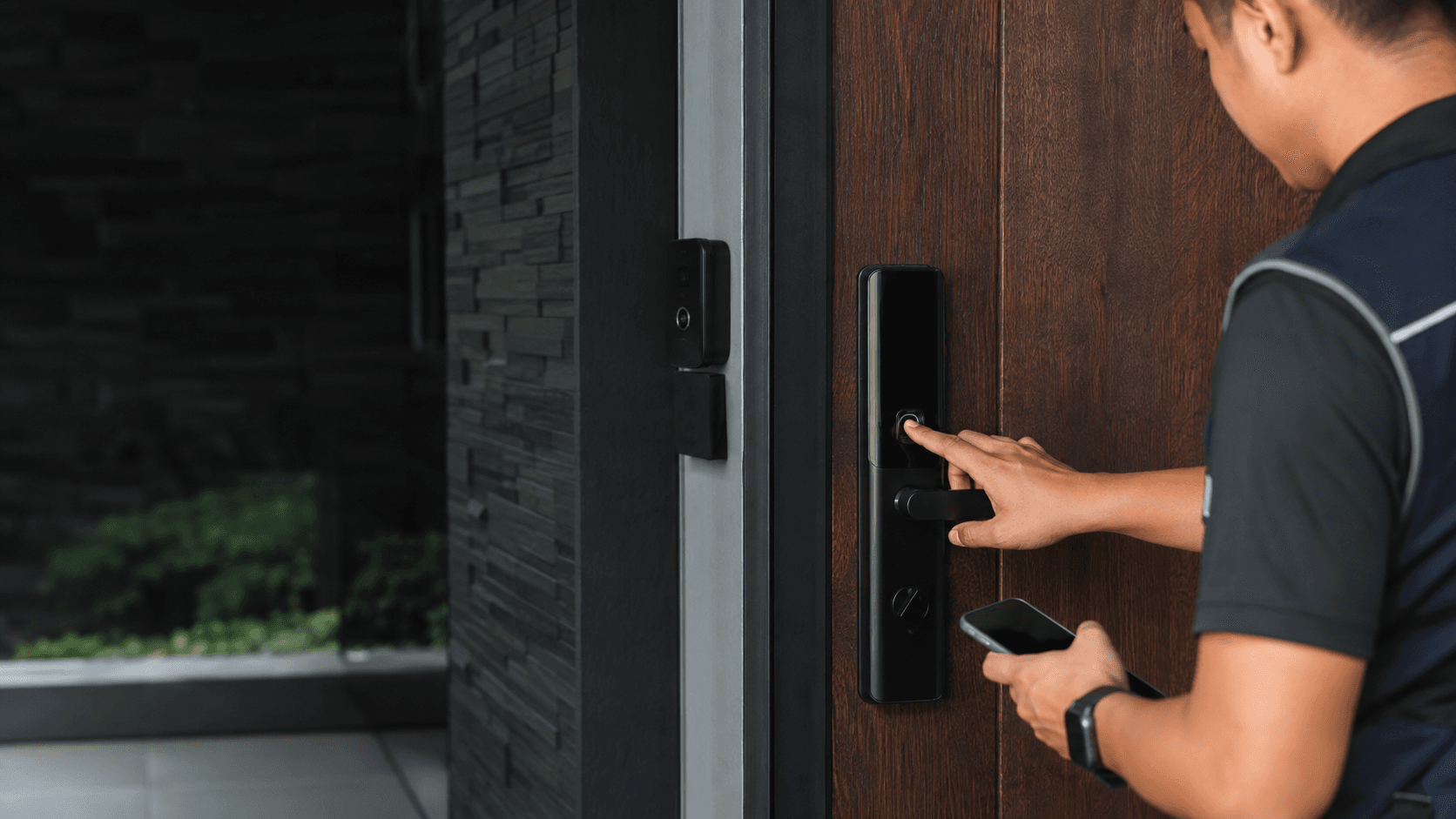
The exact-match query biometric door knob describes a small category of door hardware rather than a single product. Most units combine a fingerprint reader with a keypad, an app, a card reader, or a mechanical key, and the differences between those combinations decide whether the hardware suits a bedroom, an office, or a main entrance.
Eyonic Sdn Bhd is a security system supplier in Sarawak that plans, supplies, and installs CCTV and ELV systems, and its product reviews cover smart lock door access alongside cameras and alarms. That matters because a biometric door knob is rarely bought in isolation. It usually sits inside a wider access plan that includes who may enter, when, and what happens when the reader fails.
Biometric Door Knob. What Matters Before Choosing
The useful starting point is the door itself, not the reader. A knob-style biometric lock replaces an existing knob or handle, so the bore hole, backset, door thickness, and latch type determine whether a unit fits without cutting new timber or metal. A door that already carries a deadbolt may only need the knob replaced; a door with no deadbolt may need the biometric unit to carry the full locking duty, which changes the security expectation.
Eyonic's own review of smart lock door access notes that smart locks work best when the door condition, user roles, and backup method are reviewed before installation. For business use, the same review describes checking whether a standalone smart lock or an access-control panel is the more appropriate choice. That distinction applies directly to a biometric door knob, because a knob is a standalone device by design.
Three numbers shape most decisions. Fingerprint capacity on common knob-style units runs from roughly 50 to 100 stored prints. Battery life on rechargeable or alkaline-powered knobs is typically quoted in months rather than years. Installation time on a standard prepared door is often described in minutes, while a door that needs modification takes longer.
What Is a Biometric Door Knob?
A biometric door knob is a door knob or handle with an integrated fingerprint sensor that unlocks when a stored print is recognised. The reader sits on the outer face, the electronics and battery sit inside the body, and the latch retracts electronically or through a small motor. Most models keep a mechanical key override or a USB emergency port so the door still opens when the battery is flat.
Recognition is the core mechanism. Optical sensors photograph the ridge pattern, while semiconductor or capacitive sensors measure the ridge and valley structure directly against the sensor surface. Capacitive readers generally handle oily or slightly damp fingers better than optical ones, and they are harder to spoof with a printed image. Response time on current units is commonly quoted in fractions of a second, and 360-degree reading means the finger does not need a specific orientation.
Access methods vary by model. A basic biometric door knob offers fingerprint plus key. A mid-range unit adds a keypad code. A fuller unit adds app control, temporary guest codes, and sometimes an IC card. App control usually requires a gateway or a Bluetooth connection, and remote unlocking from outside the property normally depends on that gateway being installed and powered.
Choosing the Right Biometric Door Knob
Match the hardware to the door's role rather than to the feature list. A bedroom door needs privacy and quiet operation more than remote access. A front door needs weather resistance, a reliable override, and enough fingerprint capacity for everyone who lives there. An office door needs user management, because staff change and a single shared code stops being useful the moment someone leaves.
Work through the decision in a fixed order so nothing important is skipped.
- Confirm the door type, thickness, backset, and whether a deadbolt is already present.
- Decide which entry methods are genuinely needed: fingerprint, code, card, app, or key.
- Count the people who need regular access and check the unit's fingerprint and code capacity.
- Check the power source, expected battery life, and how the door opens when power fails.
- Confirm whether remote app access needs a separate gateway, and whether that gateway is available.
- Decide who administers users, and how a lost print or departed staff member is removed.
- Confirm the door still meets fire, egress, or building requirements where those apply.
Step five catches more buyers than any other. A knob advertised with app control may only offer Bluetooth proximity control out of the box, with remote unlocking added through a gateway sold separately. That is a real constraint for a landlord or a business owner who expects to open a door from another location.
Practical Considerations for Biometric Door Knob Installation
Installation on a standard prepared door is a homeowner-level task: remove the old knob, fit the latch, seat the two halves, and pair the prints. Doors that are hollow, unusually thin, metal-framed, or fitted with a non-standard latch are a different job, and forcing a knob into a misaligned bore hole is the most common cause of a stiff or unreliable lock.
Placement of the reader matters as much as the wiring. A sensor on a door exposed to direct rain, salt air, or heavy dust degrades faster than one under a porch or inside a corridor. Fingers also behave differently across users. Manual workers, older users, and anyone with worn or very dry prints may get inconsistent reads, which is why a keypad code or a key remains a practical backup rather than a redundant extra.
Eyonic's project work shows how access decisions scale beyond a single door. The Kuching Immigration Office project focused on arrival flow, staff areas, visitor movement, and dependable daily operation. A public building with that pattern cannot rely on one fingerprint reader at one entrance; it needs a plan for visitors who have no stored print, staff who arrive in volume, and a clear fallback when a reader fails during operating hours.
For smaller premises, the same logic applies at lower volume. A shop with two staff and a storeroom door has a simple access problem. An office with rotating tenants, cleaners, and deliveries has a harder one, and a standalone biometric door knob may be the wrong tool if the requirement is a full audit trail across several doors.
Making an Informed Choice About Biometric Door Knob Hardware
The strongest reason to choose a biometric door knob is convenience with a real security gain over a plain knob. Removing the need to carry a key for an interior door, a bedroom, or a small office is a genuine improvement, and fingerprint access avoids the shared-code problem that plagues keypad-only locks.
The limits are equally clear. A knob-style unit is a standalone device, so it does not coordinate with other doors, produce a central access log, or integrate with a building system unless the model supports an app with that function. Battery dependence means a flat cell can lock out every user at once, which is why the mechanical override and the emergency power port deserve a test before the door is relied upon.
Cost sits between a conventional knob and a full access-control installation. A single biometric door knob is a modest purchase; a multi-door access-control system with a panel, credentials, and central management is a project. The dividing line is usually the number of doors and whether anyone needs to review who entered and when.
For properties in Sarawak, the practical sequence is a site check of the door, a decision on entry methods and user count, then installation and a handover that includes testing the override and enrolling every user. Eyonic's installation process follows that shape: site survey, system proposal, installation, and handover. The same discipline applies whether the job is one knob or a full ELV scope.
Where a property already runs CCTV, an alarm, an autogate, or an intercom, treating the biometric door knob as part of that wider setup avoids duplicated apps and separate user lists. Eyonic's published packages for CCTV, alarm, and autogate are each listed at RM 1,599, which gives a sense of the entry-level budget for connected security work in the region. Larger projects sit well above that: the Kuching Immigration Office work carried an approximate budget of RM 12,000 to RM 28,000, and the KTA Sarawak Sdn Bhd office project an approximate budget of RM 8,000 to RM 18,000.
Share your location, property type and required system with Eyonic on WhatsApp at +60 11-5111 7959 for the next practical step.