
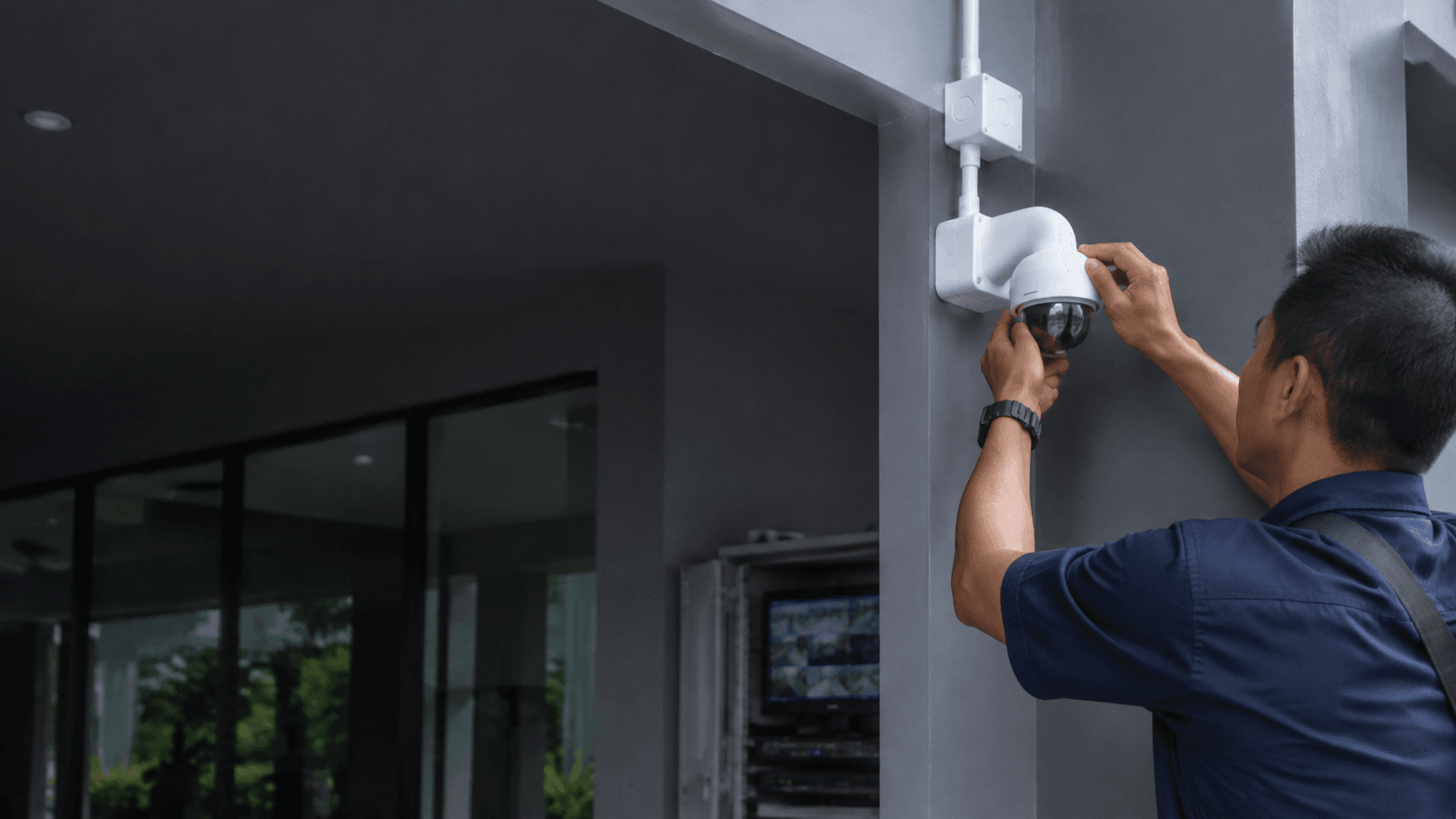
The exact-match query ir bullet camera dahua describes a specific combination: a Dahua-manufactured bullet-shaped camera with infrared illumination. Buyers in Malaysia usually arrive at this search while weighing a supply-and-install decision, not just a box purchase. The practical questions are whether the camera suits the site after dark, how placement affects results, and who handles survey, cabling, recording and handover.
Ir Bullet Camera Dahua. What to Check Before You Buy
An IR bullet camera Dahua purchase should start with the site, not the model number. Dahua publishes many bullet camera families across HDCVI and IP ranges, and the differences that matter on a Malaysian site are usually housing, lens choice, illumination type and how the camera connects to a recorder.
Eyonic's own installation process follows a fixed sequence, and the same sequence applies to a Dahua bullet camera job.
- Site survey — walk the property, note lighting, entry points, cable routes and mounting surfaces.
- System proposal — match camera type, lens and recorder to what the survey found.
- Installation — mount cameras, run cabling, configure recording and remote viewing.
- Handover — test the system with the user and confirm how to view footage.
That order matters because a bullet camera chosen before the survey often ends up pointed at the wrong area, or mounted where a wall or roof edge blocks part of the frame. The survey is also where power and network availability get confirmed, since a bullet camera needs a cable run regardless of whether it uses coax or network cabling.
What an IR bullet camera Dahua unit is built to do
Infrared illumination lets a camera keep recording after ambient light drops below the level a normal colour image needs. The camera switches to infrared mode, the image turns monochrome, and the built-in IR LEDs light the scene for a limited distance. That distance is a published figure for each model, and it varies widely across the Dahua range.
Bullet housings suit outdoor and long-corridor coverage because the body shields the lens from rain and the shape allows a longer lens and larger IR array than a compact dome. The trade-off is that a bullet camera is visibly directional. Anyone standing near it can see where it points, which is useful as a deterrent in some settings and undesirable in others.
Dahua bullet cameras appear across both HDCVI and IP product lines. HDCVI models transmit over coaxial cable and suit sites that already have coax or a DVR. IP models use network cabling and a recorder or NVR, and suit sites where higher resolution, analytics or integration with other network systems is planned. The choice affects cabling, recorder and cost, so it belongs in the proposal stage rather than after purchase.
Where IR bullet cameras suit Malaysian sites
Bullet cameras with infrared work well where the target area is a defined outdoor zone: a gate, a driveway, a perimeter fence line, a back lane, a loading area or a long corridor. They also suit shopfronts and industrial compounds where the camera can be mounted high enough to be out of easy reach.
They suit sites less well when the area to cover is wide and close to the camera, when the mounting point is low, or when the owner wants a discreet installation. In those cases a dome or turret camera is usually the better fit, and a supplier should say so rather than sell a bullet camera regardless.
Sarawak sites add their own considerations. Heavy rain, high humidity and long monsoon periods put pressure on housing seals and cable entries. Direct afternoon sun on a camera body can also affect image quality and long-term reliability, which is one reason placement is checked on site rather than decided from a floor plan.
How to Compare IR Bullet Camera Dahua Options
Comparison should be driven by what the site needs to see, not by the highest number on a specification sheet. Four factors do most of the work.
Resolution determines how much detail survives when footage is reviewed. Higher resolution helps identify faces and plates, but it also increases storage and bandwidth requirements, so the recorder has to match.
Lens determines how wide or narrow the view is. A wide lens covers more area with less detail per metre; a narrower lens covers less area with more detail. The right choice depends on the distance from the camera to the point that matters most.
Illumination type determines what the camera does at night. Infrared produces a monochrome image in darkness. Some Dahua models combine infrared with a warm-light or dual-light mode that can produce colour at night, but that behaviour depends on the specific model and the available ambient light.
Connection type determines the rest of the system. HDCVI and IP are not interchangeable at the recorder, so this decision locks in cabling and recording hardware.
Eyonic's published package pricing covers a Hikvision CCTV package at RM 1,599, a Hikvision alarm system at RM 1,599 and an autogate package at RM 1,599. Those figures cover different product lines and are not a Dahua bullet camera price. Any Dahua supply-and-install figure depends on camera count, model, cabling distance and recorder, so it belongs in a written proposal after the survey.
Ir bullet camera Dahua placement and lighting checks
Placement decides whether an infrared camera is useful or decorative. Eyonic's own guidance on low-light cameras is to check actual lighting conditions before confirming placement, and the same principle applies to infrared models.
- Check what light exists at night — street lighting, security lights, shop signage and neighbouring lighting all change how the camera behaves.
- Check the distance from the camera to the point that must be identifiable, and confirm the lens covers it.
- Check for reflective surfaces, glass and shiny walls that can bounce infrared light back into the lens.
- Check for obstructions such as tree branches, roof edges, signboards and parked vehicles that will block the view at some times of day.
- Check the mounting height and surface, and confirm the camera cannot be reached or turned by hand.
- Check the cable route and confirm power and network or coax reach the position without excessive distance.
Infrared reflection is a common and avoidable problem. A camera mounted too close to a wall, soffit or glass panel can produce a washed-out image at night even though the daytime picture looks fine. Moving the camera a short distance usually resolves it, which is why the check happens before drilling.
Coverage overlap is worth planning deliberately. Two cameras with overlapping fields of view reduce the chance that a single blind spot hides movement, and they give a second angle if one view is obstructed. On larger compounds, the perimeter is usually covered in segments rather than by one camera trying to cover everything.
Installation and Handover for IR Bullet Camera Dahua Systems
Installation quality determines whether the system still works well a year later. Cabling should be routed and secured rather than left exposed, connections should be protected from water ingress, and the recorder should be positioned where it has ventilation and is not easily tampered with.
Configuration matters as much as mounting. Recording schedules, motion or event settings, storage retention and remote viewing access all need to be set up deliberately. A system that records continuously with no retention planning will overwrite footage sooner than the owner expects, and a system with poorly tuned motion detection will generate alerts that get ignored.
Handover is the step that turns an installed system into a usable one. It should include a live test of each camera, a check of night behaviour, confirmation that remote viewing works on the owner's device, and a clear explanation of how to find and export footage. Eyonic's process includes handover as a defined stage, and it is the point where the owner can raise anything that does not match the proposal.
Eyonic has completed work for the Kuching Immigration Office, covering arrival flow, staff areas, visitor movement and dependable daily operation, and for KTA Sarawak Sdn Bhd, covering staff movement, visitor handling, tidy cabling and clearer daily site control. Both projects involved public-facing and staff areas where camera placement and cable tidiness were part of the brief. Approximate budgets for that type of work were RM 12,000 to RM 28,000 and RM 8,000 to RM 18,000 respectively, which gives a sense of scale for office and institutional installations rather than single-camera jobs.
Questions that come up before committing
Does an infrared camera record in colour at night? Standard infrared recording is monochrome. Colour at night depends on the specific model and on whether enough ambient light is present, and it should be confirmed against the model being proposed rather than assumed.
How far can the infrared reach? Each Dahua model publishes its own IR distance rating. That figure is measured under specific conditions, so real-world reach is usually shorter when the scene is wide or the surfaces are dark. The rating should be treated as a guide, not a guarantee.
Can a Dahua bullet camera work with an existing recorder? It depends on whether the existing recorder supports the same technology. HDCVI and IP cameras need matching recorders, and mixing brands or generations can limit features or prevent the camera working at all. This is checked during the survey.
Is a bullet camera better than a dome? Neither is universally better. Bullet cameras suit long outdoor views and visible deterrence; domes suit wide indoor coverage and discreet mounting. The site decides.
What affects the final cost? Camera count and model, cabling distance and difficulty, recorder and storage, mounting hardware, and whether the site needs additional work such as conduit or trunking. A proposal built from a survey reflects those factors; a price given over the phone does not.
For sites in Sarawak, the practical next step is a survey that records lighting, entry points, cable routes and the areas that need identification rather than just coverage. Share the location, property type and required system with Eyonic on WhatsApp at +60 11-5111 7959, and the proposal can be built around what the site actually needs.