
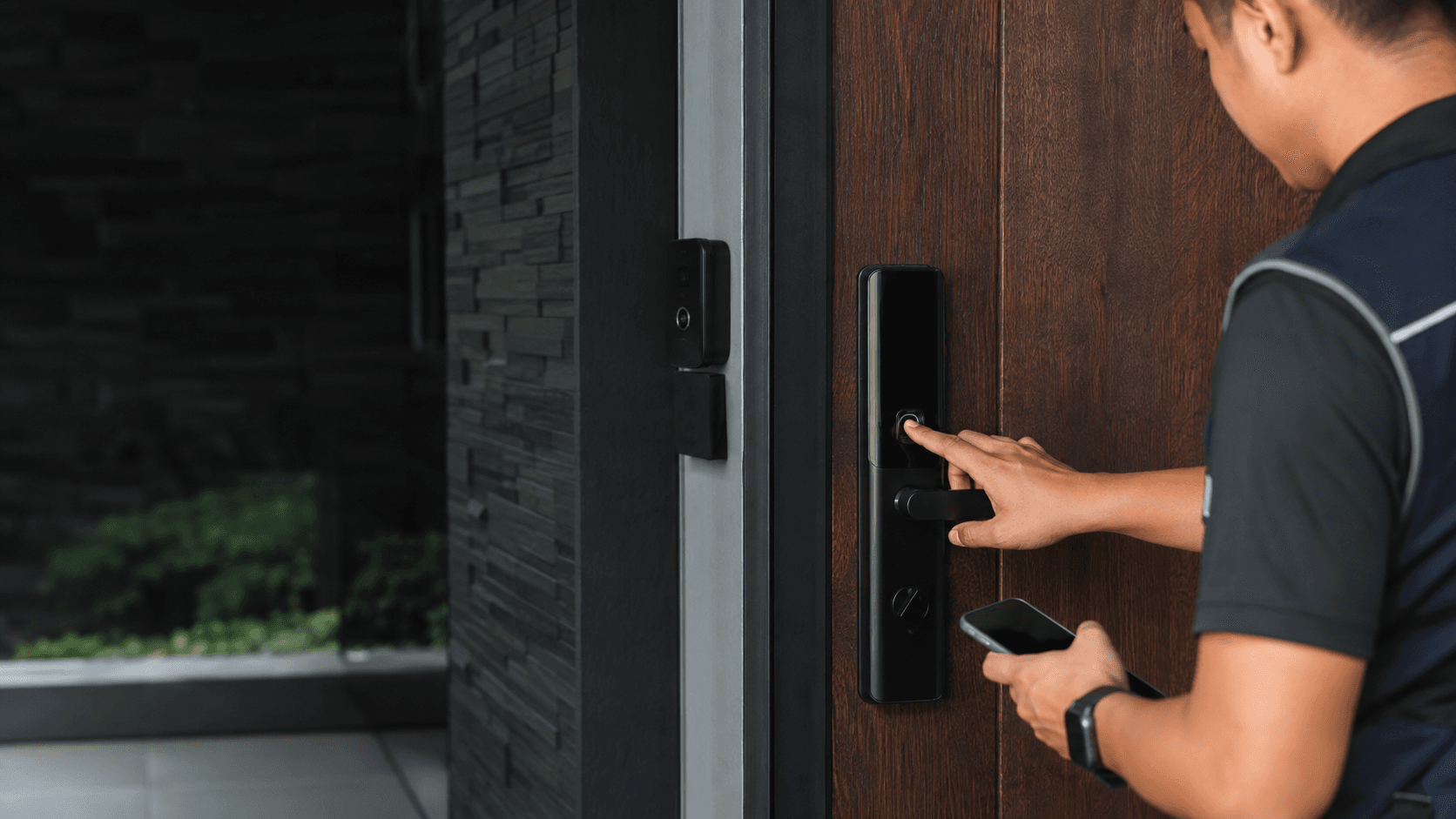
Most buyers in Malaysia arrive at this question after a keypad or remote has already failed them once. A remote gets lost, a shared code spreads further than intended, and the gate still has to open for deliveries, family members, and staff. Biometric entry solves part of that problem and creates a different set of questions about power, weather, and what happens when the reader does not recognise anyone.
The sections below cover how biometric gate lock access behaves at an actual gate, which recognition methods suit which situations, what to compare before committing, and how a supply-and-installation job normally runs from first visit to handover.
Biometric Gate Lock. What to Check Before You Install
Three checks decide most projects: whether the gate itself can carry the hardware, who needs to get through and how often, and what happens when the reader fails or the power drops. Skip any one of them and the system will work on day one and frustrate everyone by month three.
Gate condition comes first. A swing gate, a sliding gate, and a folding gate present different mounting surfaces, different travel paths, and different risks of the reader being knocked or misaligned over time. A reader mounted where the gate body flexes will drift out of alignment, and a reader mounted where rain drives in sideways will face conditions a covered door never sees.
User roles come second. A household with four people has a simple enrolment list. A shop with rotating staff, regular suppliers, and occasional contractors needs a way to add and remove users without a technician visit each time. That difference alone often decides whether a standalone reader is enough or whether the gate should sit on a wider access-control arrangement.
Backup entry comes third, and it is the check most often skipped. Every biometric system will eventually fail to read a legitimate user: wet hands, a cut finger, a changed appearance, a dead battery, or a sensor fault. The gate still needs to open. A mechanical key override, a separate keypad code, or a remote held in reserve all work, but the choice has to be made before installation, not after.
How Biometric Gate Lock Access Works at a Gate
Enrolment captures a template from a finger, face, or palm and stores it in the reader or a connected controller. At the gate, the reader captures a fresh sample, compares it against stored templates, and sends a release signal to the gate motor or an access-control panel when it finds a match. The gate then opens under its own normal operating logic.
That last point matters more than it first appears. The biometric device is a credential reader, not a gate motor. It tells the gate to open; the gate decides how. If the existing motor has no input for an external release signal, the project grows before it starts.
Recognition quality depends on the sample and the environment. Fingerprint recognition struggles with wet, dirty, or worn fingers, which is a real consideration at an outdoor gate in a wet climate. Face recognition depends on lighting at the reader position and on the user facing the device. Palm and vein methods avoid some finger-surface problems but need the hand placed in a specific position.
Power is the other mechanism to understand. Readers draw from mains power, a battery, or both. A mains-powered reader with no battery backup stops working during an outage, and a battery-only reader eventually needs charging or replacement. Neither is automatically wrong, but the failure behaviour should be known before the gate is the only way in or out.
Fingerprint, Face, and Other Biometric Gate Lock Options
Fingerprint recognition is the most common choice for gates because the hardware is compact and the enrolment process is familiar. It suits households and small sites where users are consistent and hands are usually clean and dry at the point of entry.
Face recognition suits sites where users arrive with hands full, on motorcycles, or carrying equipment. It depends on consistent lighting at the reader and on users standing in roughly the same position each time. A reader placed where afternoon sun hits the lens directly will behave differently from one in shade.
Palm and vein methods trade speed for tolerance of surface conditions, since they do not rely on the outer skin. They typically need more deliberate hand placement, which slows throughput at a busy gate.
Multi-method readers combine two or more of these with a keypad or card option. That redundancy is useful at a gate where different users have different needs, and it also provides a natural fallback when one method fails for a particular person.
What to Compare Before Choosing Biometric Gate Lock Access
Comparisons should stay on the factors that change daily experience rather than on marketing categories. Four matter most.
User capacity and management. How many people need enrolment, and how easily can that list be changed? A reader that requires a technician to remove a departed staff member creates an ongoing cost that never appears in the purchase price.
Failure behaviour. What happens when the reader does not recognise a legitimate user, and what happens when power is lost? The answer should be a specific method, not an assumption that it will not happen.
Environmental fit. An outdoor gate exposes hardware to rain, heat, dust, and insects. Any reader considered for a gate should be assessed against the actual mounting position, not against a showroom or an indoor door.
Integration with what already exists. If the property already has an autogate motor, an intercom, or a camera system, the new reader may need to work alongside them. Checking compatibility before purchase avoids a second visit and a second invoice.
One comparison worth resisting is price alone. Without verified specifications for a specific model, a cheaper reader is not evidence of a better value; it is simply a reader with unknown behaviour at the gate.
Planning, Installation, and Handover Steps
Eyonic's documented installation process runs through four stages, and the same sequence applies to gate access work.
- Site survey — assess the gate type, mounting position, power availability, and existing motor or intercom setup.
- System proposal — set out the recommended reader, how users will be enrolled, and the backup entry method.
- Installation — mount and wire the reader, connect it to the gate or access-control panel, and enrol users.
- Handover — test recognition for each enrolled user, confirm the backup method works, and explain day-to-day management.
The survey stage carries the most weight. Gate geometry, cable routes, and power sources are all easier to resolve before hardware is ordered. A survey also reveals whether the gate motor accepts an external release signal, which determines whether the project is a reader swap or a wider change.
Handover is where most of the long-term value sits. Testing each enrolled user at the actual gate, in the actual lighting, catches problems that a bench test never will. Confirming the backup method at handover means the first failure is a minor inconvenience rather than a locked-out evening.
Eyonic's work for the Kuching Immigration Office focused on arrival flow, staff areas, visitor movement, and dependable daily operation, which reflects the same principle: access hardware is judged by how it behaves on an ordinary working day, not by how it performs in a demonstration.
Where Evidence Is Still Missing
Several questions that buyers reasonably ask cannot be answered with verified information at present, and it is more useful to say so than to fill the gap with assumptions.
There are no verified technical specifications for any biometric gate lock model here, including sensor type, user capacity, power requirements, or environmental rating. There is no verified pricing for supply or installation in Malaysia, and no verified brand, model, or certification facts for gate-specific biometric products.
Performance data is also absent. No verified accuracy, false-rejection, or failure-rate figures are available for biometric recognition at a gate, and no verified warranty, service, or support terms apply specifically to this type of work. There is likewise no verified Malaysian regulatory or standards requirement covering gate access control.
What can be stated with confidence is narrower but still useful. Smart lock door access works best when user permissions and backup entry are planned properly, and for business use the choice between a standalone smart lock and an access-control panel should be reviewed before installation rather than assumed. The same logic applies at a gate.
For a property in Sarawak, the practical next step is to share the location, property type, and required system with Eyonic on WhatsApp at +60 11-5111 7959 so the gate, users, and backup method can be assessed together.