
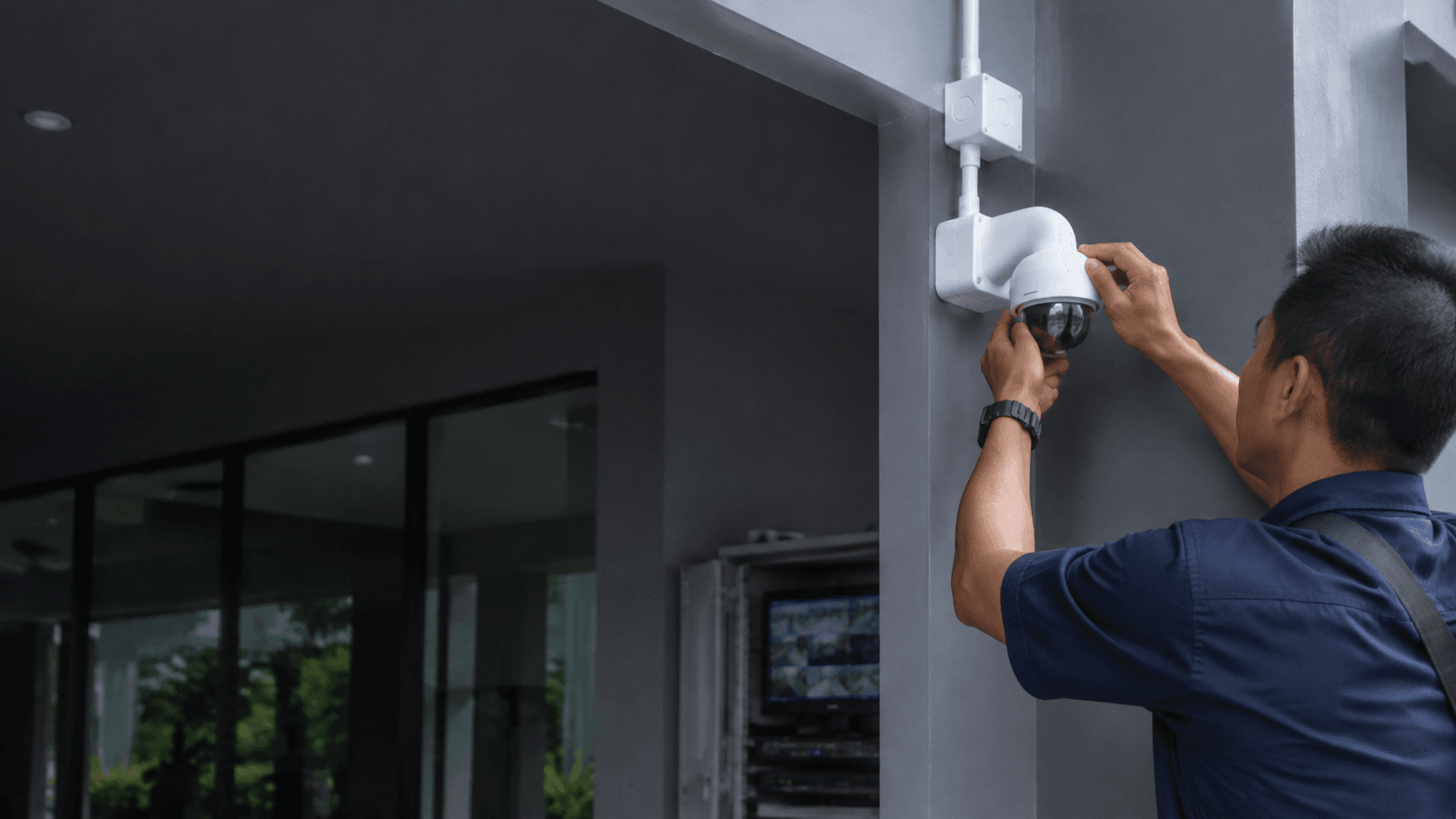
The phrase cctv cameras argos describes a retail route: a boxed camera bought off a shelf, taken home, and set up by whoever bought it. That route suits some buyers. It suits far fewer than most people expect, because a camera is one component of a working system and rarely the component that decides whether the system works.
Eyonic Sdn Bhd is a security system supplier in Sarawak, Malaysia, working on CCTV and ELV systems for homes, offices, shops and industrial sites. The company plans, supplies and installs monitoring systems with camera placement, recording and remote viewing. That is a different product from a retail box, and the difference is worth understanding before money changes hands.
Cctv Cameras Argos. what the retail route actually covers
A retail listing typically covers the camera itself, a mounting bracket, a power adapter, and a quick-start guide. It does not cover the cable run, the recorder, the storage drive, the network configuration, or the person who climbs the ladder.
That is not a criticism of retail. It is a description of scope. A shop sells a product; an installer delivers an outcome. Buyers who understand the split make better decisions, because they can see which parts of the job they are willing to own.
No supplied evidence verifies Argos product specifications, prices, stock, warranty or delivery terms in Malaysia, and no supplied evidence verifies which CCTV brands or models Argos currently sells. Those details change often and belong on the retailer's own pages. What can be discussed honestly is the shape of the decision, which is the same regardless of which box is on the shelf.
What a box usually includes, and what it leaves out
A single-camera kit generally leaves out three things that decide real-world performance: a recording destination with enough retention, a network path that survives a router reboot, and a mounting position chosen after looking at the actual light and the actual sightlines.
Each of those is a decision, not an accessory. A camera pointed at a wall records a wall. A camera on a recorder with a small drive overwrites footage before anyone reviews it. A camera on Wi-Fi that drops when the router restarts is offline exactly when it matters.
Cctv cameras and the gap between a box and a working system
The gap is not technical sophistication. It is sequence. A working system is designed backwards from what needs to be seen, then built forwards from power, cable and mounting points.
Retail kits are designed forwards from the camera. That works when the camera happens to land in the right place. It fails when the entrance, the counter, the gate and the back lane all need coverage and one camera is available.
Eyonic's CCTV installation process runs through four stages, and the order matters more than the individual steps.
- Site survey — walk the property, note entry points, sightlines, existing cabling and lighting conditions.
- System proposal — match camera count, recorder capacity and storage to what the survey found.
- Installation — mount cameras, run cable, configure the recorder and set up remote viewing.
- Handover — test the system with the people who will use it daily and confirm they can retrieve footage.
Retail buyers can borrow this sequence even without hiring anyone. Survey first, decide second, buy third. The failure mode is buying first and surveying never.
Where a retail kit genuinely fits
A retail kit fits a single-room rental, a small shop with one obvious choke point, or a homeowner who wants a visible camera at the front gate and accepts that it is a deterrent more than an evidence system.
It fits less well where footage has to hold up: a business handling disputes, a premises with multiple entrances, or any site where someone will need to find a specific ten-second clip three weeks later. Retention, resolution and camera position decide that, and all three are set before the camera is switched on.
Site survey, camera placement, NVR setup and remote viewing
These four items are the working parts of an installed system, and each one has a failure mode that a retail box cannot fix after the fact.
A site survey records where people actually move, which is often not where the owner assumes. Camera placement follows the survey, not the nearest power socket. NVR setup covers recording schedules, storage sizing and retention. Remote viewing covers the phone or desktop access that lets someone check the premises without being there.
Eyonic lists site survey, camera placement, NVR setup and remote viewing as distinct services, which reflects how the work is actually divided. Skipping the survey and starting at placement produces cameras in convenient positions rather than useful ones.
Lighting checks before confirming ColorVu-style camera placement
Low-light performance depends on the light that is actually present at night, not the light present during a daytime visit. Eyonic recommends checking actual lighting conditions before confirming placement for ColorVu-style cameras, because a position that looks adequate in the afternoon can be near-dark at 2am.
No supplied evidence verifies Hikvision ColorVu performance figures, resolution or low-light measurements, so no numbers are offered here. The practical point stands without them: confirm the night-time light at the mounting position before drilling, because moving a camera afterwards means new cable, new holes and a second visit.
Kuching Immigration Office. arrival flow staff areas visitor movement
Eyonic completed a project for the Kuching Immigration Office, focused on arrival flow, staff areas, visitor movement and dependable daily operation. The approximate budget for that type of work is RM 12,000 to RM 28,000.
The scope is instructive. A public office does not need cameras for their own sake; it needs coverage of how people arrive, where staff work, and how visitors move through the space. Those are survey outputs, not product features. A comparable commercial project, KTA Sarawak Sdn Bhd, covered staff movement, visitor handling, tidy cabling and clearer daily site control, with an approximate budget of RM 8,000 to RM 18,000.
Both examples show the same pattern: the camera list is short, and the planning is long.
Package pricing and the next practical step
Eyonic publishes a Hikvision CCTV Package at RM 1,599, covering camera supply and setup, basic recording configuration, and mobile viewing handover. A Hikvision Alarm System and an Autogate Package are also listed at RM 1,599 each.
That figure is a useful reference point when comparing a retail purchase against an installed system. A boxed camera plus cable, recorder, storage and mounting hardware adds up, and the total rarely includes the labour or the configuration. The comparison is only fair when both sides are priced as complete jobs.
No supplied evidence verifies Eyonic coverage outside Sarawak, or whether Eyonic installs customer-supplied or retail-purchased cameras and under what terms. Buyers outside Sarawak, or buyers holding hardware already, should confirm that directly rather than assume.
Eric Yong founded Eyonic Security Systems and has worked in the industry for more than ten years, with experience in technical installation of digital security solutions for commercial businesses in Sarawak.
Share the location, property type and required system with Eyonic on WhatsApp at +60 11-5111 7959 for the next practical step.