
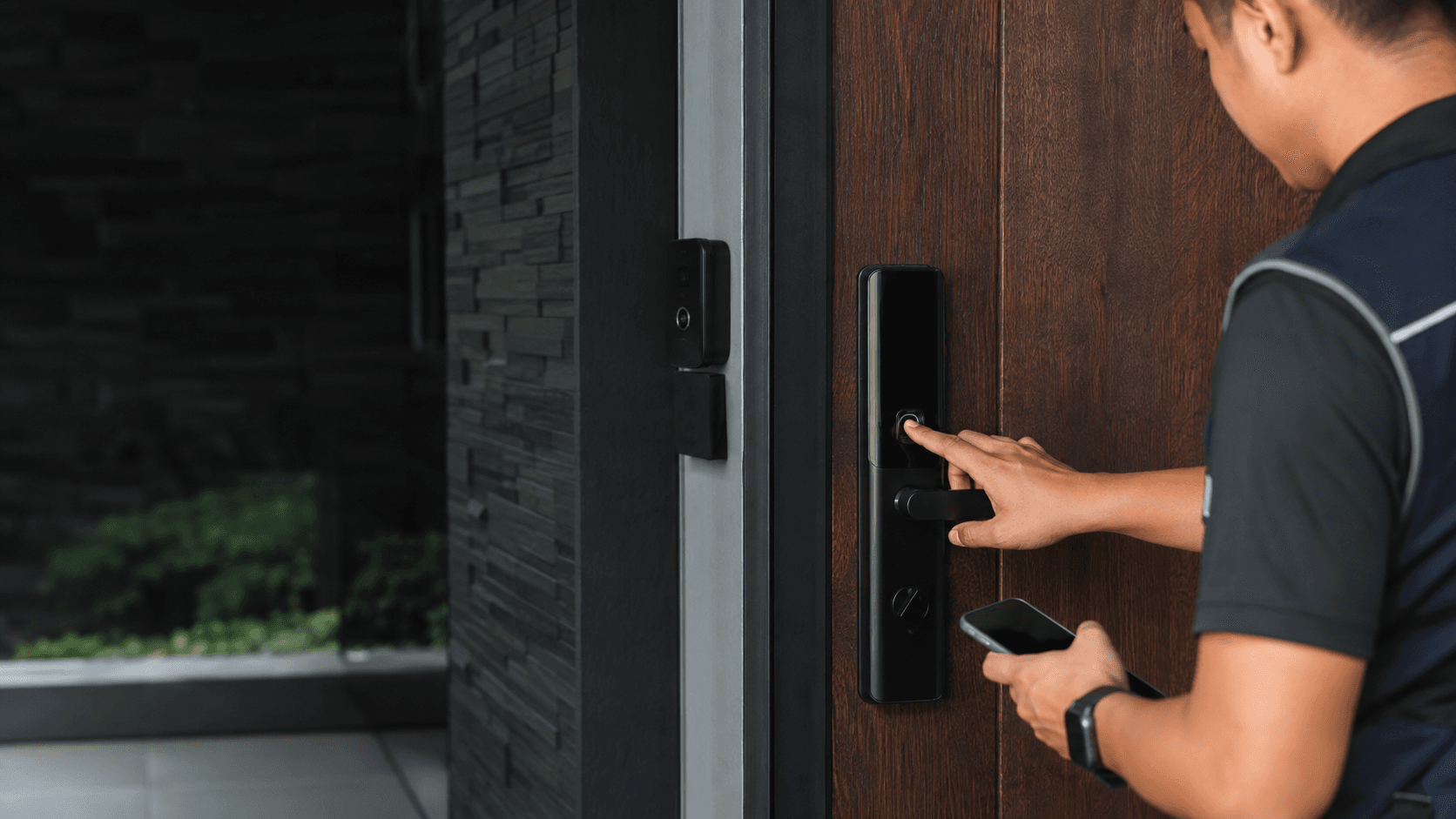
That single sentence carries the whole decision. Everything after it is about whether the door, the people using it, and the fallback plan line up before anyone drills a mounting plate.
What the Yale Keyless Connected Ready Smart Door Lock Is Built For
The Yale Keyless Connected Ready Smart Door Lock belongs to the keyless entry category: a lock opened by code or credential rather than a cut key. Eyonic's own product review position is narrow and specific — smart locks work best when the door condition, user roles and backup method are reviewed before installation. That is a fit statement, not a specification sheet, and it is the honest way to describe this lock without inventing hardware details.
Two things follow from that framing. First, the lock is a convenience and control product, not a substitute for a full access-control system. Second, its value depends on how many people need entry and how often that list changes. A household with three regular users and a cleaner is a different problem from a shop with rotating staff and delivery drivers.
Eyonic's published review of smart lock door access describes the category as good for controlled convenience when user permissions and backup entry are planned properly. That sentence is the closest thing to a buying rule the evidence supports, and it applies directly to this model.
Where a keyless lock stops being the right answer
A standalone keyless lock manages one door. When a site needs entry records, time-based restrictions, multiple doors under one policy, or integration with an existing security platform, the requirement has outgrown a single lock. Eyonic's review notes that for business use, the usual check is whether a standalone smart lock or an access-control panel is more appropriate. That check happens before purchase, not after.
Door Condition and User Roles Before Choosing a Keyless Lock
Door condition decides whether a keyless lock can be fitted at all. Alignment, existing hardware, and how the door currently latches all matter, because a lock that fights a misaligned door will fail in daily use regardless of how good the electronics are. This is the same logic Eyonic applies elsewhere: verify the real conditions on site before confirming a placement or a product.
User roles decide how the lock gets configured. A short list of permanent users is simple. A list that changes weekly — staff turnover, tenants, contractors, domestic helpers — needs a plan for adding and removing credentials, and someone responsible for doing it.
Eyonic applies a short set of pre-installation checks to smart lock door access:
- Inspect the door condition, including alignment, existing hardware and how the door currently latches.
- Map the user roles, listing who needs entry, how often the list changes, and who administers it.
- Confirm the backup method so entry is still possible if the primary credential fails or power runs out.
- Decide whether a standalone smart lock or an access-control panel better matches the site's requirements.
Those four checks are the difference between a lock that works quietly for years and one that generates a support call every month.
What to confirm about the lock itself
Technical specifications for the Yale Keyless Connected Ready Smart Door Lock — locking mechanism, connectivity modules, battery type, compatibility list, finishes and dimensions — should be confirmed against current official Yale documentation before ordering. Regional product lines and support pages change, and a specification copied from an old listing is a poor basis for a purchase decision. The same applies to availability and warranty terms in Malaysia, which vary by supplier and should be confirmed in writing at the point of purchase.
Backup Entry and Daily Operation
Backup entry is the part most buyers under-plan. A keyless lock removes the key, so the fallback has to come from somewhere else: a secondary credential, a mechanical override, or a documented process for getting in when the primary method fails. Eyonic's review places backup method alongside door condition and user roles as a pre-installation check, which reflects how often this becomes the actual problem.
Daily operation is quieter than the installation but matters more over time. Battery replacement, credential changes, and who holds administrative access all need an owner. On a household door, that owner is obvious. On a shop or office door, it usually is not, and the gap shows up the first time someone leaves.
There is also a practical limit worth stating plainly. A keyless lock on a single door does not tell anyone who entered, when, or whether the door was left open. If that information is required, the requirement points toward a system rather than a lock.
Comparing a Standalone Smart Lock With an Access-Control Panel
The comparison is about scope, not quality. A standalone smart lock serves one door and a small, fairly stable user group. An access-control panel serves multiple doors, larger or changing user groups, and sites where entry needs to be recorded or restricted by time.
Eyonic's review frames the business decision exactly this way: for business use, the usual check is whether a standalone smart lock or an access-control panel is more appropriate. A retail unit with one staff entrance and a handful of keyholders sits comfortably on the standalone side. A site with a front counter, a storeroom, a staff door and a service entrance does not, because managing four independent locks with four independent user lists creates more administration than it removes.
Cost follows scope. Eyonic's published package pricing for other security work starts at RM 1,599 for a Hikvision CCTV package, RM 1,599 for a Hikvision alarm system, and RM 1,599 for an autogate package. Those figures cover different systems and are not a price for this lock, but they show the order of magnitude for installed security work in Sarawak. Larger multi-point projects sit higher: Eyonic's Kuching Immigration Office project carried an approximate budget of RM 12,000 to RM 28,000, and the KTA Sarawak Sdn Bhd office project an approximate budget of RM 8,000 to RM 18,000.
When the answer is both
Some sites run a standalone keyless lock on a secondary door while the main entrance sits on a controlled system. That is a legitimate arrangement, provided the two are administered by the same person and the backup method for each is documented. The failure mode is not the hardware; it is two systems with two owners and no shared record of who holds access.
Installation and Handover in Sarawak
Eyonic's installation process runs through site survey, system proposal, installation, and handover. Applied to a keyless lock, that sequence means the door is inspected before anything is ordered, the proposal states what will be fitted and how users will be managed, installation follows, and handover covers the credentials, the backup method and the day-to-day administration.
Handover is where most of the long-term value sits. A lock handed over without a documented backup method and a named administrator tends to be re-opened as a support issue rather than used as intended.
Eyonic Sdn Bhd is a security system supplier based in Sarawak, working across homes, offices, shops and industrial sites, with completed projects including the Kuching Immigration Office and KTA Sarawak Sdn Bhd. The company's founder, Eric Yong, has more than ten years in technical installation of digital security solutions for commercial businesses in Sarawak. That background is relevant here because door hardware problems are physical problems, and they are diagnosed on site rather than over the phone.
For readers in Kuching and elsewhere in Sarawak evaluating the Yale Keyless Connected Ready Smart Door Lock, the practical sequence is straightforward: confirm the door, confirm the users, confirm the backup, then decide whether one lock or a wider system is the right scope. Share your location, property type and required system with Eyonic on WhatsApp at +60 11-5111 7959 for the next practical step.