
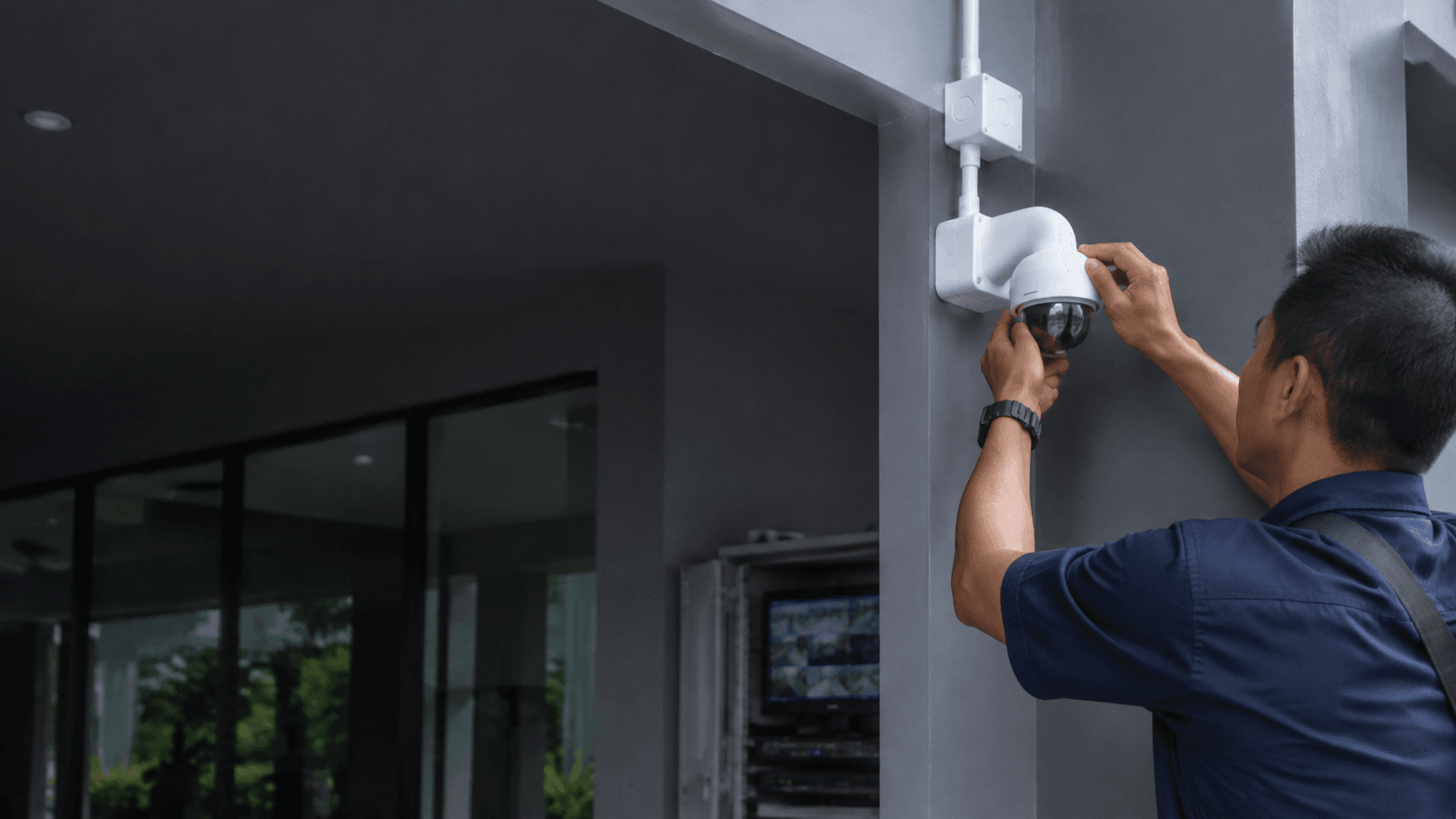
The work behind that sequence is less about picking a camera model and more about deciding where each camera goes, what it records, and how the recorded footage reaches the people who need it. Eyonic Sdn Bhd handles that planning, supply and installation for homes, offices, shops and industrial sites, and the company has completed project work for the Kuching Immigration Office and for KTA Sarawak Sdn Bhd.
Cctv Camera Company Work in Malaysia Starts With a Site Survey
A site survey is the first documented stage of an Eyonic CCTV installation. It exists because the same camera placed in two different buildings produces two different results, and the difference usually comes down to light, movement and distance rather than the camera itself.
Eyonic recommends checking actual lighting conditions before confirming placement for ColorVu-style cameras. That check is a survey activity, not a product decision. A corridor lit by a single fluorescent tube at night, a covered car porch that receives indirect daylight, and an open yard under direct sun all behave differently, and a placement confirmed from a floor plan alone can miss that.
The survey also establishes what the system is meant to support. For the Kuching Immigration Office, the stated focus was arrival flow, staff areas, visitor movement and dependable daily operation. Those are operational descriptions rather than equipment descriptions, and they shape where cameras are positioned and what the recording has to capture.
What the survey looks at
Lighting conditions at the times the site is actually in use, the routes people and vehicles take through the property, the surfaces and structures available for mounting, and the path cabling can follow without creating a mess or a hazard. Eyonic lists tidy cabling as part of the KTA Sarawak Sdn Bhd office setup, which suggests cabling routes are treated as a planning question rather than an afterthought.
What a CCTV Camera Company Supplies and Installs
Eyonic describes its CCTV scope as planning, supplying and installing monitoring systems with camera placement, recording and remote viewing. Those four elements are the practical content of the service.
Camera placement decides what the system can see. Recording decides how long footage is kept and where it lives, which is the NVR setup element. Remote viewing decides who can check the site from a phone or computer and under what conditions. Supply covers the cameras, recorders and supporting hardware.
The published Hikvision CCTV Package is priced at RM 1,599 and includes camera supply and setup, basic recording configuration, and mobile viewing handover. That package describes a defined scope rather than an open-ended installation, which matters when comparing what different providers include.
Where the scope ends
Eyonic's published service list covers CCTV alongside alarm systems, autogate, keyphone intercom and Starlink internet installation. A buyer who needs cameras plus one of those other systems is dealing with a supplier that already works across them, which can simplify coordination on a single site.
How Eyonic Runs a CCTV Installation From Survey to Handover
The documented process has four stages, and each one produces something the next stage depends on.
- Site survey — lighting, movement, mounting surfaces and cable routes are checked on site before any placement is confirmed.
- System proposal — the survey findings are turned into a proposed system covering camera positions, recording and remote viewing.
- Installation — cameras, recorders and cabling are installed and configured according to the proposal.
- Handover — the system is passed to the user with recording and mobile viewing set up so daily operation does not depend on the installer.
Handover is the stage that decides whether the system actually gets used. A recorder that is running but whose mobile viewing was never configured leaves the buyer dependent on walking to a monitor. The published package explicitly includes mobile viewing handover, which places that step inside the delivered scope rather than outside it.
Why the sequence matters more than the equipment list
Two installations using identical cameras can produce very different results if one was placed after a lighting check and the other was placed from a plan. The sequence is what converts a set of components into a system that works on the site it was bought for.
Project Experience in Sarawak
Eyonic's published project work is concentrated in Sarawak, with two named references that describe the problem rather than the hardware.
The Kuching Immigration Office project covered a public office environment, with the stated focus on arrival flow, staff areas, visitor movement and dependable daily operation. The approximate budget for that type of work is RM 12,000 to RM 28,000. A public office brings constraints that a home does not: steady foot traffic through defined entry points, staff-only areas that need separation from public areas, and a system that has to keep running through a working day without someone managing it.
The KTA Sarawak Sdn Bhd project covered an engineering consultancy office in Kuching, supporting staff movement, visitor handling, tidy cabling and clearer daily site control. The approximate budget for that type of work is RM 8,000 to RM 18,000. The emphasis on tidy cabling is worth noting, because an office installation that leaves exposed or poorly routed cable creates a maintenance problem later.
What the project references do and do not show
They show the type of site Eyonic has worked on and the operational problems the work was aimed at. They do not establish a count of completed installations, a coverage area beyond Sarawak, or performance figures for any installed system.
Camera Placement Lighting and Recording Decisions
Placement is where most of the practical judgement sits. A camera aimed at a doorway records faces; the same camera aimed slightly higher records the top of heads. A camera covering a wide yard records movement across a large area but may not resolve detail at the far edge.
Lighting is the second constraint. Eyonic's guidance on ColorVu-style cameras is to check actual lighting conditions before confirming placement, which is a caution against assuming that a low-light capability removes the need to look at the site. Reflective surfaces, strong backlight from a window or doorway, and mixed light sources can all change what a camera captures at night.
Recording and remote viewing are the third set of decisions. Recording configuration determines what is retained and for how long. Remote viewing determines who can check the site and from where. Both are configured during installation and both are part of what handover is meant to confirm.
Where a buyer s own constraints enter
Property type changes the plan. A shop with a public frontage, an office with staff-only areas, a home with a car porch, and an industrial site with outdoor yards each raise different placement questions. Sharing the property type and the required system before the survey gives the installer something concrete to plan against.
Choosing a in Malaysia
The useful comparison is not between camera brands but between what each provider actually does on site. A supplier that ships boxes and a company that surveys, installs and hands over are offering different things, and the price difference usually reflects that.
Four questions separate the two. Does the provider survey the site before quoting? Does the proposal state where cameras will go and why? Is recording and remote viewing configuration included, or treated as an extra? And does handover include showing the user how the system runs day to day?
Eyonic's published process answers all four in the affirmative for its own work, and its project references describe sites where daily operation was the stated concern. The published Hikvision CCTV Package at RM 1,599 covers camera supply and setup, basic recording configuration and mobile viewing handover, which gives a concrete baseline for what a defined package includes.
For larger sites, the published project budget ranges of RM 12,000 to RM 28,000 and RM 8,000 to RM 18,000 indicate the scale of work involved in office and public-building installations. Those ranges describe project work, not a fixed price for any particular site.
Share the location, property type and required system with Eyonic on WhatsApp at +60 11-5111 7959 for the next practical step.